Technology that unifies GPU and transceiver into one
Jensen Huang calls it a turning point for infrastructure upgrades… market expected to grow to KRW 4 trillion by 2032
Samsung Electronics, TSMC and others move to commercialization
U.S. government to provide funding support for domestic firms
As artificial intelligence (AI) models grow in scale and the era of “AI agents” unfolds, connectivity technologies that enable high-speed communication with low power consumption are coming to the fore. Recently, AI data centers have been operating multiple graphics processing units (GPUs) connected in parallel, making high-speed connectivity technologies essential. Among the most closely watched connectivity technologies at this point is Co-Packaged Optics (CPO), which integrates GPUs and optical components (optical transceivers) into a single package.
● CPO technology that creates a closer, faster path
According to the semiconductor industry on the 10th, global semiconductor companies such as Samsung Electronics, TSMC, and Broadcom have recently moved to commercialize CPO technology. Jensen Huang, CEO of Nvidia, which sells AI accelerators, highlighted CPO technology as a major inflection point for next-generation AI infrastructure at the “GTC 2025” annual developer conference held in Silicon Valley in the United States last year.
CPO technology, which all global companies are entering, is a packaging technology that integrates compute semiconductors such as GPUs and central processing units (CPUs) with optical transceivers that convert electrical signals into light in a single package.
Previously, GPUs and optical transceivers, which were located far apart, processed data via copper wiring connections. Because the distance between the GPU and the optical transceiver was long, signal loss during transmission and severe heat generation occurred. More importantly, as AI computation volume surged, more copper wiring was required, pushing spatial constraints to their limit.
CPO technology packages compute semiconductors and optical transceivers together, resolving all of these issues. The industry estimates that the introduction of CPO technology could save at least 30% or more in power consumption compared with existing approaches. Using a road analogy for data pathways, CPO technology shortens the physical distance to the destination and provides a wider, more stable “paved road” for data traffic.
● Samsung Electronics, TSMC accelerate commercialization
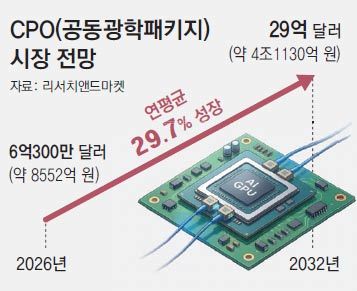
Due to these powerful advantages, demand for CPO is growing even among big tech companies engaged in intense competition over AI infrastructure. Global market research firm Research and Markets forecast that the CPO market, estimated at USD 603 million (about KRW 855.2 billion) in 2026, will grow at a compound annual growth rate of 29.7% to reach USD 2.9 billion (about KRW 4.113 trillion) in 2032.
Accordingly, global semiconductor foundry companies plan to begin full-scale commercialization in the second half of this year (July–December). TSMC has unveiled its “COUPE” semiconductor packaging platform incorporating CPO technology and is targeting mass production in the second half of this year. At the TSMC Technology Symposium held in Taiwan in May this year, Kevin Zhang, senior vice president of business development and overseas operations at TSMC, said that COUPE “will become the next key keyword in the semiconductor industry.” Samsung Electronics is also known to be developing CPO technology with the goal of commercialization in 2027.
As CPO emerges as a core technology in next-generation semiconductor packaging, the U.S. government has also moved to support domestic companies. On the 29th of last month (local time), the U.S. government decided to provide USD 300 million (about KRW 425.5 billion) in support to GlobalFoundries, a U.S. foundry company. Under the U.S. CHIPS Act, GlobalFoundries will receive government funding to strengthen its research and development (R&D) capabilities in optical packaging technology for AI data centers. Reuters assessed that the main objective of this support is the advancement of CPO technology in the United States.
Co-Packaged Optics (CPO) technology
A packaging technology that integrates a graphics processing unit (GPU) and an optical engine into a single unit. For high-speed data processing, electrical signals from the GPU must be converted into light, and until now, copper wires have been used to connect the GPU and the optical engine. By employing CPO technology, it is possible to prevent signal loss and power consumption issues that have been cited as problems of traditional copper wiring.
ⓒ dongA.com. All rights reserved. Reproduction, redistribution, or use for AI training prohibited.
Popular News