Expanding into high value-added segments where China struggles to catch up
Samsung Display unveils screens for humanoid robots
LG Display showcases 48-inch in-vehicle display
LG Display posts Q2 loss on one-off charges
The so-called “chipflation” phenomenon, in which prices of electronic products that contain semiconductors rise in succession due to a sharp increase in memory chip prices, is weighing down even on the display industry. Both of Korea’s two major players, Samsung Display and LG Display, have voiced concerns over these challenges. On the same day, display companies highlighted humanoid robots’ “faces” and automobiles as the future growth drivers of the display industry.
● “Chipflation is making things extremely difficult”
At the “K-Display 2026” exhibition, which opened on the 22nd at COEX in Gangnam District, Seoul, Lee Chung, President of Samsung Display (and Chairman of the Korea Display Industry Association), was asked about market conditions in the second half of the year (July–December). He replied, “It is extremely difficult because of chipflation. It is really very hard, and our clients are also having a very hard time,” adding, “It would be good if those in semiconductors could offer lower prices.” He said, “For both smartphones and IT OLEDs (organic light-emitting diodes), overall (semiconductor) volumes are decreasing significantly,” and “Component companies, including display makers, are under pressure to (cut) prices.” This is interpreted to mean that as semiconductors push up product costs, finished-goods manufacturers are trying to reduce costs in components other than semiconductors, which in turn is placing pressure on the display industry to lower its selling prices.
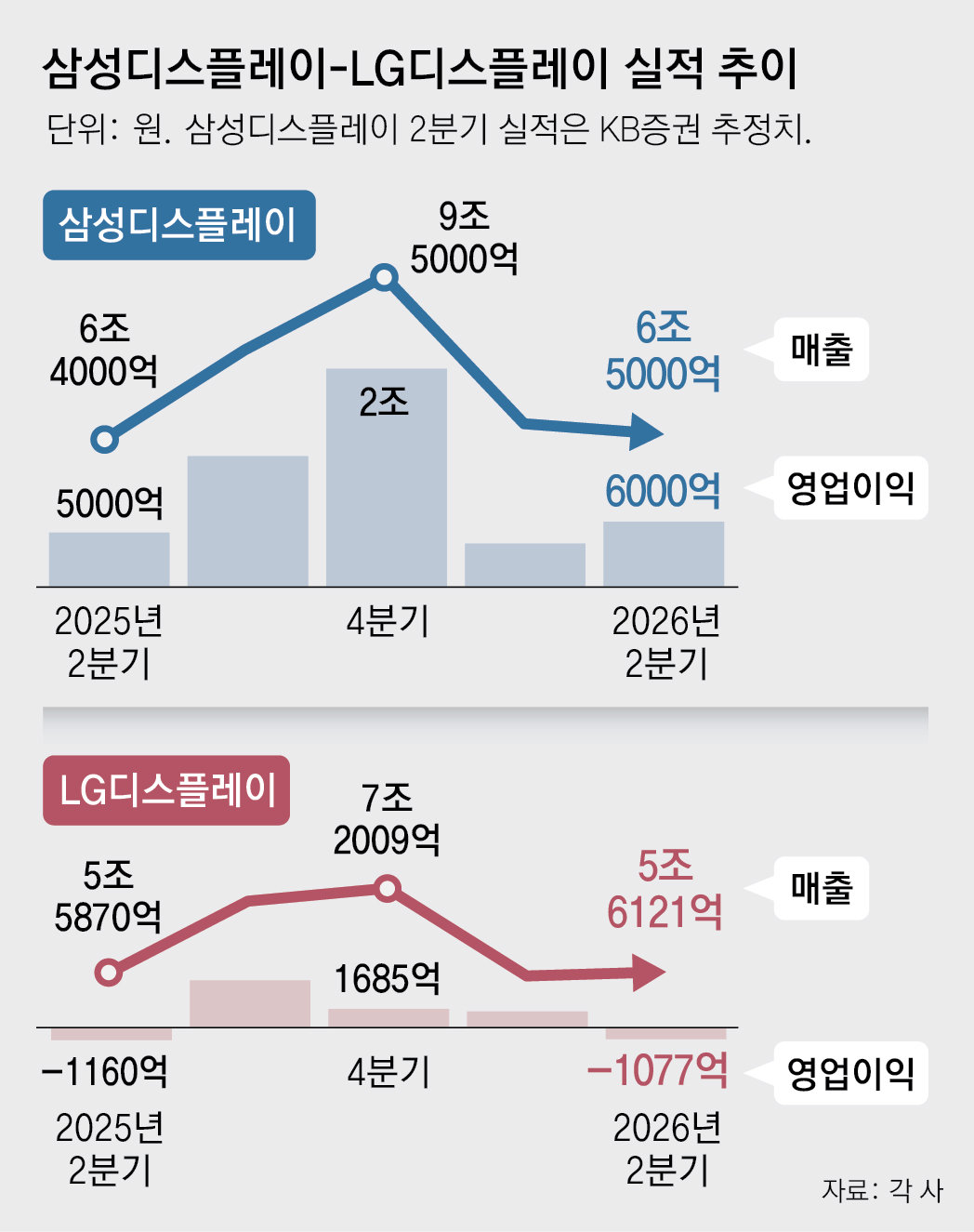
On the same day, Jeong Cheol-dong, President of LG Display, also acknowledged that the company is under pressure to cut selling prices due to rising memory semiconductor prices, saying, “We are being affected,” but added that the situation is “at a level we can endure.” On that day, LG Display announced its results for the second quarter (April–June). On a consolidated basis, it posted revenue of KRW 5,612.1 billion and an operating loss of KRW 107.7 billion. The profit streak that had continued from the third quarter of last year (July–September) through the first quarter of this year (January–March) ended after three quarters, and the company returned to the red.
President Jeong said, “The second-quarter results reflect one-off costs; in reality, we are in the black,” and added, “Second-half results will be better than in the first half.” In a conference call held after the earnings announcement, Kim Sung-hyun, Chief Financial Officer (CFO) of LG Display, explained, “One-off costs of around KRW 240 billion related to voluntary retirement were incurred and reflected in the second-quarter results.” LG Display added, “Operating profit in the first half was KRW 39 billion,” and noted, “The first-half profit is the first in five years since 2021.”
● Robot faces and finished vehicles as the future of displays
The two major display makers both focused on humanoid and automotive displays. Products were showcased that demonstrate how displays can expand into the “faces” and interfaces of artificial intelligence (AI) devices.
Samsung Display unveiled for the first time a 6.9-inch screen for humanoids that naturally shows the robot’s expressions and status while its pupils track the gaze of visitors. It also introduced a “big hole” automotive display prototype with an 80 mm-diameter hole in the center of the screen to accommodate a gear dial and air vent. LG Display, for the first time in Korea, showcased a plastic OLED for humanoids that can withstand temperatures from minus 30 degrees Celsius to 85 degrees Celsius. For automotive applications, it presented a 48-inch screen that spans the front windshield. In this concept, the driver views navigation while the passenger watches a movie at the same time.
The display industry’s move into high value-added areas such as robots and vehicles, where it is difficult for China to catch up, is driven by competitive pressure from China. In 2025, Korea’s global OLED market share rebounded to 68.7% from 67.2% the previous year, but market research firm Counterpoint Research forecasts that China’s production capacity will ultimately overtake Korea’s by 2029.
ⓒ dongA.com. All rights reserved. Reproduction, redistribution, or use for AI training prohibited.
Popular News