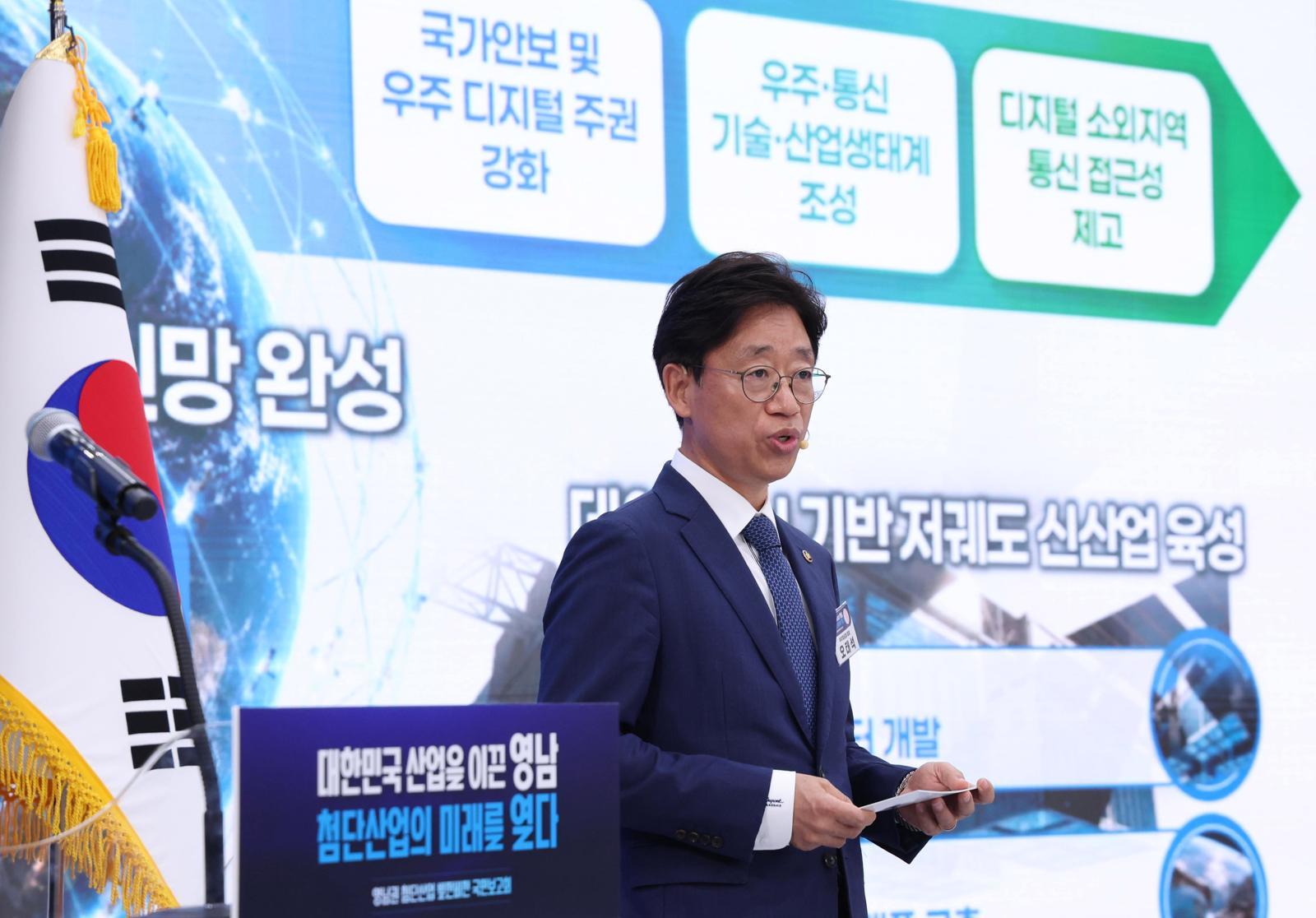
Woo Tae-seok, Administrator of the Korea AeroSpace Administration, gives a presentation at the National Briefing on the Vision for Advanced Industry Development in the Yeongnam Region held in Jinju, South Gyeongsang Province, on the 3rd. 2026.7.3 News1
The government has decided to complete a Korean-style low Earth orbit (LEO) satellite communication network consisting of hundreds of satellites, similar to the Starlink satellite communication network of U.S. company SpaceX, by 2035. The target date for a lunar landing will also be brought forward by two years to 2030. The Korea AeroSpace Administration announced this “Strategy for Fostering the Republic of Korea’s Space and Aviation Industry” at the “National Briefing on the Vision for Advanced Industry Development in the Yeongnam Region” held in Jinju, South Gyeongsang Province, on the 3rd. The strategy was approved the same day at a meeting of the National Space Committee chaired by President Lee Jae-myung.
To begin with, the government plans to complete an indigenous LEO satellite communication network system by 2035. A LEO satellite communication network is a system that connects multiple satellites orbiting several hundred to several thousand kilometers above the Earth’s surface to provide high-speed internet and communication services even in areas where terrestrial networks have difficulty reaching. By 2035, between at least 128 and up to 512 satellites will be launched to build the satellite communication network, with the budget projected to reach up to KRW 14.2586 trillion.
The lunar exploration schedule will also be accelerated. The government had originally planned to send a lunar lander in 2032 using a next-generation launch vehicle, but has decided instead to shorten the timetable by first launching a private-sector small lunar lander in 2030 using an upgraded Nuri rocket. Woo Tae-seok, Administrator of the Korea AeroSpace Administration, stated, “The government will support the space and aviation industry so that it can grow into a core driver of growth for the Republic of Korea, with a focus on the South Coast Belt.”
Jeon Hye-jin
AI-translated with ChatGPT. Provided as is; original Korean text prevails.
ⓒ dongA.com. All rights reserved. Reproduction, redistribution, or use for AI training prohibited.