Original “Mir” IP owner, pioneer of Korean gaming Hallyu
Founder sells entire stake for KRW 920 billion
Chinese capital moves beyond passive investment into management
Rising influence on a slowing Korean game industry
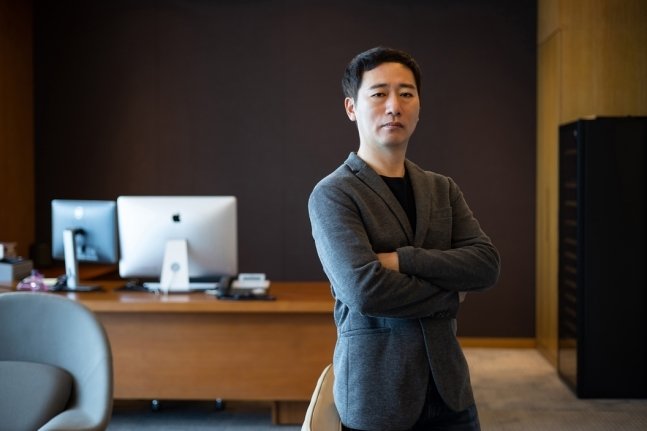
Park Kwan-ho, founder of Wemade. Provided by Wemade
The largest shareholder of Wemade, a first-generation Korean game company that holds the intellectual property (IP) “Mir,” regarded as a pioneer of the K-game Korean Wave, has changed to Chinese-affiliated capital. The transaction volume is about KRW 920 billion, and it is the first time in 22 years since the 2004 sale of Actoz Soft that management control of a domestically listed game company has been transferred to China.
Until now, Chinese capital has expanded its influence in the Korean game industry by partly acquiring stakes in domestic game companies or taking control of distribution networks, but this deal is drawing attention as it goes one step further by acquiring management control.
● Chinese major investor goes beyond the “Tencent model”
On June 30, Wemade founder and chairman of the board Park Kwan-ho signed a share purchase agreement (SPA) to sell his entire 39.33% stake (13,350,738 shares) for about KRW 920 billion. The buyer is Neopulse, a Korean corporation wholly owned by a Hong Kong-based investment firm known to have close ties with Alibaba. After the balance payment date of October 30, Neopulse will secure a 40.25% stake in Wemade and become the largest shareholder.
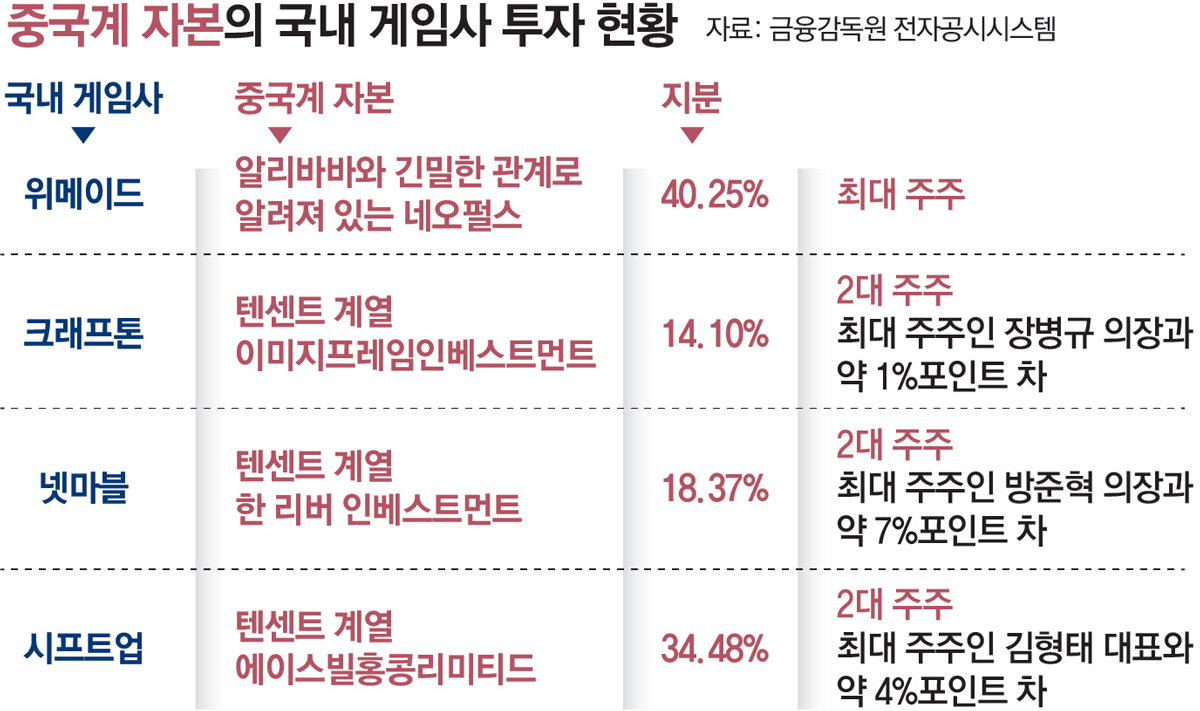
Investment by Chinese capital in Korean game companies has generally followed the so‑called “Tencent-style investment.” This refers to a model in which Tencent-affiliated Chinese game companies become the second-largest shareholder in major Korean game companies such as Krafton (14.10%), Netmarble (18.37%), and Shift Up (34.48%), while not directly intervening in management. Neopulse’s investment in Wemade goes beyond this established practice.
Behind Chinese capital’s focus on Korean game companies lies proven IP. From the perspective of Chinese companies, securing IP that already has a confirmed fan base in the Chinese-speaking world, such as Mir, is easier than developing a new title from scratch. It also allows them to bypass the “banhao” (版號, game service license in China) regulations, which foreign game companies cannot apply for directly. Since the THAAD-related restrictions, Chinese capital has strengthened its own development capabilities, and Korean game companies have effectively become “assets for sale” that allow them to secure both IP and development talent at the same time.
In the game industry, there is also an assessment that this sale illustrates how heavily Korean game companies depend on the Chinese market. Wemade generated about 20% of its annual revenue last year from China. In an internal notice, Chairman Park stated, “Expansion into larger markets is now not a choice but a condition for survival,” adding, “The Mir IP is still creating enormous value in China, and at the same time, the major markets of North America and Europe are waiting for us.”
● Declining K-games, deepening dependence on China
Significant dependence on China has already taken root across the domestic game industry. Shift Up generated 97% of its 2023 revenue from royalties for “Goddess of Victory: Nikke,” serviced by Tencent. Although the hit of “Stellar Blade” subsequently reduced that proportion to 56.1%, reliance on Chinese distribution networks remains substantial. As growth in the domestic game industry slows, this structure could become even more entrenched.
According to the Korea Creative Content Agency, Korean game exports fell 6.5% in 2023, the first decline in 25 years, and increased only 1.3% last year. Based on Mobile Index data, in June, half of the top 10 games by domestic revenue were titles distributed by Chinese companies.
As a result, there are observations in the industry that domestic game companies with IP that has strong market potential in China could again come up for sale. Wi Jung-hyun, a professor of business administration at Chung-Ang University, said, “Chinese game development capabilities have now risen to a level comparable to those of Korea,” adding, “Chinese game companies now believe that as long as they secure proven IP, they can develop new games as much as they want with their own in-house capabilities.”
ⓒ dongA.com. All rights reserved. Reproduction, redistribution, or use for AI training prohibited.
Popular News