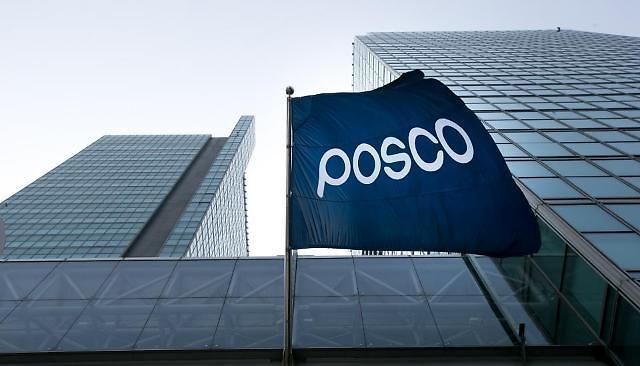
Panoramic view of POSCO Center. Provided by POSCO Group
POSCO Group is expanding its steel-centered business structure into a resource-centered portfolio including lithium, rare earths, LNG, and renewable energy. Its strategy is to secure key resources in a stable manner amid simultaneous global supply chain instability and low-carbon transition, thereby contributing to national industrial security.
On the 2nd, POSCO Group announced at its “CEO Investor Day” that it will establish a “Triple Core” system encompassing industrial resources, strategic resources, and energy resources. Through this, it aims to become a “national flagship core resource supplier” and achieve combined sales of KRW 187 trillion and operating profit of KRW 13.1 trillion by 2035.
The Triple Core consists of industrial resources centered on steel, strategic resources including lithium, cathode materials, anode materials, and rare earths, and energy resources such as LNG and renewable energy. Based on its existing steel competitiveness, the group plans to expand its business scope to include core materials and energy required for future industries.
POSCO Group Chairman Jang In-hwa told investors that “now, as external uncertainties deepen due to unstable supply chains and the acceleration of the low-carbon transition, is precisely the time to create new growth opportunities through bold innovation of the business portfolio,” adding that “by extending the business domain from steel and materials to resources, POSCO Group will take the lead in strengthening national industrial security and supply chains.”
The area of greatest focus is lithium. POSCO Group has presented a plan to complete an annual lithium production system of 173,000 tons by 2033 and emerge as a top 5 global lithium company. It has also set a target of achieving operating profit of more than KRW 1.8 trillion from the lithium business by 2035.
The brine lithium business will be expanded mainly in Argentina. POSCO Argentina turned to an operating surplus in March and obtained approval under RIGI, Argentina’s large-scale investment promotion scheme. POSCO Group plans to accelerate its Phase 3 and 4 investments in brine lithium with the goal of completing a 100,000-ton brine lithium production system by 2033.
In ore-based lithium, it has laid the groundwork for expanding its refining business through a joint venture agreement with Australia’s Mineral Resources. Through this, the group expects to secure more than 187,000 tons of lithium concentrate annually and generate stable income of about KRW 200 billion per year.
Rare earths and rare/specialty gases will also be fostered as strategic resources. Rare earths are key minerals needed for the electric vehicle and robotics industries, while rare and specialty gases are essential materials used in advanced industries such as semiconductors. POSCO Group plans to cultivate these sectors as new growth engines to contribute to stabilizing the supply chains of future national industries.
The steel business will seek breakthroughs through overseas growth investments. In response to stagnant domestic steel demand, the group will expand production capacity to 10 million tons by 2031 in high-growth markets such as India, the United States, and Indonesia. Profits secured through overseas investments will be reinvested in domestic low-carbon transition and other areas to enhance the competitiveness of the steel business.
In the energy resources business, the group will focus on LNG and renewable energy. For LNG, it will pursue an expansion strategy across each part of the value chain and increase trading volume in line with the growth in global cargo flows. In renewable energy, it will move in earnest into the domestic offshore wind and overseas solar power markets to help strengthen energy security.
As a new business, the group is pushing for the commercialization of physical AI for process industries. Based on its accumulated experience in facility automation and intelligence at steel sites and related field data, POSCO Group plans to develop AI business models that can be applied to industrial sites.
To support the transition of its business portfolio, POSCO Group will invest KRW 16.7 trillion over three years, from 2026 to 2028, in future growth projects.
The group also presented measures to resolve the holding company discount. POSCO Holdings plans to optimize its equity stakes in listed subsidiaries to around 50% and concentrate the capital thereby secured on investment projects in strategic resources. About 10% of the sale proceeds will be used to repurchase and cancel treasury shares to enhance shareholder value.
Following the domestic event, POSCO Group plans to continue communication with global investors by holding CEO Investor Day in Singapore on the 6th and in Hong Kong on the 8th.
ⓒ dongA.com. All rights reserved. Reproduction, redistribution, or use for AI training prohibited.
Popular News