SK and global private equity fund (PEF) manager Kohlberg Kravis Roberts (KKR) are joining forces to launch the largest renewable energy company in Korea. The strategy is to consolidate SK Group’s dispersed renewable energy businesses to achieve economies of scale, and to secure investment capital in advance to respond to the surge in energy demand in the era of artificial intelligence (AI). Synergies are also expected with the “Korea’s Great Leap Forward Three Mega Projects,” under which the government and major corporations are building large-scale semiconductor fabrication plants (fabs) and AI data centers across the country.
SK Inc. announced on the 1st that it had signed an equity investment agreement with a fund managed by KKR for an integrated renewable energy company. SK Group is currently in the process of selling renewable energy business assets, which are scattered across three affiliates—SK Innovation, SK ecoplant, and SK Discovery—to KKR. According to business circles and the investment banking (IB) industry, the total size of the assets SK is selling is estimated to be around KRW 2 trillion.
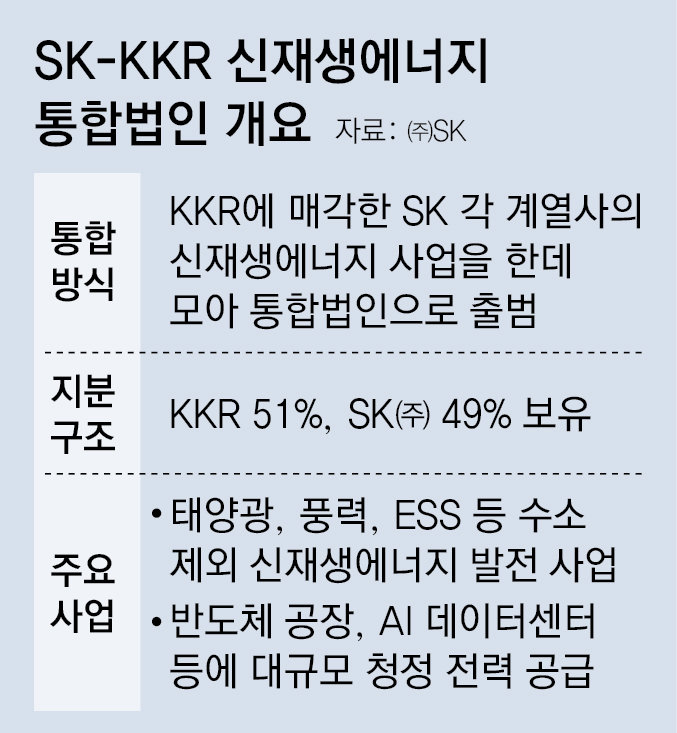
After completing the sale process, SK plans to bring these renewable energy businesses together to establish an integrated entity in which KKR and SK Inc. will hold 51% and 49% equity stakes, respectively. The tentative name is “HoldCo,” with a target launch by the end of this year. SK stated, “This is a strategy to restructure renewable energy businesses that are dispersed across several affiliates and to combine them with strategic investment capital.” The company added that while KKR will initially hold management control of the integrated entity and SK Inc. will participate via equity investment, the possibility remains open for SK to acquire management control later through further negotiations.
The integrated company plans to cover all areas of renewable power generation other than hydrogen, including solar, wind, and energy storage systems (ESS). It will operate an integrated model spanning the entire supply chain, from development and construction to operation and maintenance.
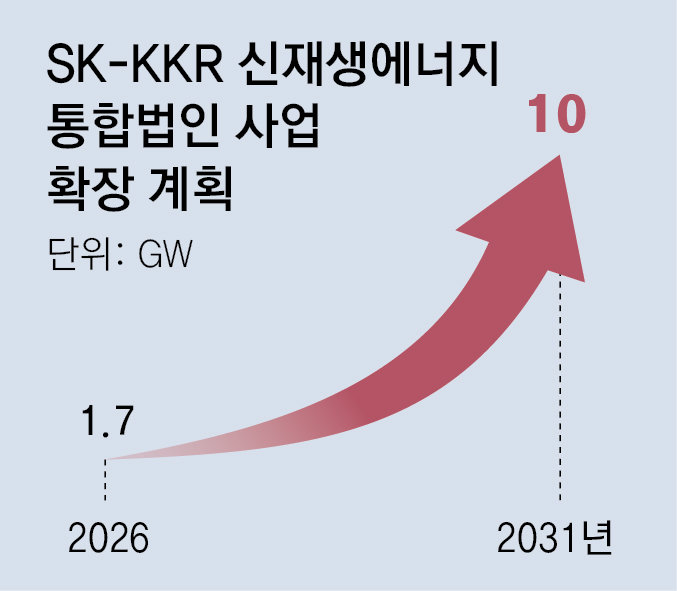
It also presented a “blueprint” to expand the business scale sixfold over the next five years. The current scale of the renewable energy businesses of each affiliate to be merged into the integrated company is 1.7GW (gigawatts) of power capacity. The integrated entity aims to expand this significantly to 10GW by 2031. This is equivalent to 10 1GW nuclear power plants and can power 100 large-scale 100MW (megawatt) data centers. SK said, “It is expected to grow into a core power source that can stably supply large volumes of clean electricity to AI data centers and semiconductor production lines.”
ⓒ뉴시스
Attention is focusing on whether this will generate synergies with the three mega projects announced by the government on June 29. For the projects to be successfully completed—from the new semiconductor fabs that Samsung Electronics and SK hynix plan to build in Gwangju with a total investment of KRW 800 trillion, to the AI data centers that SK Telecom, GS, Naver, and others will expand with KRW 1,000 trillion by 2035—large-scale power infrastructure must be in place.
Kim Yang-han, Head of Infrastructure for Northeast Asia at KKR, said, “Korea is an attractive renewable energy market, with solid demand for clean power in semiconductors, data centers and the manufacturing sector as a whole,” adding, “Through cooperation with SK, we will build large-scale renewable energy infrastructure and reliably respond to the high power demand of domestic industry.”
ⓒ dongA.com. All rights reserved. Reproduction, redistribution, or use for AI training prohibited.
Popular News