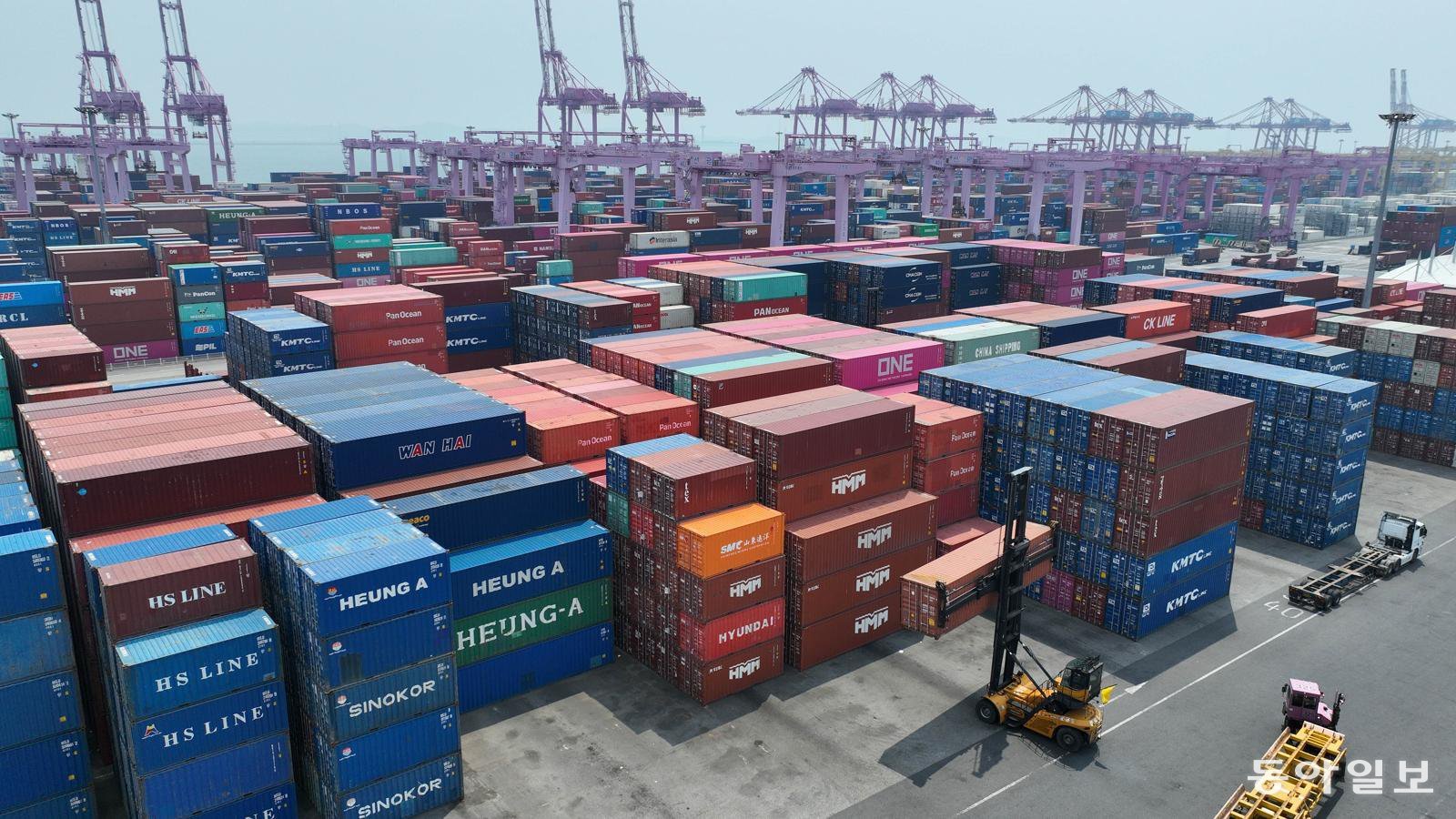
Export-bound containers are stacked at the Incheon New Port container terminal in Yeonsu District, Incheon, on the 1st. Incheon=Reporter Jeon Young-han scoopjyh@donga.com
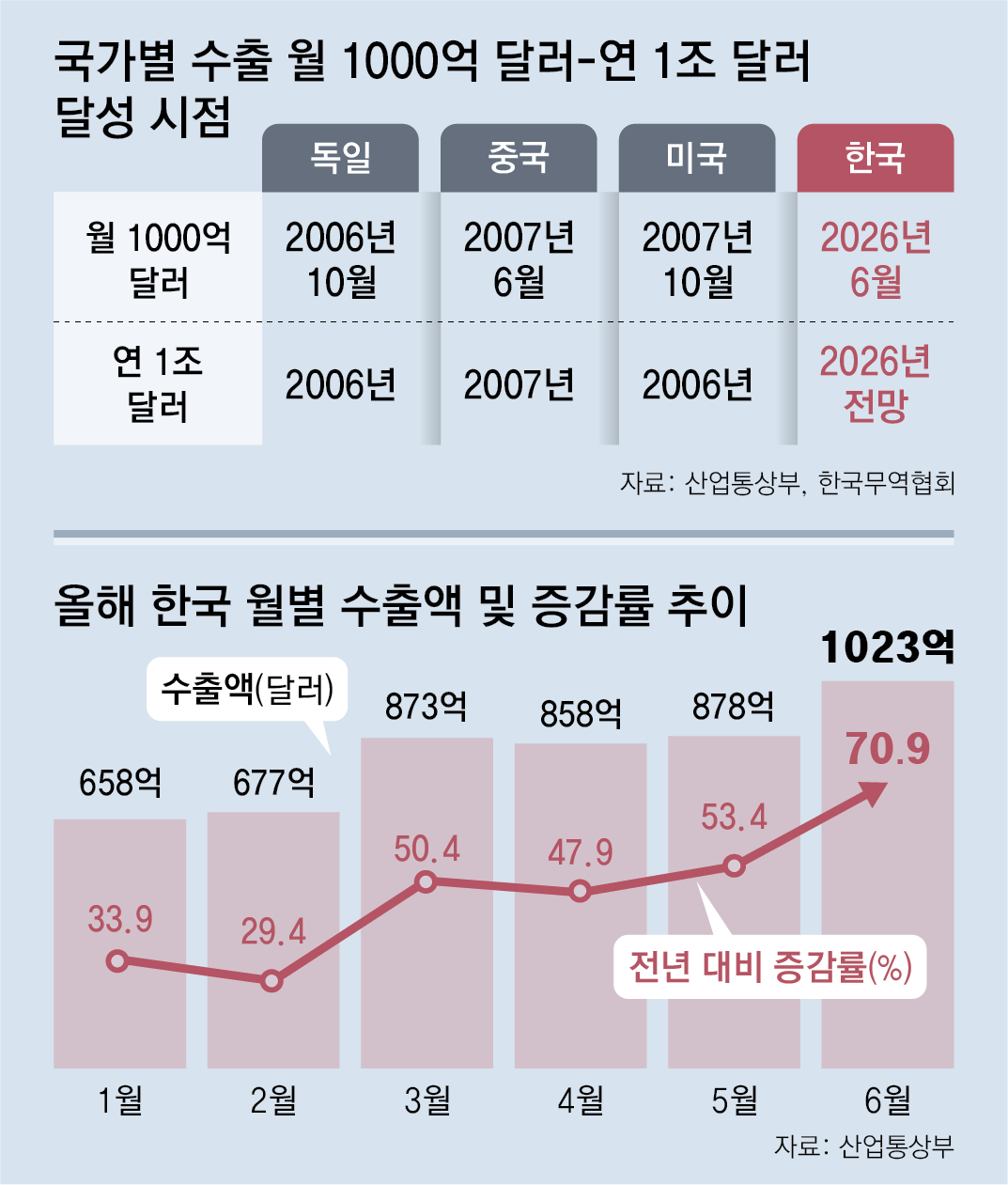
Last month, the Republic of Korea’s monthly export value surpassed USD 100 billion for the first time, largely due to a sharp rise in semiconductor prices driven by sustained growth in memory semiconductor demand stemming from artificial intelligence (AI). Exports of computers, automobiles, petroleum products, and consumer goods also increased.
As a result, projections are emerging that the country may achieve the unprecedented target of “USD 1 trillion in annual exports” this year. However, domestic demand is struggling to keep pace with export growth, and the deepening “K-shaped polarization” is cited as a structural challenge that the Korean economy must address.
● Semiconductors pulled, IT and autos pushed up
According to the “Export-Import Trends for June and the First Half (January–June)” released by the Ministry of Trade, Industry and Energy (MOTIE) on the 1st, Korea’s semiconductor exports last month amounted to USD 44.82 billion, up 199.5% from USD 14.96 billion in the same month a year earlier. On 18 June, the U.S. Department of Energy requested that the Federal Energy Regulatory Commission (FERC) shorten the review period for grid interconnections, which pushed data centers into early operational stages and is seen as having spurred semiconductor demand and driven up contract prices. According to MOTIE, fixed prices applied to bulk contracts for 16Gb (gigabit) DRAM and 128Gb NAND, both essential for AI servers, rose by USD 2.5 and USD 2.3 month-on-month, respectively, last month.
While semiconductors took the lead in driving Korea’s export growth, other products also provided support. Exports of 17 out of 19 major products excluding semiconductors increased by 28% last month. In particular, eight categories—computers, automobiles, petroleum products, electrical equipment, nonferrous metals, agricultural and marine products, cosmetics, and bio-health—recorded all-time high performances.
Computer exports (USD 5.41 billion) surged 308.8% from a year earlier on increased demand for solid-state drives (SSDs) driven by expanded investment in AI infrastructure. Wireless communication devices such as smartphones (USD 1.55 billion) rose 51.9% thanks to strong sales of new models. Ship exports (USD 2.83 billion) increased 12.9% on expanded exports of high value-added vessels, while petroleum product exports (USD 5.59 billion) climbed 49.8% as export prices rose amid a high oil price trend. Steel exports (USD 2.14 billion) also increased 9.6% on higher demand associated with expanding AI data center construction, returning to growth for the first time in 14 months since April last year.
On a cumulative basis for the first half (USD 496.7 billion), Korea’s exports increased 48.4% year-on-year, setting a new record high. The cumulative trade surplus reached USD 138.3 billion, up USD 110.9 billion from the same period last year, already surpassing the previous annual record of USD 95.2 billion set in 2017.
● Expectations for USD 1 trillion a year ↑… Risk factor is prolonged high FX rate
With strong exports continuing, expectations are rising that annual exports this year will exceed USD 1 trillion. If this happens, Korea could challenge the position of the Netherlands, currently the world’s fourth-largest exporter. According to the Korea International Trade Association, the Netherlands’ exports last year amounted to about USD 964.1 billion. Kang Gam-chan, Director General for Trade and Investment at MOTIE, said, “The upward trend in memory prices is expected to continue at least through the second half of this year,” adding, “Considering that exports are typically higher in the second half than in the first, the likelihood that annual exports will exceed USD 1 trillion has increased.”
The prolonged trend of a high exchange rate is viewed as a variable. In the past, a high exchange rate was considered favorable for exports, but recently there have been concerns that the weak won is increasing the burden of raw material and energy imports and eroding corporate profitability. On the 1st, the won-dollar exchange rate closed at KRW 1,554.9 in the Seoul foreign exchange market, up KRW 5.5 from the previous trading day. On a weekly trading basis (3:30 p.m.), this was the highest level in 17 years and 4 months since 5 March 2009 (KRW 1,568.0). It was also the first time this year that the weekly closing rate exceeded KRW 1,550. During intraday trading, the won-dollar rate rose to as high as KRW 1,559. On the heels of 30 June, the intraday rate surpassed KRW 1,550 for a second consecutive session.
Lee Jeong-hwan, professor at the School of Economics and Finance at Hanyang University, noted, “The notion that a higher exchange rate boosts the export competitiveness of domestic firms reflects past assessments,” adding, “The negative side effects on the overall economy, such as rising raw material procurement costs, are now becoming larger.”
The failure of export momentum to spill over into domestic demand is a concern. While export-driven companies, including semiconductor makers, continue to post record performances, the construction sector and domestic service industries remain stuck in a slump. Due to the nature of the semiconductor industry, its job creation effect is limited, and the trickle-down to employment and income is constrained. According to the Hyundai Research Institute, as of 2023, the semiconductor sector’s employment inducement coefficient was 2.4 persons per KRW 1 billion in output, far below the all-industry average of 8.2 persons. The share of semiconductor employment also accounts for only 0.3% of total employment.
Lee Jeong-hee, professor at the Department of Economics at Chung-Ang University, said, “If the severe gap between exports and domestic demand further deepens into so-called ‘K-shaped polarization,’ Korea will ultimately be driven into a situation where a decline in its potential growth rate is unavoidable,” adding, “It is time for policies that channel the substantial tax revenues generated by export performance not into short-term cash handouts but into mid- to long-term tasks such as supporting small and medium-sized enterprises and creating youth employment.”
ⓒ dongA.com. All rights reserved. Reproduction, redistribution, or use for AI training prohibited.
Popular News