MasAuto leads autonomous trucking with a Tesla-style approach
Truck autonomy takes a different path from passenger cars… betting on cameras and AI instead of lidar
A landmark achievement: crossing the U.S. continent without maps… paid Korea–U.S. freight operations with 13 trucks
Pursuing the challenge since KAIST undergraduate days… “We will unveil commercial driverless trucks next year”
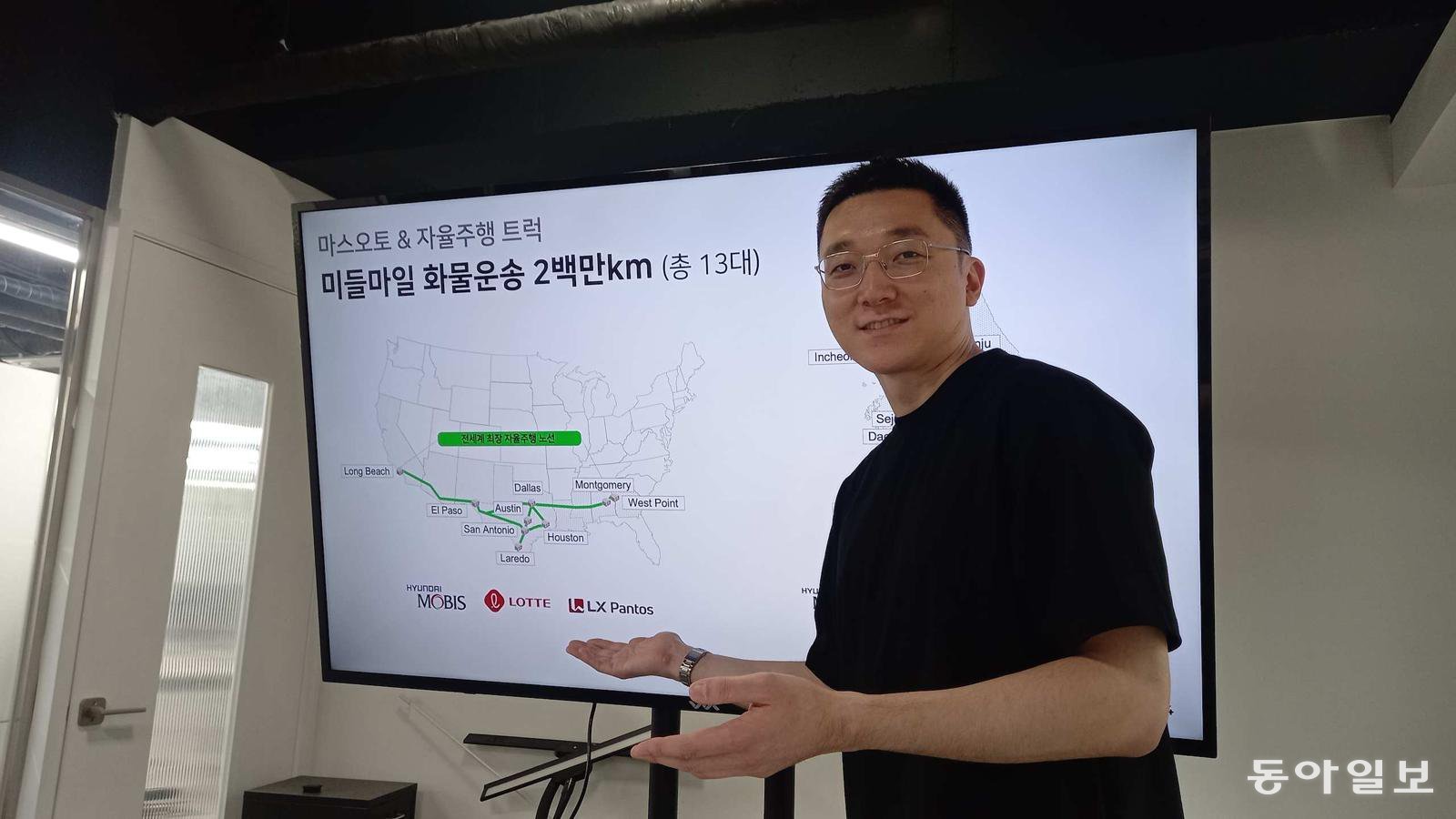
On 22 June, Mars Auto CEO Park Il-soo explains the technological advantages of commercially operating autonomous truck routes in the United States, while looking at the routes at the company’s office in Gangnam, Seoul. Photo by reporter Heo Jin-seok, jameshur@donga.com
There is a company that has actually developed and is operating autonomous trucks that read the road using only cameras and artificial intelligence. It is Mars Auto, located in Yeoksam-dong, Gangnam District, Seoul. Autonomous driving is often consumed as the future of passenger cars, but it is also needed for trucks. Passenger cars are relatively light and move within a short braking distance, whereas heavy trucks are much heavier and longer. Once cargo is loaded, the center of gravity changes, and with heavy loads traveling at high speed, they must read much farther ahead. CEO Park Il-soo (35), met at the office on 22 June, said, “Even for humans, if a taxi driver wants to drive a truck, a new license is required,” adding, “Truck autonomous driving is not a simple extension of passenger car technology.”
Trucks are bigger, heavier, and faster than taxis. As with passenger car autonomous driving, it is not enough to see only 50–80 meters ahead. As Park explains, heavy trucks must read at least 200–300 meters ahead, and as far as 300–400 meters. Moreover, cargo is not always evenly loaded. It may be skewed to the left or tilted to the right. Humans endure such changes through bodily sensation, but computers must learn those sensations as data.
● The lidar path and the camera path
Autonomous driving technology broadly follows two paths. One uses lidar and high-definition maps laid in advance and drives on top of them; the other, like Tesla, uses cameras and AI to see and decide like a human. The lidar approach is advantageous for precisely reading distances and objects, and is suitable for delivering stable performance on specific sections. However, the cost of sensors and building high-definition maps is high, and every time a new route is added, maps must be newly created and maintained, which reduces scalability for long distances or new routes.
The camera-centered autonomous driving AI adopted by Mars Auto does not require high-definition maps. Camera sensors are also much cheaper. As long as general maps comparable to what humans use are available, vehicles can operate freely even on new roads. In addition, there is a strong advantage in being able to collect large amounts of data from many vehicles to train a single neural network model.
Mars Auto explains that, through this method, it aims for autonomous driving at less than one-tenth of the cost of the conventional lidar and high-definition map-based approach. Of course, the camera-based method has long been suspected of being vulnerable to weather and light changes. Park, however, noted, “Originally, people were skeptical about Tesla’s technology. But as Tesla achieved driverless operation last year, sentiment in academia and industry is shifting.” A path that once seemed reckless is now being reinterpreted as the most scalable route.
● The biggest problem in the oldest industry
While some have sought the future of autonomous driving in urban robotaxis, Park entered the freight transportation sector, the heaviest and one of the oldest industries. There was much to improve in this field. Long-haul freight transport always involves night driving and fatigue. When an accident occurs, it does not end with the vehicle being damaged; an entire shipment can be lost. The cost structure is also considerable. Park explains that fuel and labor each account for around 40% of total trucking costs.
The problem Mars Auto seeks to solve is not simple driving technology. It is to automate long-distance freight transport itself with heavy truck autonomous driving AI. Park said, “We want to automate long-haul routes, such as from Seoul to Busan or from the U.S. East Coast to the West Coast, like trains.” He expects that full autonomy will be realized before long, as 98% of long-distance routes consist of highway sections, where implementing autonomous driving is relatively easier.
● MarsNet, MarsBox, MarsPilot
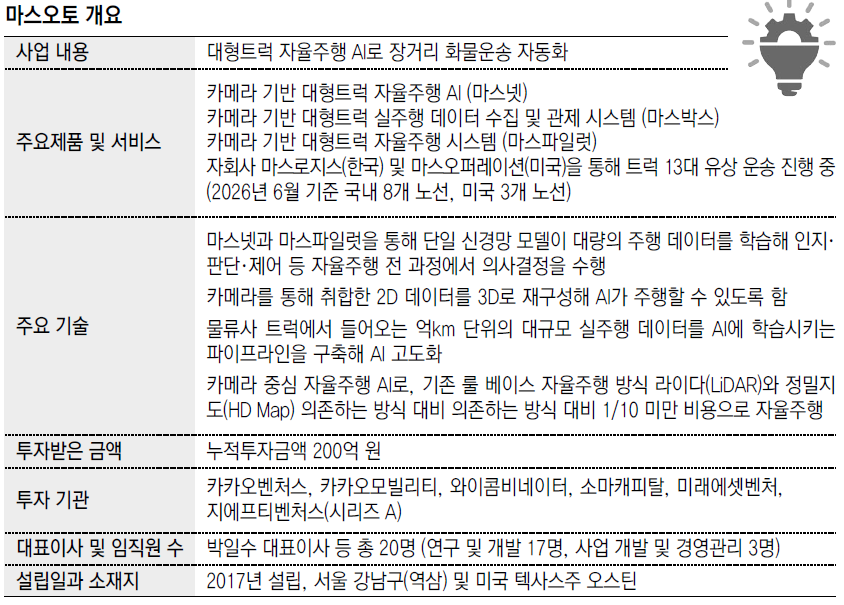
Mars Auto’s product lineup is clear from the names. MarsNet is a camera-based autonomous driving AI for heavy trucks. MarsBox is a camera-based heavy truck real-world driving data collection and control system. MarsPilot is a camera-based heavy truck autonomous driving system that serves as the core system responsible for driving in actual operations. These three are not separate products; they interlock like a single ecosystem that collects data, trains models, and connects to real-world operation.
The core of the technology is a single neural network model. Through MarsNet and MarsPilot, one neural network learns massive driving data and performs decision-making across the entire autonomous driving process—perception, judgment, and control. It reconstructs 2D data coming through cameras into 3D-like representations so that AI can make actual driving decisions, and builds a pipeline that trains the model on large-scale real-world driving data, on the order of hundreds of millions of kilometers, coming from logistics companies’ trucks, continuously advancing the model. Park stated, “When training an AI model, it should not be trained on autonomous driving data; it should learn from cameras mounted on human-driven trucks.” He believes the completeness of autonomous driving depends not on sensors but on learning.
● Refined in Korea, proven in the U.S.
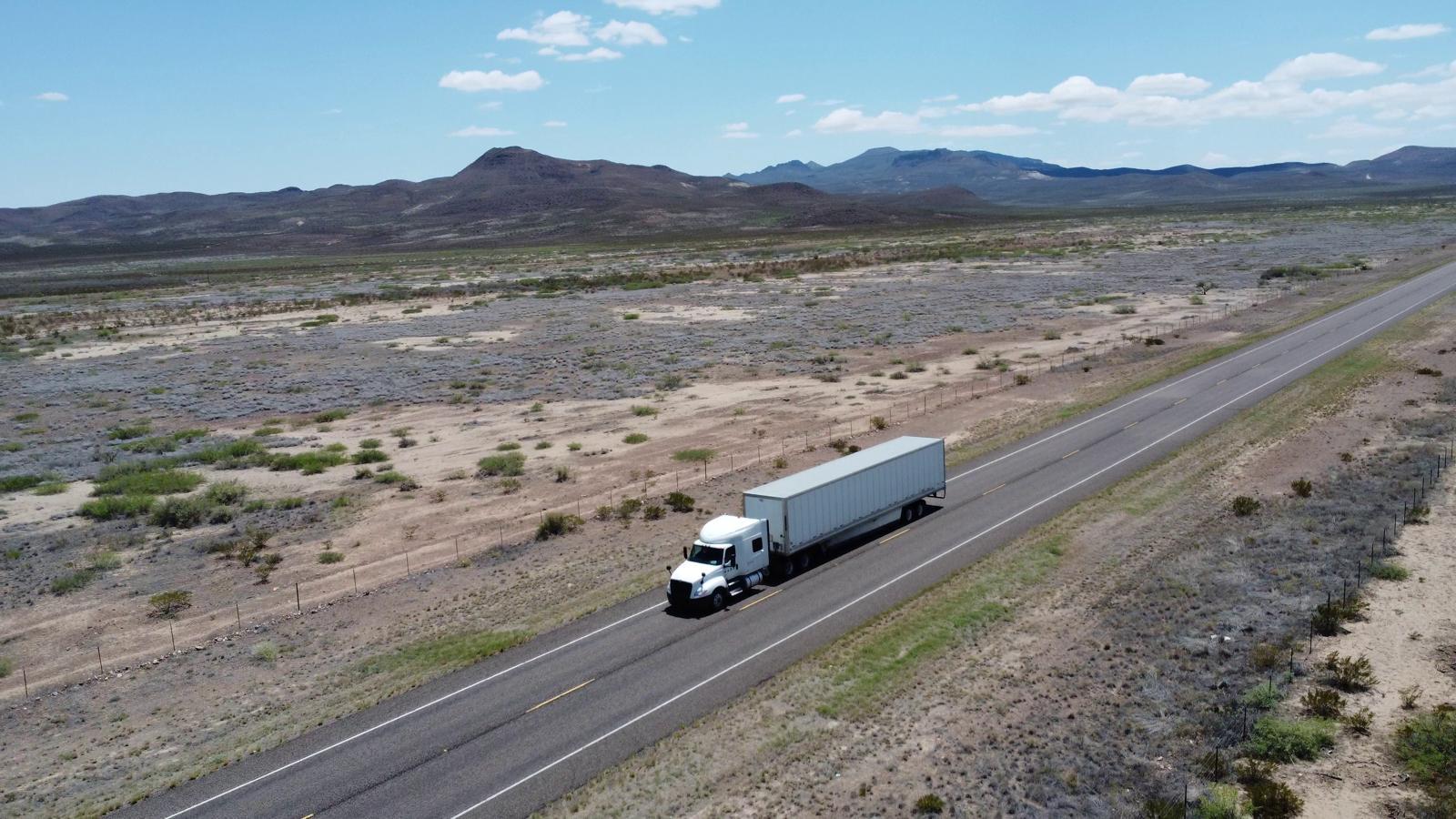
A Mars Auto autonomous truck in operation on a U.S. road. Courtesy of Mars Auto
Mars Auto’s achievements are most dramatically visible in the United States. The company is operating 13 trucks for paying freight transport in Korea and the U.S. Its subsidiary Mars Logis handles operations in Korea, and Mars Operation in the U.S. As of June 2026, its trucks are running on eight domestic routes and three U.S. routes. This means the company has already moved beyond the laboratory stage and is running like an actual transport operator.
The U.S. results are even more symbolic. This year, Mars Auto announced a long-haul autonomous freight route running 3,379 km from Long Beach, California, to Georgia. Park said, “Among autonomous truck companies, there is no other operating such a long route.” The key point is not just the distance record. It is that an AI model trained in Korea immediately drove on U.S. roads. Park recalled, “It became an opportunity to actually prove what we had been claiming up to that point.” This was possible because the method does not require laying down maps in advance, but instead learns by seeing like a human.
● The survival strategy of a founder born in 1991
Park does not come from a car manufacturer background. After graduating from the Department of Computer Science at KAIST, he jumped into entrepreneurship, worked at Hyperconnect, and then returned to the startup front. He founded the company with a co-founder in 2017 and has since endured in the unfamiliar realm of autonomous trucks. He expressed pride, saying, “We are doing what no one else has been able to do.”
Mars Auto is based in Yeoksam-dong, Gangnam District, Seoul, and in Austin, Texas, in the United States. The structure is to refine technology in Korea and validate the market in the U.S. This setup is not coincidental. The U.S. heavy truck logistics market is much larger, and Texas is cited as a relatively favorable region for testing and deploying autonomous trucks. Park’s decision to convert the headquarters to a U.S. structure ultimately stemmed from the judgment that the company must go where the market is larger than the technology.
As a result, Mars Auto is now building up both development capabilities in Seoul and real-world data from U.S. highways. In connecting Korean logistics companies with industrial sites in the U.S., the company’s ambition goes beyond achieving autonomous driving for a single truck. It is closer to redesigning the entire land logistics network.
● The expected scene on highways in 2027
Mars Auto’s goal is clear: unmanned highway freight transport by 2027. An ongoing project under the Ministry of Trade, Industry and Energy is designed in line with this direction. Major domestic logistics companies and institutions are collaborating.
Risks do exist. It must overcome public perceptions that camera-based systems are unsafe, and raise completeness despite the much longer braking distances and more complex control challenges of heavy trucks compared with passenger cars. Regulatory frameworks and accident liability issues also require ongoing refinement.
Nonetheless, industry trends are moving toward data- and AI-centric approaches. As lidar and high-definition map-dependent methods scale, they increase cost burdens, while camera-centric AI can enhance performance with more data and broader route coverage.
Park is a founder rewriting the rules of the logistics industry on highways. He said, “We will drive heavy truck autonomous driving to the stage of unmanned commercial operation,” and added, “We will move beyond the current assisted driving with a human on board and, on a timeline of around two years, realize unmanned autonomous freight transport centered on highways.”
ⓒ dongA.com. All rights reserved. Reproduction, redistribution, or use for AI training prohibited.
Popular News