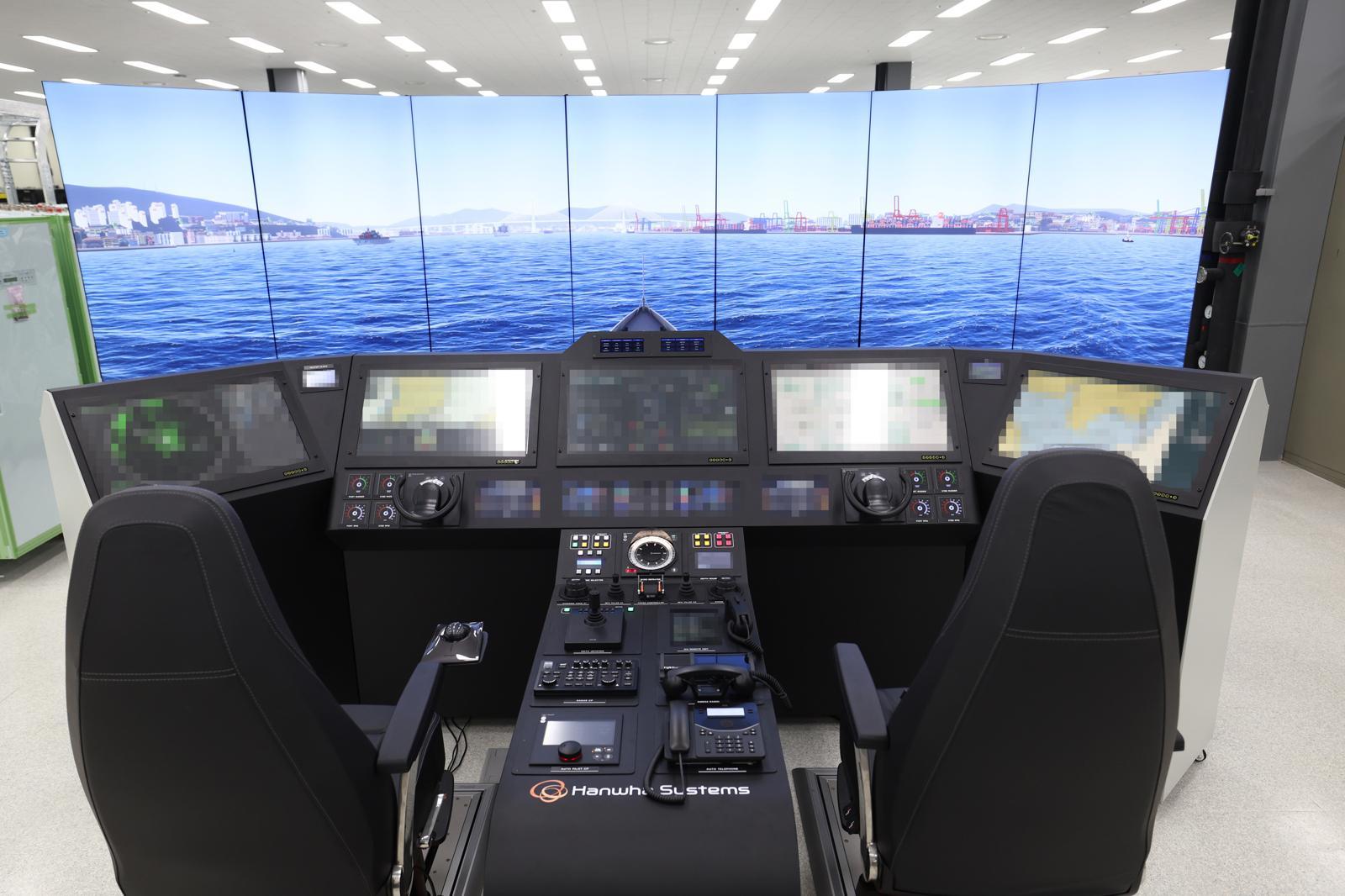
Hanwha Systems’ cockpit-type Integrated Bridge System (IBS)
Hanwha Systems is the only company in Korea that has independently developed and localized all three core systems for unmanned naval vessels: the combat management system (CMS), the Engineering Control System (ECS), and the Condition Based Monitoring System (CBMS) for ship propulsion systems. These technologies were previously possessed only by a few advanced countries such as the United States, Italy, and Norway.
In April, Hanwha Systems once again demonstrated its capabilities in naval systems technology by successfully installing the Engineering Control System—known as the “heart of a warship”—on the ROK Navy destroyer Yang Manchun (DDH-I). This marks the first time that a domestically developed Engineering Control System, based entirely on Korean proprietary technology, has been supplied to a domestic naval vessel.
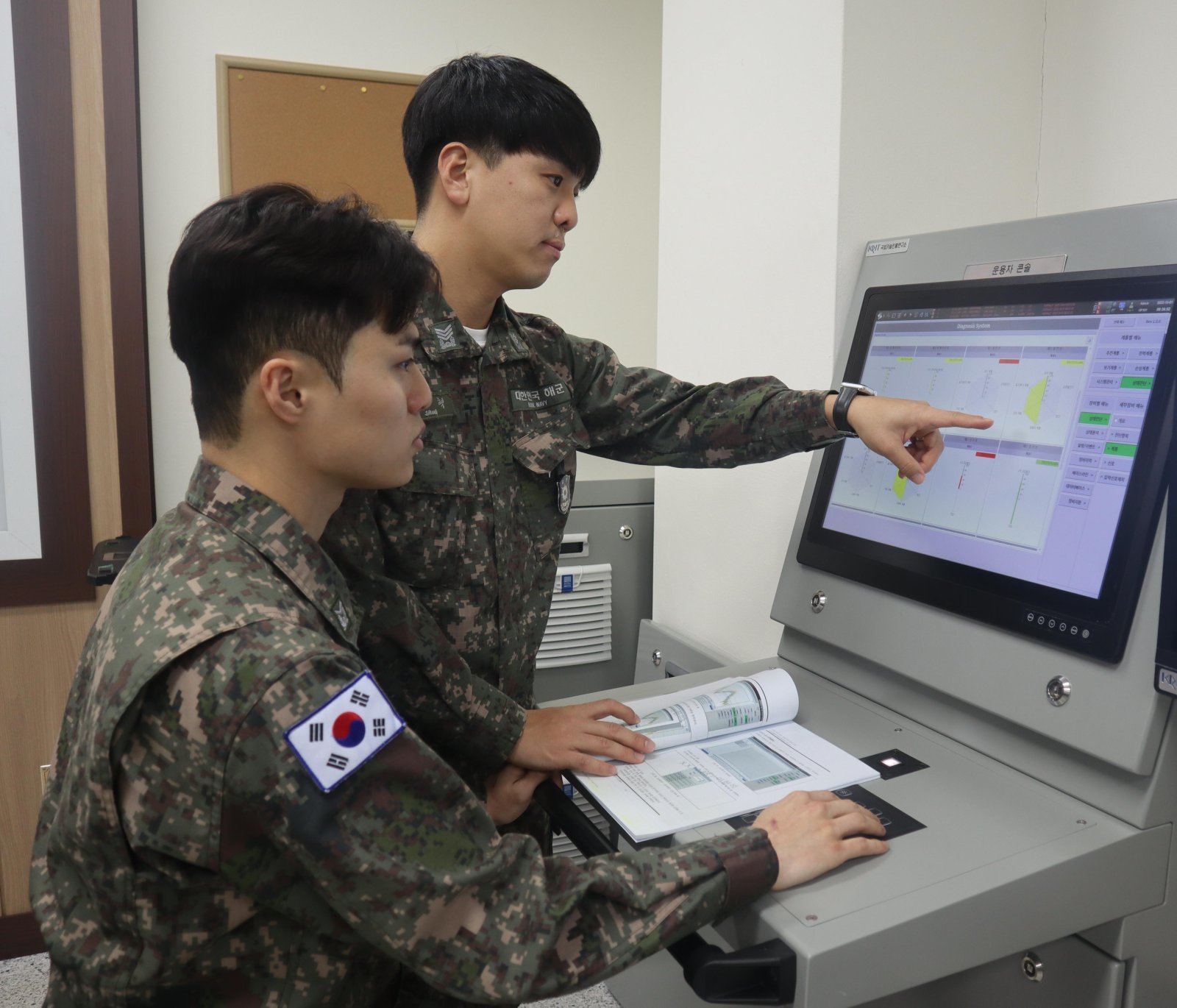
Navy trainees are test-operating the Condition Based Monitoring System (CBMS) for ship propulsion, donated by the Agency for Defense Development and Hanwha Systems. Provided by Hanwha Systems
Localization of ECS and CBMS… First acquisition of technology at global level Hanwha Systems previously became the first in Korea to develop the Engineering Control System and the Condition Based Monitoring System—technologies that had been held only by a few advanced nations such as the United States, Italy, and Norway.
The Engineering Control System (ECS) is an advanced control device that integrates the propulsion, power, auxiliary equipment, and damage-control systems required for ship operation into a single network-based system, enabling a vessel to perform missions in a stable and efficient manner. It is often described as the “heart” of a warship. Together with the “brain of a warship”—the Combat Management System (CMS), which Hanwha Systems has independently developed and localized—the ECS is regarded as one of the core systems for realizing hyper-intelligent and automated future naval vessels. As with autonomous driving for vehicles, technology that can properly control speed according to sea conditions is crucial to achieving autonomous navigation at sea.
On April 30, at Jinhae Port in Changwon, Gyeongsangnam-do, Hanwha Systems held a ceremony to mark the completion of performance upgrades of the Engineering Control System on the Yang Manchun. The event was attended by key organizations including the Navy and the Defense Rapid Acquisition Technology Research Institute, as well as executives from Hanwha Systems. The Yang Manchun (DDH-I) is a 3,200-ton helicopter-capable destroyer built as part of the Korean Destroyer eXperimental-I (KDX-I) program, together with Gwanggaeto the Great and Eulji Mundeok. Until now, the Yang Manchun had used equipment manufactured by overseas companies, but through this project, it was newly refitted with a domestically produced Engineering Control System developed jointly by Hanwha Systems and the Defense Rapid Acquisition Technology Research Institute.
Compared with existing products, Hanwha Systems’ ECS significantly enhances functionality through improvements such as strengthened precision monitoring and control performance, more efficient power operation modes, and the addition of an onboard training system. It also improves material procurement stability by using domestically produced components and software developed in Korea. Meanwhile, in December 2024, Hanwha Systems also won the Defense Acquisition Program Administration’s project to develop the Engineering Control System for the next-generation Ulsan-class frigate Batch-IV (FFX Batch-IV), and is currently proceeding with equipment development.
The Condition Based Monitoring System (CBMS) for ship propulsion is a system that monitors and diagnoses in real time the operating status of the propulsion system—comprising more than 50 pieces of equipment, including engines, reduction gears, seawater pumps, and refrigeration units—and, when necessary, recommends maintenance to the crew. With advanced machine learning technology applied, the system goes beyond simple monitoring to perform trend analysis through performance evaluation, fault diagnosis, and remaining life prediction. It is expected to significantly contribute to enhancing the Navy’s operational capability by preventing unexpected failures in the propulsion system that generates the ship’s power and by increasing the operational availability of naval vessels. The Engineering Control System and the Condition Based Monitoring System for ship propulsion are expected to become leading export products in various overseas markets, including Southeast Asia—such as the Philippines, where Hanwha Systems has supplied combat systems to 15 vessels—as well as the Middle East and South America.
Crew requirements cut to one quarter… Cockpit-type Integrated Bridge System Based on the perfect compatibility of its domestically localized combat management system and Engineering Control System technologies—which Hanwha Systems alone has successfully developed in Korea—the company has also secured cockpit-type Integrated Bridge System (IBS) technology. This next-generation smart bridge system is designed to enable integrated operation of combat and engineering control systems and other key functions from a single space.
The bridge is the raised deck area located centrally at the front of the upper deck, from which the commanding officer steers and directs the ship. The key feature of Hanwha Systems’ solution is that it integrates the previously linear and distributed bridge layout into a configuration similar to an aircraft cockpit. Through three displays positioned directly in front of the pilot and co-pilot, operators can integrally control and monitor the main systems that are central to vessel operation. In particular, by comprehensively digitizing what were previously analog control panels, the system enhances spatial efficiency and minimizes the personnel required for operation. The number of personnel needed to operate the system is expected to be reduced to as little as one quarter of the current level.
ⓒ dongA.com. All rights reserved. Reproduction, redistribution, or use for AI training prohibited.
Popular News