[Public Corporation Inspirational Management] Korea Environmental Industry & Technology Institute
Launched five new projects last month
Expanding into projects totaling KRW 254 billion
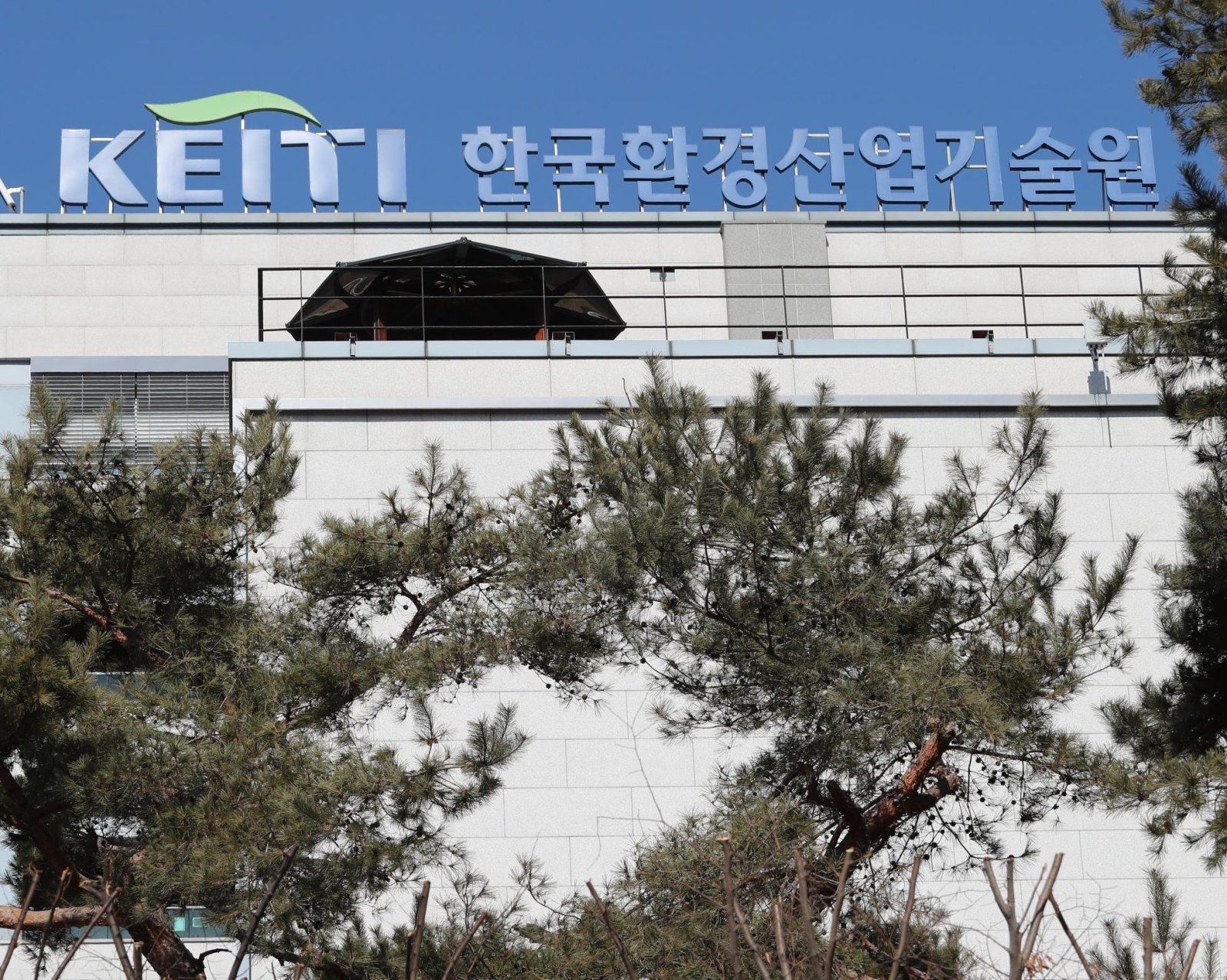
Panoramic view of the Korea Environmental Industry & Technology Institute. Courtesy of the Korea Environmental Industry & Technology Institute
The Ministry of Climate, Energy and Environment and the Korea Environmental Industry & Technology Institute (KEITI) have launched full-scale implementation of five new research and development (R&D) projects in the resource circulation sector since May. The common objective is to convert waste resources, which have so far been subject only to simple treatment, into eco-friendly fuels, energy, and industrial raw materials.
First, a total of KRW 48.7 billion will be invested by 2030 in the “Technology Development Project for High-Quality Biofuel Production Using Organic Waste Resources.” The project will develop technologies to convert by-products from the food industry—such as coffee grounds, rice bran, and animal fats from cattle, chickens, and pigs—into high-quality biofuels including sustainable aviation fuel (SAF). It is designed to prepare for surging SAF demand once the Carbon Offsetting and Reduction Scheme for International Aviation (CORSIA) becomes mandatory from 2027.
The “Technology Development Project for Reuse and Recycling of Core Parts of Hydrogen Vehicles” will receive KRW 40.8 billion in funding through 2029. The project aims to safely remove residual hydrogen from high-pressure hydrogen storage tanks and then reuse the tanks and fuel cell stacks with remaining service life as power generation systems at construction sites, on islands, and on ships. It will also develop technologies to recover rare earth elements at high purity from rare-earth permanent magnets in drive motors, thereby reducing dependence on overseas supplies of critical minerals.
The “Technology Development Project for Localization of Biogas Generators” will be funded with KRW 36.6 billion through 2029. The project will localize key components (such as fuel control valves, engine bodies, and bearings) of dedicated generators that produce electricity using biogas derived from food waste, sewage sludge, and livestock manure. Currently, most of these generators are imported. It will also develop real-time analysis technologies that can detect in advance when impurities are entering the biogas stream.
The “Flagship Technology Development Project for Recycling to Resolve the Waste Clothing Problem” will receive KRW 25.0 billion (including KRW 17.5 billion in central government funding) through 2030. The project will develop technologies to apply an artificial intelligence (AI)-based automatic separation and sorting system that can distinguish waste clothing with more than 95% accuracy—waste that has so far been limited to second-hand exports or simple repairs—and then utilize it broadly not only as recycled fibers and garments but also as materials for automobile interiors and building and civil engineering sub-materials.
The “Technology Development Project for Securing High-Quality Raw Materials and Commercialization Using Waste Tires” will receive KRW 48.0 billion over the same period. The goal is to recover high-quality carbon black from waste tires—which have so far been recycled mainly as fuel in cement kilns (clinker kilns)—through a pyrolysis process and use it to produce eco-friendly tires containing more than 15% of this recovered material. The project is intended to respond to tightening global environmental regulations such as the European Union’s Ecodesign for Sustainable Products Regulation (ESPR).
The scale of initiatives will further expand next year. The “K-Circular Economy Re-born Project,” which passed a preliminary feasibility study in March, is a large-scale program that will invest a total of KRW 254.0 billion (including KRW 177.8 billion in central government funding) over seven years from 2027 to 2033.
Targeting four key waste categories—waste plastics, end-of-life vehicles, decommissioned wind power components, and small to medium-sized waste electrical and electronic equipment—the project will simultaneously upgrade technologies across the entire circular-use chain, from pretreatment to conversion into raw materials and subsequent management. It is the first full life-cycle R&D project in the resource circulation sector to be implemented at a preliminary-feasibility scale.
Nam Kwang-woo, President of KEITI, stated, “The new resource circulation R&D projects that have entered full-scale implementation this year mark a starting point for transforming discarded resources into core raw materials for future industries,” adding, “We will actively support the entire technology development process, seamlessly linking it with the K-Circular Economy Re-born Project that begins next year, so that the Republic of Korea can lead in the era of the circular economy.”
ⓒ dongA.com. All rights reserved. Reproduction, redistribution, or use for AI training prohibited.
Popular News