Amid big tech’s expanded AI infrastructure investments, sales forecast to reach USD 10 billion by year-end Chairman Lee Jae-yong inspects HBM production site On-device memory ‘UFS 5.0’ under development
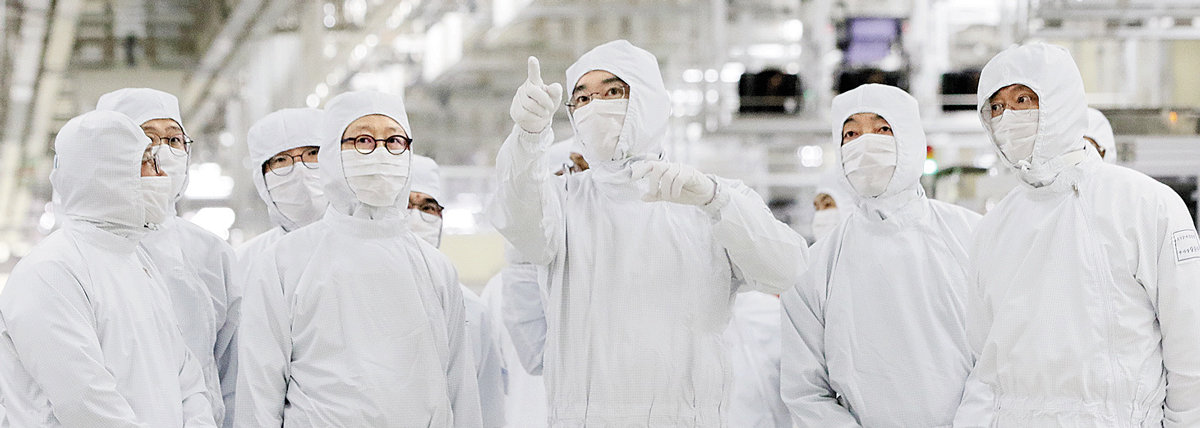
Samsung Electronics Chairman Lee Jae-yong (third from right) inspected the high-bandwidth memory (HBM) production site during a visit to Samsung Electronics’ Cheonan plant on the 23rd. The photo shows Chairman Lee visiting the Cheonan plant in February 2023. Provided by Samsung Electronics
Samsung Electronics Chairman Lee Jae-yong visited the company’s Cheonan plant in South Chungcheong Province on the 23rd to directly inspect the high-bandwidth memory (HBM) production site. The visit is seen as on-site management aimed at checking production competitiveness and the supply system amid surging HBM demand driven by growth in the artificial intelligence (AI) market.
On this day, Chairman Lee visited the C1 and C2 lines at the Cheonan plant, where he received reports on plant operations, production plans, and technology development status, and then toured the HBM package production line wearing cleanroom garments. The Cheonan plant is a core production hub responsible for Samsung Electronics’ HBM back-end processes and advanced packaging.
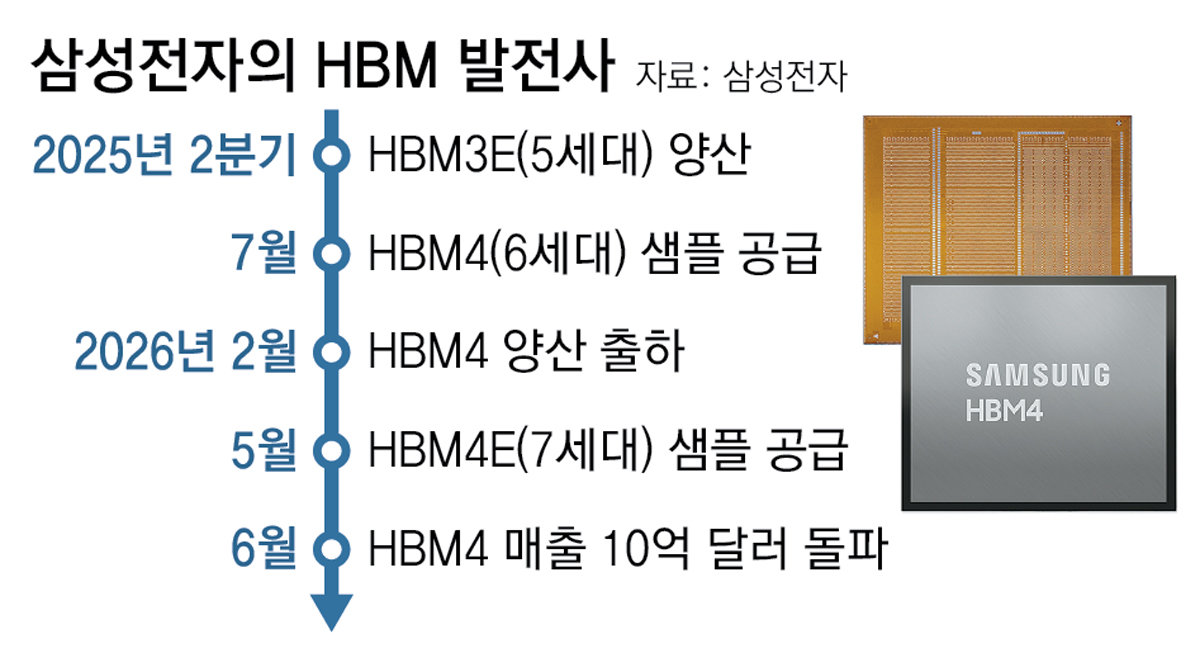
Chairman Lee’s on-site visit came at a time when Samsung Electronics is strengthening its leadership in the HBM market. Samsung Electronics announced that cumulative sales of HBM4, its sixth-generation HBM, have surpassed USD 1 billion (approximately KRW 1.54 trillion) for the first time in the industry. This milestone was reached roughly 130 days after the company began mass production and shipments of HBM4 in February this year, a world first. As of the end of June, cumulative sales are expected to exceed USD 1.2 billion (approximately KRW 1.8433 trillion). Samsung Electronics projected that HBM4 sales would surpass USD 10 billion (approximately KRW 15.4 trillion) by year-end.
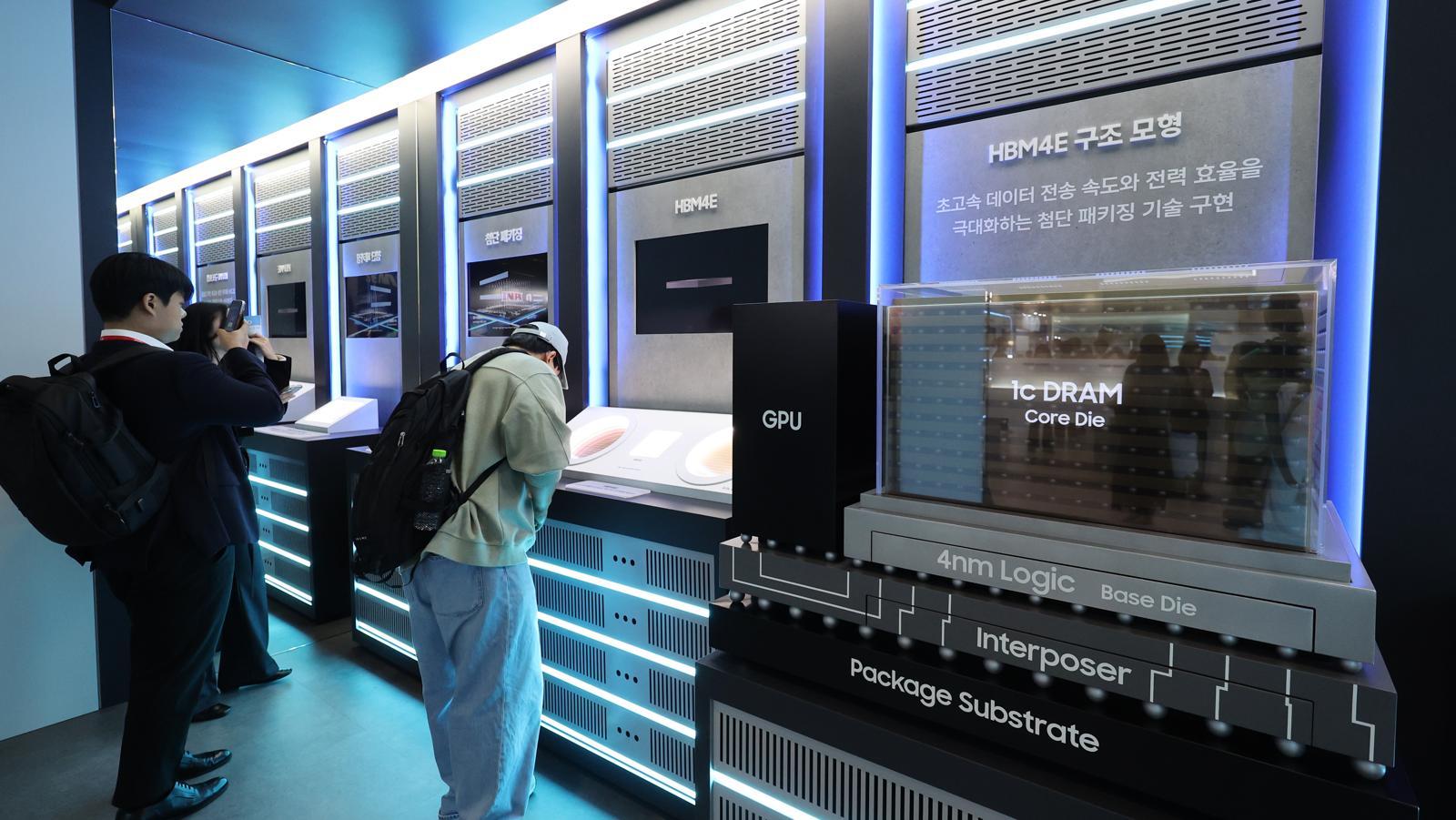
The key feature of HBM4 is the application of Samsung’s own cutting-edge 4-nanometer process to the base die. By integrating memory and foundry technologies, Samsung secured both performance and mass-production stability. The amount of data processed at one time has increased by about 2.7 times compared with the previous generation HBM3E. In February, Samsung succeeded in mass producing and shipping HBM4, and in May it became the first in the world to supply 12-high HBM4E (seventh-generation HBM) samples to global customers. With HBM4 mass production and HBM4E sample supply following at roughly three-month intervals, industry observers say development and supply of next-generation products are progressing rapidly.
The rapid progress is underpinned by surging demand stemming from expanded AI infrastructure investment. Big Tech companies such as Google, Amazon, Meta, and Microsoft are accelerating development of their own AI chips—application-specific integrated circuits (ASICs)—which is driving up HBM demand. Samsung Electronics is also receiving successive requests for supply partnerships from major graphics processing unit (GPU) manufacturers and ASIC customers. Park Yuak, an analyst at Kiwoom Securities, forecast that “HBM shipments this year could increase by more than 200% from last year due to rising ASIC demand.” The adoption of HBM4 in Nvidia’s next-generation AI accelerator “Vera Rubin,” scheduled for release in the second half of this year (July–December), is also seen as a positive factor.
Meanwhile, Samsung Electronics announced on the same day that it has developed “UFS 5.0,” a next-generation memory optimized for the on-device AI era, where AI is embedded and runs within devices, marking a first in the industry. As generative AI spreads from being primarily cloud-based to running directly on devices as on-device AI, the volume of data that mobile devices must process has surged sharply. As a result, storage devices are evolving beyond simple storage spaces into core infrastructure that supports AI computation. Samsung plans to begin mass production of UFS 5.0 in the fourth quarter of this year (September–December) and to supply it not only for flagship smartphones but also for next-generation devices such as extended reality (XR) headsets and AI wearables.
Lee Min-a;Park Hyun-ik
AI-translated with ChatGPT. Provided as is; original Korean text prevails.
ⓒ dongA.com. All rights reserved. Reproduction, redistribution, or use for AI training prohibited.