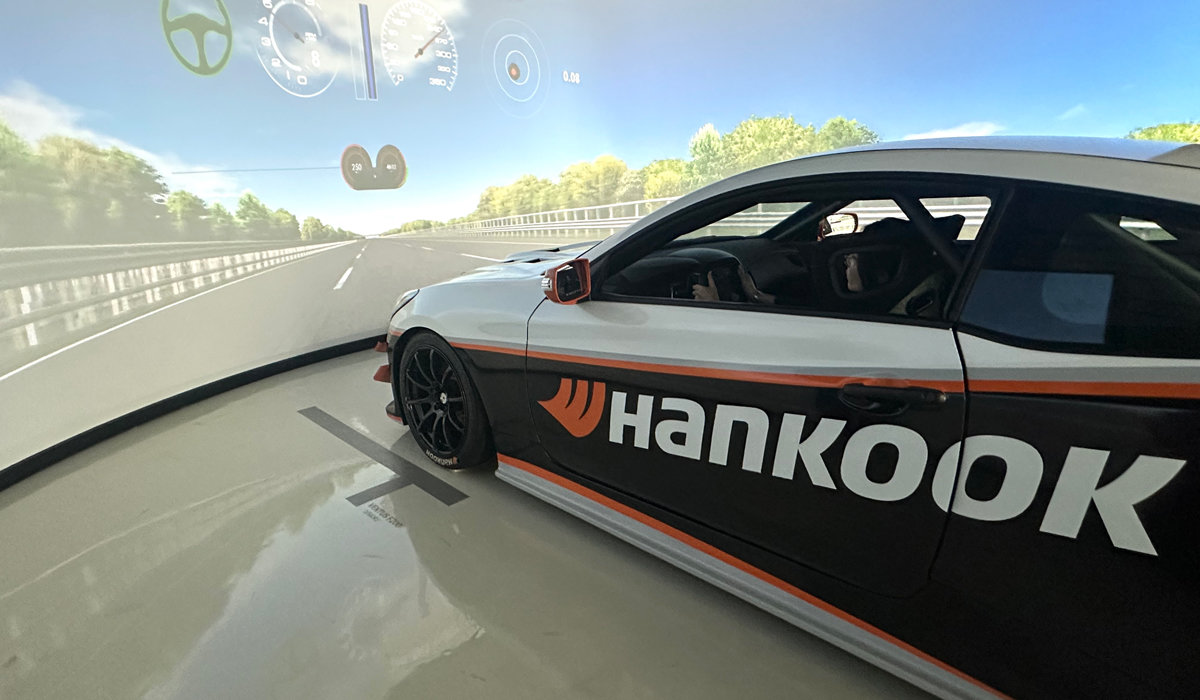
A reporter from this newspaper drives a racing car for virtual tire simulation in the driving simulator room at Hankook Technodome of Hankook Tire in Yuseong-gu, Daejeon, recently. Even during a short drive, items related to tire performance, such as the road grip and wear level of the virtual tire, were checked. Provided by Hankook Tire
“It may look like just playing the game ‘KartRider’ while standing still, but every piece of data, from the pressure applied to the pedal, is being stored.”
Recently, in the driving simulator room at “Hankook Technodome,” Hankook Tire’s research center in Yuseong-gu, Daejeon. Sitting in a stationary racing car facing a panoramic large screen, a virtual drive at up to about 300 km/h was experienced. Even after just a few minutes of driving, several gigabytes (GB) of data had accumulated on the researcher’s computer right next to it. Detailed items related to tire performance, such as the road grip and wear level of the “virtual tire” applied in the driving, were checked.
In the era of software-defined vehicles (SDVs—vehicles whose performance is determined by software rather than hardware and can be continuously upgraded), finished vehicle manufacturers are demanding that tire companies submit such “virtual tires” in order to shorten development lead times and enable rapid strategy adjustments. In the past, a physical tire was produced first and a digital model was built afterward based on measurement data from testing machines, but the process has now effectively been reversed.
● Cutting tire development time by 50% with an ‘AI recipe’
Within the domestic tire industry as well, “virtual tire” test systems have taken root. Kumho Tire has been operating, since 2024, a system that uses artificial intelligence (AI) to model virtual tires and predict their performance. Hankook Tire has been interested in AI-based modeling since 2015 and has converted data on millions of tires into digital form. It then went on to build virtual development systems one after another over the past several years.
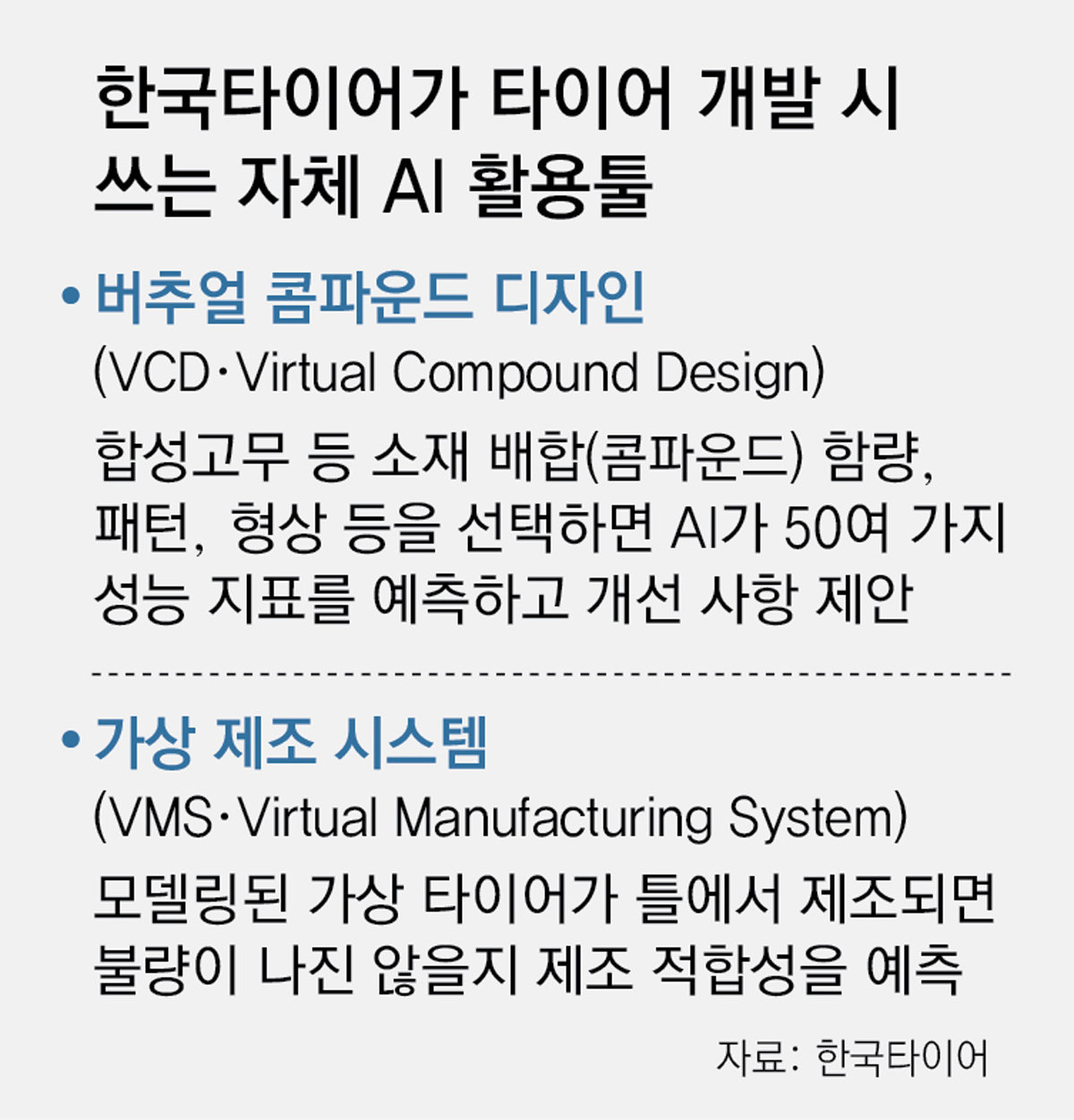
First, the optimal “tire compound” is identified using AI. “Virtual Compound Design (VCD),” a kind of tire recipe guide, is an in-house tool that Hankook Tire has used since 2021. By adjusting the content of key materials such as synthetic rubber and selecting specific patterns and shapes, the tool instantly analyzes more than 50 performance indicators, including wear resistance, fuel efficiency, and noise. These are results that previously could only be known after producing a physical tire, testing it on a machine, and waiting several dozen days. In fact, when the “predict” button was pressed on the tool that day, results were produced in just over 10 seconds, and within one minute the AI also suggested items for improvement.
Hankook Tire generates several hundred thousand prediction results per year using this tool. As the period of use has lengthened, the reliability of the data is assessed to have improved. Senior researcher Choi Hyo-won of the AI Technology Research Team said, “Tire development, which can take as long as two years, has been shortened by up to 50%,” adding, “We pass these prediction results on to the team that actually handles tire compounding, and further refinement and development proceed from there.”
● “Skipping physical tests and going straight to mass production after virtual verification within a few years”
The “Virtual Manufacturing System (VMS)” also assesses in advance the likelihood of problems arising in the process of manufacturing tires designed in this way. If tire manufacturing is likened to making fish-shaped bread filled with red bean paste, the system effectively predicts whether the filling might leak out during the process or whether the dough might become thin in specific areas. Principal researcher Park Dong-jin of the Analysis Technology Research Team said, “Defects caused by material being pushed away under pressure and resulting in a lack of ‘tire compound’ in certain areas have declined by 20–30%.”
Afterwards, physical tire prototypes are produced and tested. Hankook Tire plans to eliminate this testing stage altogether within the next several years. Executive Vice President Kim Sung-ho of the R&D Innovation Division said, “We plan to skip full verification tests using VMS and move directly to mass production.” Kim added, “We can now create tires with performance levels that previously could not be achieved. At this point, we can even manufacture ball-pin tires in the shape of a bowling ball,” emphasizing that virtual manufacturing methods are also highly useful for developing future growth drivers.
ⓒ dongA.com. All rights reserved. Reproduction, redistribution, or use for AI training prohibited.
Popular News