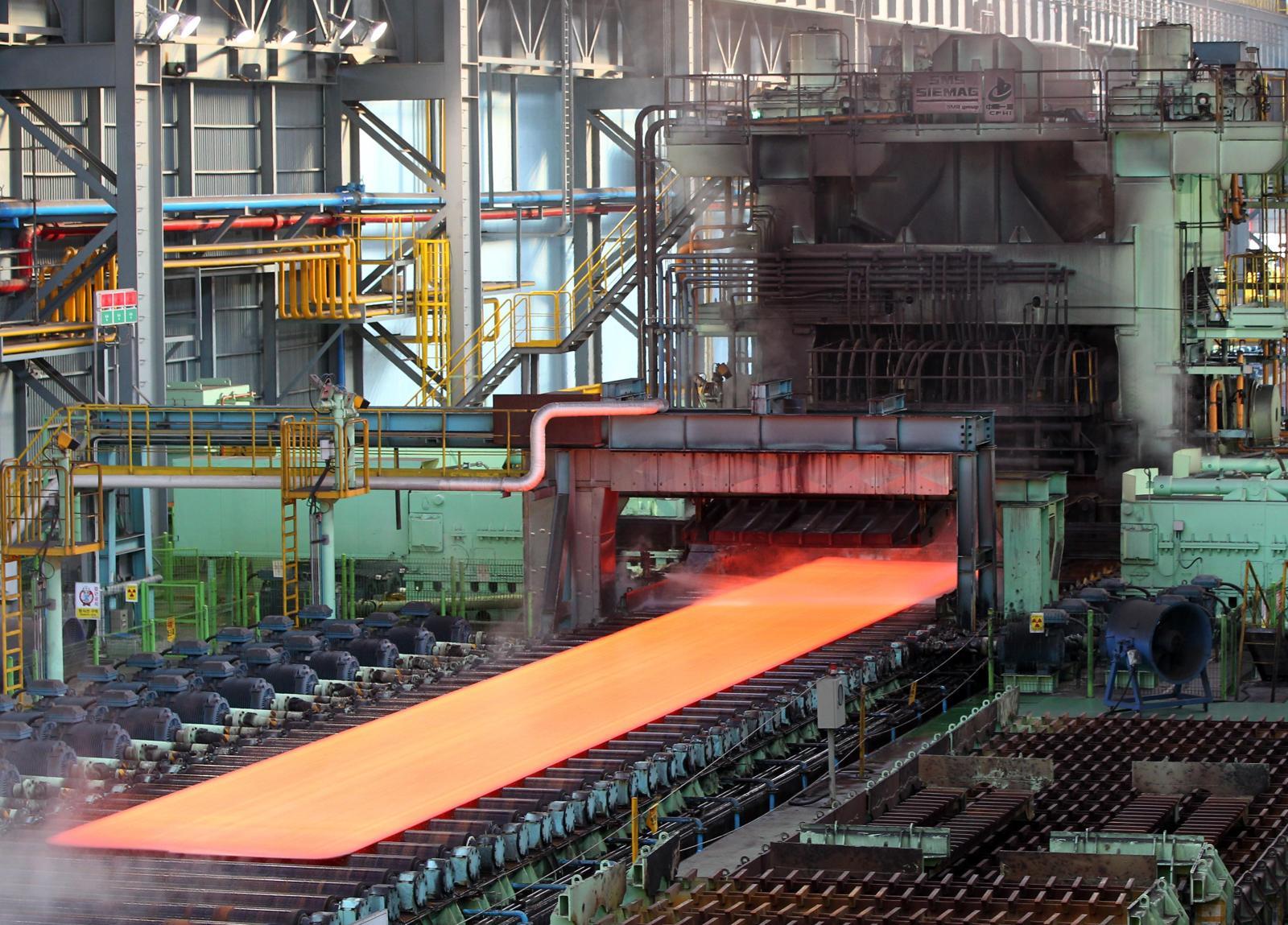
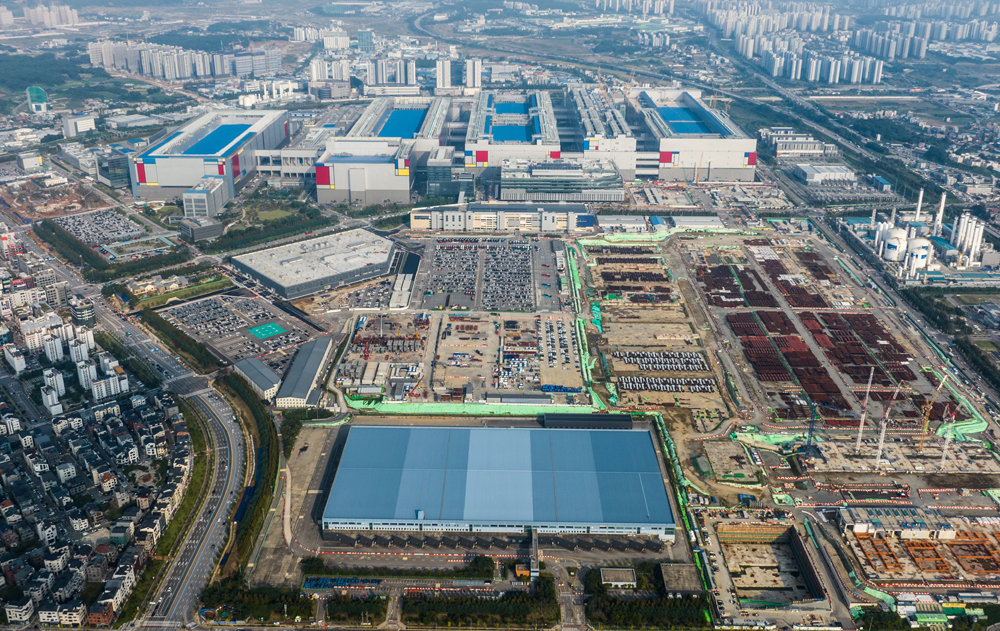
A slab (a mass of steel plate) passing through the rolling facilities at the heavy plate plant of Hyundai Steel’s Dangjin Steelworks in Dangjin, South Chungcheong Province. After going through processes such as rolling, cooling, and machining, the slab is finally produced as heavy plate, a hard steel plate. Provided by Hyundai Steel
“Today this mass of steel plate will be processed for shipbuilding, but as soon as the era of small modular reactors (SMRs), so-called ‘mini nuclear power plants,’ opens, it can be immediately mass-produced for SMR use as well.”
On the 28th of last month at Heavy Plate Plant No. 1 of Hyundai Steel’s Dangjin Steelworks in Dangjin, South Chungcheong Province. In front of the reheating furnace, emitting thunder-like roaring noise and acrid smoke. Referring to a bright red rectangular mass of steel plate that had just completed reheating at over 1,000 degrees, a plant official gave this explanation. Once the “mass of steel plate” passed through rolling and cooling processes that flatten it with cylindrical rolls, it transformed into a thin steel plate. After subsequent processing for each application, heavy plate (thick, hard steel plate) is finally produced.
Of Hyundai Steel’s heavy plate, with an annual shipment volume of 2.65 million tons, half is currently produced for shipbuilding and 30% for construction and energy uses such as bridges and steel pipes. Nuclear power applications remain minimal. However, Hyundai Steel has become the first in Korea to develop dedicated heavy plate for SMR containment that will serve as its “shield,” and last year completed the establishment of a mass production system. It has effectively moved preemptively to secure a future source of revenue.
● Steelmakers move to secure high value-added markets
Amid a “triple whammy” of a construction downturn, an influx of low-priced Chinese steel, and tariff barriers in the United States and European Union (EU), domestic steelmakers are ramping up efforts to identify high value-added business opportunities. Diversifying portfolios and finding breakthroughs in emerging markets have become prerequisites for survival. POSCO is developing high-manganese steel for liquefied hydrogen, capable of withstanding ultra-low temperatures of minus 253 degrees Celsius, in preparation for the anticipated arrival in several years of the era of large liquefied hydrogen carriers. Hyundai Steel entered the development of dedicated heavy plate material for SMRs in 2023 to secure an early lead in the SMR market. Nuclear power plants are broadly composed of two layers: the pressure vessel, which is akin to the “heart” and houses the reactor, and the containment vessel, the protective shield surrounding it. In conventional large nuclear power plants, the containment vessel has been built as a reinforced concrete structure, with heavy plate merely attached to the inside of this structure to help prevent radioactive material from leaking.
In SMRs, where weight reduction is crucial, heavy plate itself becomes the standalone containment vessel without additional structural elements. Senior researcher Lee Sang-hyup of the Heavy Plate Development Team at the Hyundai Steel Research Institute explained, “Unlike heavy plate for large nuclear power plants, which is made from ordinary steel that only requires rolling, heavy plate for SMR containment vessels is made from special steel that demands highly sophisticated heat treatment, resulting in a high technological barrier.”
● Production base secured before the SMR era arrives
Approximately 4,000 tons of heavy plate are used per SMR containment vessel. Once the SMR market opens, Hyundai Steel plans to mass-produce a total of 40,000–60,000 tons of heavy plate annually. Senior researcher Yoon Dong-hyun said, “Nuclear power is not yet the mainstay of the company’s heavy plate business, but we have secured not only development but also the production base before market demand has formed.”
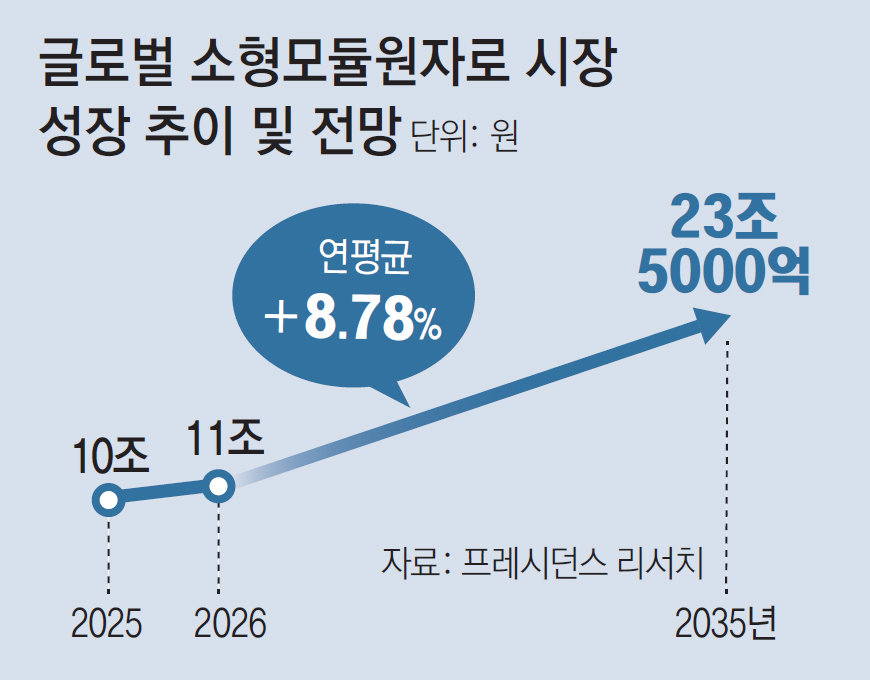
The global SMR market is expected to grow rapidly in the mid-2030s, when full-scale commercial operation begins. According to global market research firm Precedence Research, this market, which was about KRW 10 trillion last year, is projected to reach approximately KRW 23.5 trillion by 2035.
Hyundai Steel is targeting both domestic and overseas markets, continuing to invest by adding another heat treatment facility last year at the Dangjin plant, which originally had only one unit. Korea Hydro & Nuclear Power’s first domestic SMR project, with completion targeted for 2035, is expected to enter full-scale implementation after the construction site is finalized on the 25th. In the United States, construction has already begun on TerraPower’s SMR in Wyoming, and Holtec’s SMR is about to break ground in Michigan.
ⓒ dongA.com. All rights reserved. Reproduction, redistribution, or use for AI training prohibited.
Popular News