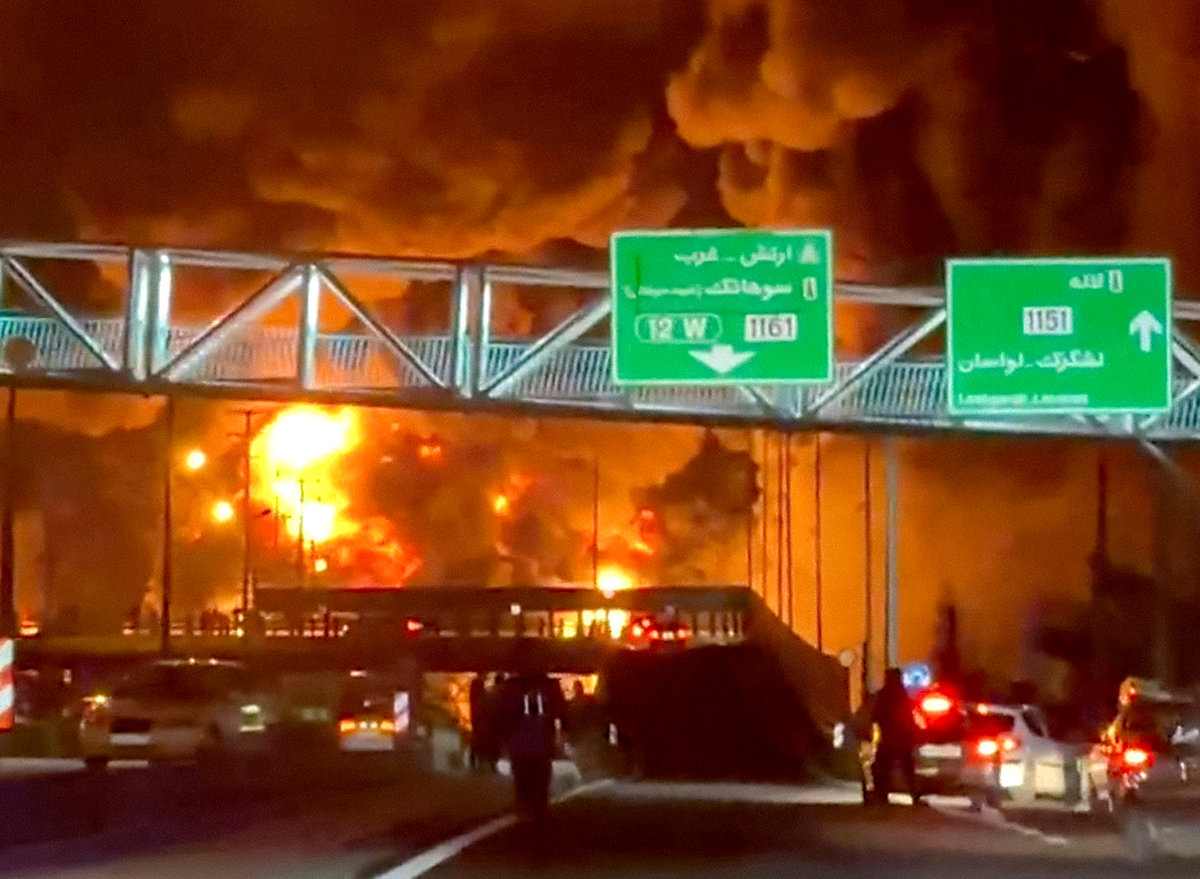
A photo that spread on social media when a fire broke out at an oil storage facility in northeastern Tehran, Iran, on March 7 (local time). With a ceasefire agreement reached and future reconstruction projects for destroyed energy facilities expected to begin, Korean companies, including construction firms, are anticipated to participate. Photo source: X
The U.S. administration is reported to be moving to spearhead Iran’s reconstruction centered on private-sector investment, drawing close attention from Korean industry. Analysts say demand will grow for Korea, which has globally competitive construction and energy plant industries, to take part in the reconstruction projects.
Korean companies are expected to participate on a large scale not only in Iran’s reconstruction but also in restoration projects for war-damaged energy facilities across the Middle East. A significant portion of energy production infrastructure in the region, including the damaged Ras Laffan liquefied natural gas (LNG) facilities in Qatar, has been built by Korean construction firms. The cost of restoring war-damaged energy infrastructure in the broader Middle East alone is estimated at about KRW 88 trillion.
● Korean companies likely to join Middle East energy infrastructure restoration
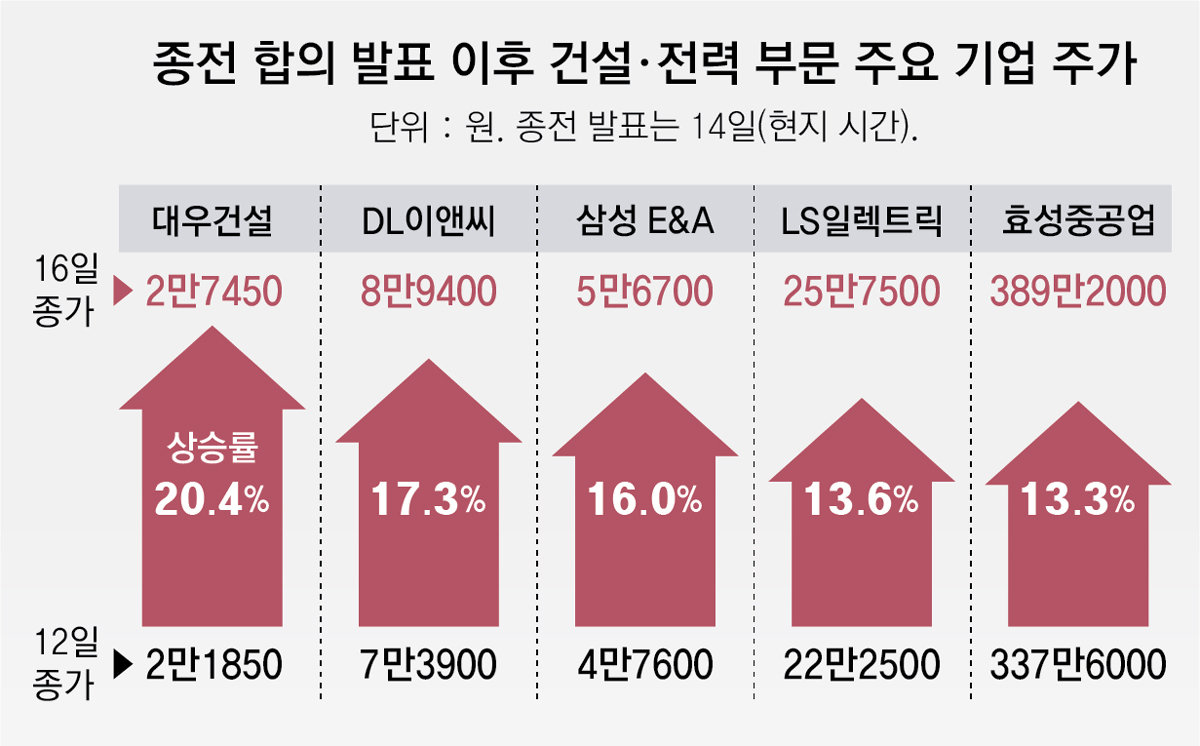
In the domestic stock market over the two trading days of the 15th and 16th, following news of the ceasefire agreement, construction shares rose, with Daewoo Engineering & Construction climbing 20.4% and DL E&C gaining 17.3%. Market expectations have grown that Korean construction firms could participate in Middle East energy infrastructure restoration and Iran’s reconstruction projects.
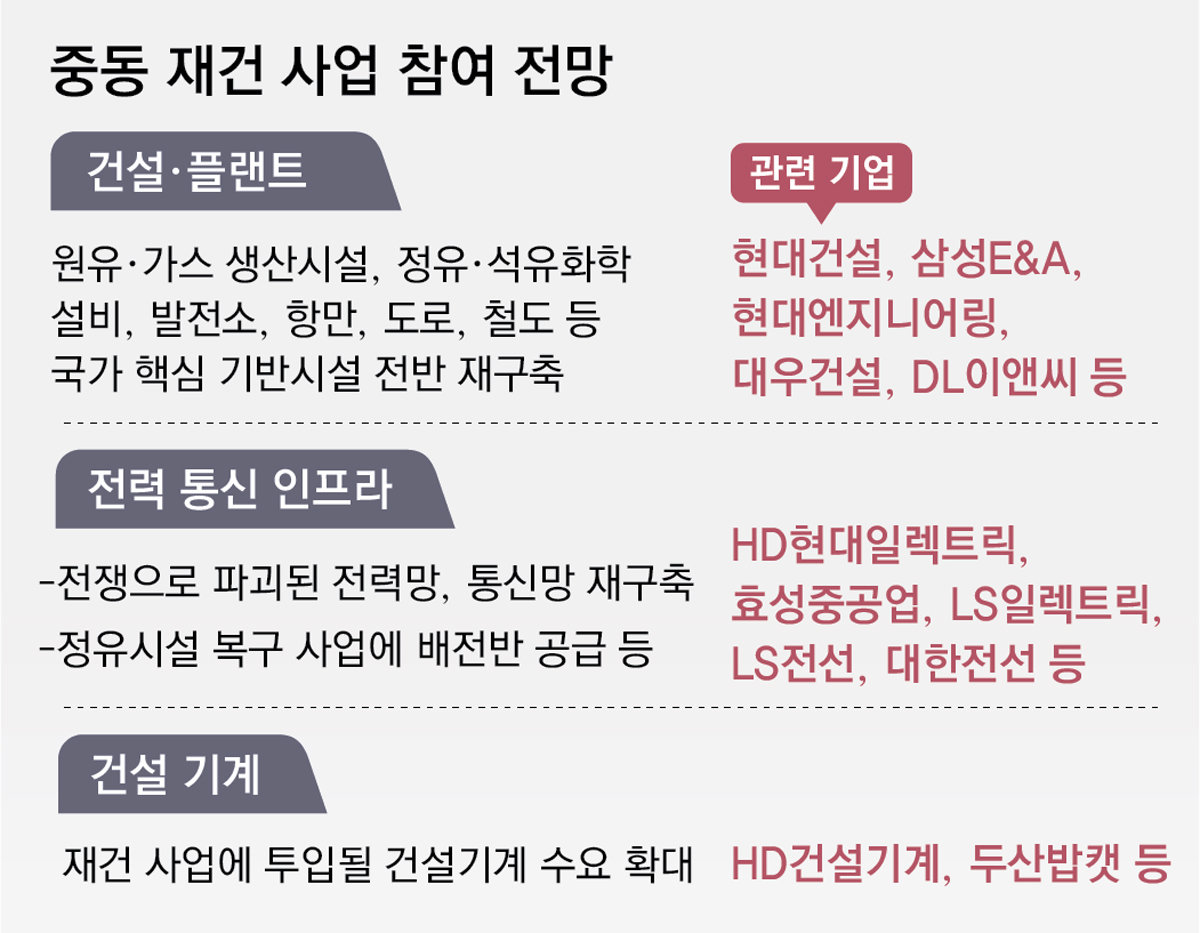
In practice, Iran and the wider Middle East are expected to embark on large-scale investments to restore core national infrastructure, including oil and gas facilities, power plants, transmission and distribution networks, ports, roads, railways, and telecommunications networks. The war has damaged not only Iran’s refining facilities but also energy production infrastructure across the region, such as the Ruwais refinery in the United Arab Emirates (UAE) and the Ras Laffan LNG processing facilities in Qatar. Rapid restoration is deemed essential to stabilize the global energy supply chain. Norwegian energy consulting firm Rystad Energy projects that the cost of restoring Middle East energy infrastructure damaged by the current conflict will reach about USD 58 billion (approximately KRW 87.78 trillion).
A particular strength is that domestic construction firms have already secured design and structural know-how for damaged gas and refining facilities in countries such as Qatar and the UAE, having won a large number of contracts there in the late 2000s. The Ras Laffan LNG facilities in Qatar were built by Samsung E&A, while the gas processing facilities in Habshan, UAE, were constructed by Hyundai Engineering & Construction. DL E&C, which still maintains an office in Iran, won a project in 2017 to upgrade the Isfahan refinery in Iran after the Barack Obama administration lifted economic sanctions on the country.
Demand for construction machinery to be deployed in reconstruction projects is also expected to increase sharply, leading to projections that Korean construction machinery manufacturers, such as HD Hyundai Construction Equipment and Doosan Bobcat, which have focused on the Middle Eastern market, could achieve large-scale export deals.
Given that reconstruction will involve rebuilding war-damaged power and telecommunications networks as well as replacing aging infrastructure, participation by Korean cable manufacturers with relevant capabilities, including LS Cable & System and Taihan Cable & Solution, is also being discussed. There is a high likelihood that transformers and switchgear produced by Korean companies such as HD Hyundai Electric, Hyosung Heavy Industries, and LS Electric will be used in the rebuilding of refining and petrochemical facilities.
Domestic refiners are anticipating a normalization of crude oil supply chains as a result of the ceasefire. Depending on the extent of sanctions relief, if they are able to utilize relatively inexpensive, high-quality Iranian crude, this would broaden their options in terms of supply chain diversification.
● “Geopolitical risks remain… U.S. ‘bill’ also a variable” However, Iran remains subject to U.S. economic sanctions, and even if those sanctions are lifted, the possibility that the regional situation in the Middle East could shift abruptly is still regarded as a persistent risk. Korean construction firms have previously experienced difficulties in Middle East reconstruction projects when sudden changes in local conditions led to issues such as unpaid receivables.
The specific mechanism for operating the U.S. reconstruction fund has yet to be disclosed. Some point out that if participation in restoration projects requires Korean public and private sectors to invest capital and it returns in the form of an “expensive” bill, it would only increase the burden.
Son Tae-hong, head of the Construction Technology and Management Research Division at the Korea Research Institute for Construction Policy, said, “Regardless of whether the United States establishes a reconstruction fund, it is clear that a reconstruction market will emerge,” adding, “It is necessary to approach this by considering whether the international community can smoothly arrange reconstruction funding and whether local institutions have sufficient project management capabilities.”
ⓒ dongA.com. All rights reserved. Reproduction, redistribution, or use for AI training prohibited.
Popular News