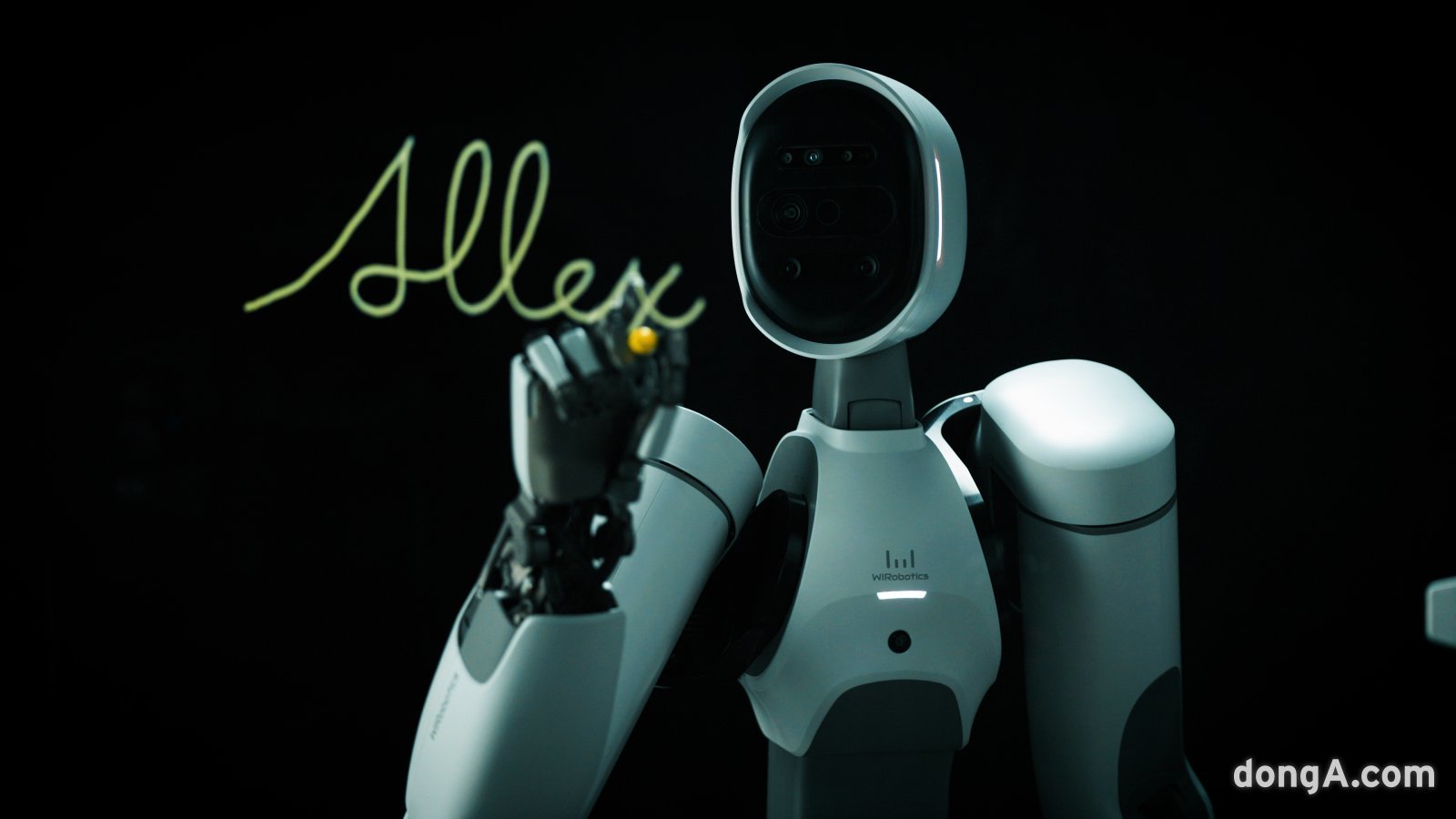
Humanoid ‘ALLEX’ of Wero Robotics, currently under development with the goal of realizing human-level manipulation intelligence. Courtesy of Wero Robotics
Wero Robotics has successfully secured large-scale capital, accelerating the establishment of its own technology ecosystem. Wero Robotics announced on the 15th that it had finalized a Series B investment round totaling KRW 95 billion. This comes about two years after attracting a Series A investment of KRW 13 billion in March 2024, bringing its total accumulated funding to over KRW 100 billion.
The latest round was led by JB Investment, with major domestic venture capital firms including Intervest, Hana Ventures, Smilegate Investment, SBVA, NH Investment & Securities, Company K Partners, Jiyu Investment, and FuturePlay joining in. In particular, existing shareholders all participated again in this round without any withdrawals, which is said to have reinforced confidence in the company’s medium- to long-term growth potential.
Wero Robotics has been developing its bipedal humanoid robot ALLEX based on proprietary core technology that analyzes and controls human biomechanical movements. Recently, it was selected for the Physical AI Fellowship, an artificial intelligence incubation program organized by global GPU company NVIDIA. The company is currently pursuing technical collaboration with Amazon Web Services and NVIDIA, and is in discussions with major global automakers on technology verification procedures for deployment in production sites. The company plans to first introduce a research-purpose robot platform by the end of this year and to begin full-scale mass production by the end of next year.
The driving force behind this next-generation robot development lies in the big data and control know-how accumulated in the wearable robot sector. Since launching WIM, a wearable device for gait assistance, Wero Robotics has spent about three years collecting mobility data from actual users in the field. Based on this, it has refined its user-customized gait control solutions and has recently diversified its business model through the introduction of subscription-based pricing plans.
Entering its third year on the market, WIM has surpassed cumulative sales of 3,000 units and expanded its export front to major countries such as those in Europe, China, Türkiye, and Japan. Revenue also more than doubled each year, rising from KRW 560 million in 2023 to KRW 1.3 billion in 2024 and KRW 2.79 billion last year, and first-quarter performance this year has already exceeded full-year 2024 revenue. The product has also demonstrated external competitiveness by winning the Innovation Award at CES, the IT exhibition, for three consecutive years.
Leveraging its field data-centric technological capabilities, the company is accelerating efforts to establish overseas footholds. In Korea, it is expanding customer touchpoints through proprietary experience spaces and major distribution channels, while in North America, its largest target market, it is proceeding with the establishment of a local subsidiary in California, USA. Network linkages with global distribution channels and healthcare organizations are also progressing smoothly.
The commercialization phase of its humanoid robots is also becoming visible. Starting this year, the company will supply Mobile ALLEX, a mobile humanoid, to global research institutes and overseas partner companies, conducting joint technology development and demonstration projects in parallel. Its strategy is to evolve the platform beyond a simple laboratory device into an intelligent platform capable of interacting within human daily life, and in the medium to long term, to expand its market across the service and manufacturing industries.
Co-CEO Lee Yeon-baek stated that the capital market has recognized that the human movement data and control capabilities obtained from the wearable robot business can be successfully transplanted into the humanoid sector, adding that the company intends to accelerate the popularization of robots that communicate organically with humans.
Co-CEO Kim Yong-jae emphasized that the fact that all existing investment shareholders participated again in this round without any withdrawals is proof of their confidence in the company’s sustainability amid global technological competition. He added that the ultimate goal is to complete a proprietary mechanism that enables human-level precise hand movements and force control, and that, using this funding as a springboard, the company aims to solidify its leadership in Korean-style humanoids, streamline its component supply chain and mass production system, and leap forward as a leading company encompassing both hardware and software.
ⓒ dongA.com. All rights reserved. Reproduction, redistribution, or use for AI training prohibited.
Popular News