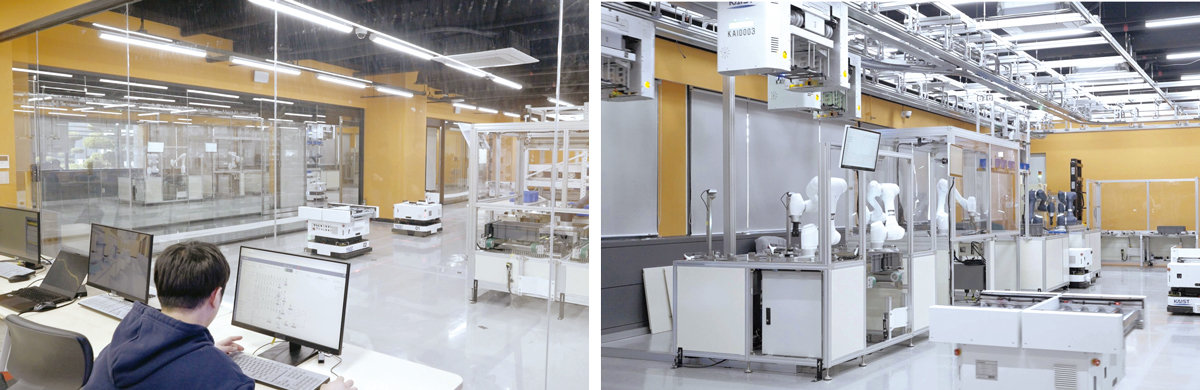
A panoramic view of “KAIROS,” a manufacturing physical AI testbed built by Professor Jang Young-jae’s team at KAIST and unveiled this March. It is a demonstration space that integrates robots, sensors, equipment, and digital twins into a single operating system for unified control, and attracted attention as the world’s first AI-based unmanned operating environment. A researcher is monitoring the logistics flow of the entire demonstration lab in real time via multiple monitors (left photo). Above the dual robot arms, an OHT (Overhead Hoist Transport, aerial material handling system) rail runs through, and on the floor an AMR (Autonomous Mobile Robot) is on standby. Provided by KAIST
Recently, interest in “physical AI (artificial intelligence)” has been growing, and corporate investment is also accelerating. Market attention is largely focused on humanoids, but the most urgent task is to make the robots and equipment already deployed on-site operate as if they were a single system. Robot arms acting as the “hands” of factories, logistics robots as the “feet,” and inspection robots as the “eyes” are used across many manufacturing sites, but because equipment and software from different manufacturers operate independently, the flow of the factory as a whole still often requires human coordination. For this reason, in the era of physical AI, competitiveness derives less from the performance of individual robots and more from the ability to operate and orchestrate multiple robots and equipment in real time.
The term “dark factory” is commonly explained as a factory that can run with the lights off because there are no people, but its essence is not simple unmanned operation. The core is “orchestration” that makes equipment, robots, material flows, work sequences, and energy use move within a single coherent system. This article revisits the main points of “How Physical AI Is Transforming the Manufacturing Floor,” introduced in DBR (Dong-A Business Review) Issue 437 (No. 2, March 2026), to examine how to operate factories as intelligent systems.
● More important than robots is the “system”
McDonald’s Big Mac set can recently be purchased for around KRW 7,000, while gimbap sets at neighborhood snack bars often exceed KRW 9,000. Why have hamburgers, which must deliver the same quality anywhere in the world, become cheaper than local gimbap? The difference lies not simply in purchasing power but in the “operating system.”
McDonald’s does not leave hamburger preparation to the intuition of a chef. It standardizes kitchen workflows, ingredient placement, cooking sequences, and task division so that even less-experienced staff can deliver consistent quality. In contrast, many small kitchens still rely heavily on the experience and intuition of specific individuals. In one case, the system guarantees quality; in the other, people bear responsibility for quality themselves.
Manufacturing stands at the same crossroads. In Korean manufacturing, the level of individual equipment and robots is high, but the capability to design the overall factory flow as a single system has been relatively weak. This is why logistics bottlenecks and inventory burdens increase even after partially automating a line. The core of physical AI-based autonomous manufacturing is not to deploy more robots, but to bind robots, equipment, and material flows into a single operating system. The fourth wave of manufacturing innovation is now starting from “systems,” not robots.
● Three technologies that power dark factories Next-generation dark factories go beyond simply automating a single process. They must determine in real time which task should be processed by which piece of equipment, when and along what route materials should be moved, and which bypass route to use in case of failure. If a factory is likened to the human body, processing equipment and assembly robots are the organs, while logistics and data networks are the nervous system. Physical AI is the brain that orchestrates the whole. No matter how strong the organs are, the body cannot function properly if the nervous system and brain do not work.
Three core technologies make this possible. The first is digital twins and reinforcement learning. By replicating an actual factory in a virtual space and running through countless scenarios, it pre-learns optimal operating methods. Instead of undergoing trial and error after the plant is built, it fails first in a virtual environment and derives improvements there.
The second is VLA (Vision-Language-Action) models. These models enable AI to see the site through cameras, understand work instructions, and select actions suited to the situation. In manufacturing environments, even small variables such as slight misalignment of parts or a tilted box can stop an automated system. VLA-based physical AI recognizes such variables and adjusts its behavior accordingly.
The third is the software-defined factory. It is a structure in which process layouts, robot motions, and logistics policies are changed through software, similar to updating smartphone apps. An integrated operating system (OS) that unifies robots and equipment from different manufacturers under a single language is necessary to avoid dependence on specific equipment and flexibly expand factory functions.
● Becoming a country that sells factory OS The challenge lies in real-world deployment. In Korea, many smart factory projects have been promoted, but quite a few cases have fallen short of expectations in terms of return on investment. This is often because different companies separately handled manufacturing IT, process equipment, logistics systems, and robot operations, leaving no overall architect responsible for the factory as a whole.
The solution is to design the entire factory as a single organism and establish a system that verifies performance in advance through digital twins before making investments. However, expensive simulation software and specialized personnel are a burden for small and medium-sized enterprises. For this reason, an “AI factory manager” platform, which even small manufacturers can use, is being discussed as an alternative. The idea is to verify design proposals at low cost and enable management and on-site staff to make decisions based on the same data.
Securing a manufacturing operating system is also important as a matter of national strategy. In the past, leadership in the computer industry went not to component manufacturers but to companies that controlled the operating system and ecosystem. The same logic applies to manufacturing. Who takes the lead in operating systems that run entire factories could determine future competitive dynamics.
Korea has a manufacturing base in semiconductors, displays, secondary batteries, automobiles, and shipbuilding that can be combined with physical AI. By layering digital twins and integrated operating systems on top of this, the country can go beyond exporting robots and equipment to exporting the “dark factory system” itself. In the era of physical AI, the real contest hinges not on the performance of a single robot, but on the capability to design entire factories as unified intelligent systems. If Korean manufacturing takes the lead in this transition, it can move beyond being a country that builds factories to become a country that sells factory operating systems.
ⓒ dongA.com. All rights reserved. Reproduction, redistribution, or use for AI training prohibited.
Popular News