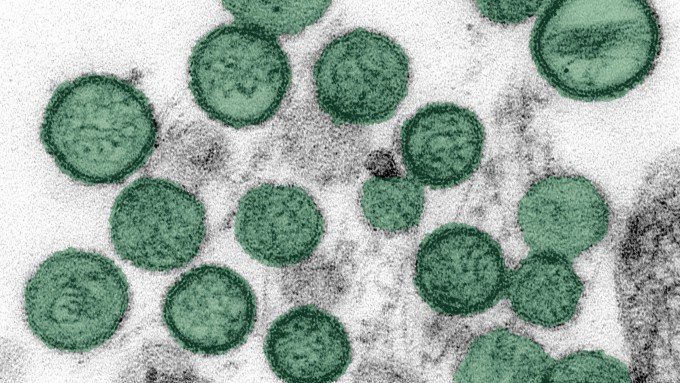
Electron microscope image of hantavirus. It is transmitted through rodent excreta, and with no approved vaccines or treatments available, its development is urgently needed worldwide. Provided by the U.S. Centers for Disease Control and Prevention (CDC)
Confirmed cases of Andes virus, a type of hantavirus for which there is neither a vaccine nor a treatment, have been successively identified on the cruise ship MV Hondius sailing across the Atlantic. This has drawn attention to the current state of development of hantavirus vaccines and therapeutics.
According to relevant agencies on the 17th, in Korea the Vaccine Innovation Center at Korea University College of Medicine has completed animal testing for a messenger ribonucleic acid (mRNA)-based vaccine that targets Hantaan virus and Seoul virus. A universal vaccine that also protects against Andes virus has just entered the initial research stage. In the United States, an Andes virus vaccine has advanced to Phase 1 clinical trials, but commercialization is still considered a long way off.
● Improvement needed for domestically developed “Hantavax”… mRNA vaccine animal testing completed
Andes virus is a type of hantavirus transmitted through rodent excreta that causes hantavirus pulmonary syndrome (HPS), which damages the lungs and heart and has a fatality rate of up to 50%. It occurs mainly in South America, including Argentina.
The principal hantavirus vaccine currently in use is “Hantavax,” developed by the late Professor Emeritus Ho-Wang Lee of Korea University, who in 1976 was the first in the world to isolate Hantaan virus. Hantavax was developed against Hantaan virus, which causes hemorrhagic fever with renal syndrome (HFRS) that damages the kidneys. It is assessed as in need of improvement due to the high number of doses required and the short duration of immunity.
Jeong Hee-jin, head of the Vaccine Innovation Center at Korea University College of Medicine, said, “Although it belongs to the same hantavirus genus, it is difficult to use against Andes virus, which is a different species.”
The Vaccine Innovation Center at Korea University College of Medicine has created a vaccine candidate by inserting its self-developed hantavirus antigen into the mRNA platform of U.S. biotechnology company Moderna, and has completed efficacy evaluation through animal experiments. mRNA vaccines work by injecting part of the viral genetic information into the body so that cells read it to produce viral surface proteins, which in turn induce an immune response.
The center is currently conducting remaining preclinical tests, including toxicity studies, and plans to complete preclinical trials by the end of 2027. Following approval from the Ministry of Food and Drug Safety (MFDS) and securing funding, the goal is to enter Phase 1 clinical trials in 2028. Jeong said, “Entering Phase 1 requires MFDS review and approval, and issues such as fundraising cannot be resolved by the university’s efforts alone, so ongoing discussions with government regulatory agencies and companies are necessary.”
The primary objective is to develop a vaccine that prevents Hantaan virus and Seoul virus, which each year cause 300–400 cases of hemorrhagic fever with renal syndrome in Korea. Jeong explained, “To include Andes virus, an additional, separate antigen needs to be added.” Early-stage research is under way on a universal vaccine, a second-phase goal, that would protect against hantaviruses in the Americas as well.
Jeong added, “Hantavirus is a World Health Organization (WHO) designated priority pathogen,” and said, “In an era of rapid climate change and changes in living environments, vaccine development against major pathogens for which no vaccines exist cannot be achieved through the efforts of researchers or pharmaceutical companies alone.” Jeong further noted, “Long-term and continuous support and attention at the national level are needed.”
● Phase 1 clinical trial completed overseas… Commercialization will take time Andes virus vaccine development is also active overseas. A research team at the University of Texas Medical Branch (UTMB) published an mRNA-based Andes virus vaccine in Nature Communications in 2024. The team designed and compared two mRNA vaccines using as an antigen a surface protein that the virus uses to attach to cells. Both vaccines demonstrated protective effects against viral infection in an animal model with a 100% mortality rate. While all animals in the unvaccinated control group died, most in the vaccinated groups survived.
A research team at the U.S. Army Medical Research Institute of Infectious Diseases (USAMRIID) published Phase 1 clinical trial results for a DNA vaccine against Andes virus in the Journal of Infectious Diseases in 2024. DNA vaccines induce an immune response by injecting viral genetic information in DNA form instead of mRNA.
In a trial of 48 healthy adults, divided into vaccine and placebo groups in a double-blind design in which neither participants nor researchers knew who was in which group, administration using the needle-free injection device “PharmaJet Stratis” resulted in most adverse reactions being mild or moderate, and antibody responses were maintained for up to 337 days in more than 80% of the vaccinated group.
The research team is also pursuing therapeutic development in parallel. SAB-1634, an antibody product produced by administering hantavirus antigens to genetically engineered cattle that generate human antibodies, demonstrated efficacy in animal models against Andes virus and three other variants.
ⓒ dongA.com. All rights reserved. Reproduction, redistribution, or use for AI training prohibited.
Popular News