New Korea-China joint research team designs novel additive
Affordable, high-performance next-generation solar cells within reach
Challenge remains to overcome vulnerability to high temperatures and humidity
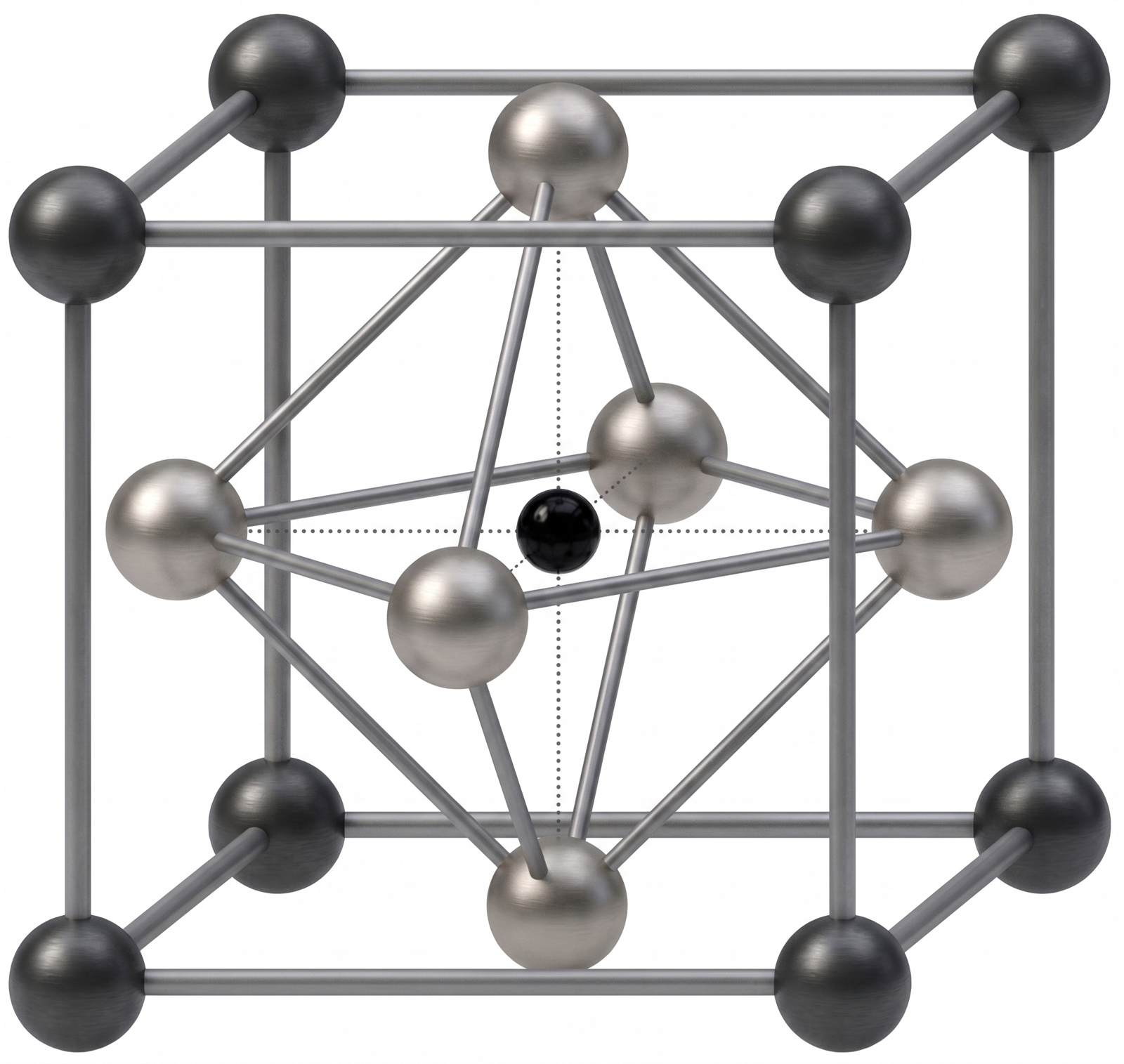
Perovskite, used as a next-generation solar cell material. Two different cations and anions combine in a 1:1:3 ratio.
A joint research team from Korea and China has achieved certification of a power conversion efficiency (PCE) of 27.6% for a next-generation perovskite single-junction solar cell, reaching a world-leading level. Unlike previous studies that mainly improved structural stability and efficiency by externally modifying solar cells, this result is drawing attention as a strategy that enhances efficiency at the molecular design level.
Professor Nam-Gyu Park’s team in the Department of Chemical Engineering at Sungkyunkwan University, together with research teams from Huazhong University of Science and Technology, Harbin Institute of Technology, and Shenzhen Polytechnic University in China, succeeded in raising perovskite solar cell efficiency to a world-leading level and published the findings in the international journal Science on the 14th (local time).
For commercial silicon single-junction solar cells, 29% efficiency is presented as the theoretical limit. Perovskite, with its high light absorption and energy conversion efficiency and relatively low manufacturing cost, is drawing particular attention in display and solar cell applications. In theory, by stacking silicon and perovskite in a multi-junction structure, solar cell efficiency of up to 80% can be achieved.
Having recently broken through the 27% efficiency barrier and closely trailing silicon solar cell efficiencies, the main challenge for perovskite solar cells is now ensuring stability. Perovskite crystals are vulnerable to high temperatures and humidity, and their internal crystal structure is prone to collapse under repeated operation.
The research team added an additive called “3-PMPCl” to the interior and surface of the crystal to improve the material so that the crystal itself maintains a more stable state. As a result of experiments, the team succeeded in achieving a world-leading power conversion efficiency of 27.6%. However, the electrode materials used to reach this maximum efficiency—silver (Ag) and gold (Au)—are partially vulnerable in terms of long-term stability due to chemical bonding and ion penetration.
The team applied bismuth (Bi) electrodes as an alternative material. Through this, although the efficiency slightly decreased to about 26.8%, the cells secured high stability, maintaining more than 93% of their initial efficiency for 1,011 hours under sunlight-level illumination and high-temperature conditions.
The core of this study is that it shifted the research paradigm from an external, supplemental approach to an intrinsic stabilization strategy through molecular design. The proposed approach is expected to be applicable not only to perovskites but also to other soft semiconductor materials.
Professor Park explained, “The current results are still based on small-area devices, so additional verification is needed regarding large-area uniformity, module manufacturability, and scalability.” Based on support from the Ministry of Science and ICT and the National Research Foundation of Korea’s Leader Research Program, Professor Park participated extensively—together with postdoctoral researcher Dr. Sanwan Ryu—from research planning to core experiments such as optoelectronic property analysis, as well as manuscript preparation.
There is also an assessment that research on next-generation solar cells in China is advancing very rapidly and is already at the stage of preparing for mass production. Professor Park stated, “Recently, China has expanded the scope of research beyond simple efficiency competition to operational stability, eco-friendly solvent processes, and machine-learning-based materials design,” adding, “It is understood that more than 100 companies are moving beyond the R&D stage and preparing for mass production.”
ⓒ dongA.com. All rights reserved. Reproduction, redistribution, or use for AI training prohibited.
Popular News