Daegu–Gyeongbuk accelerate creation of a ‘robot ecosystem’
Logistics and transfer robot hub to be built in Gumi
Daegu deploys mobile robots on production floors
Aiming for a virtuous cycle of testing, demonstration, and commercialization
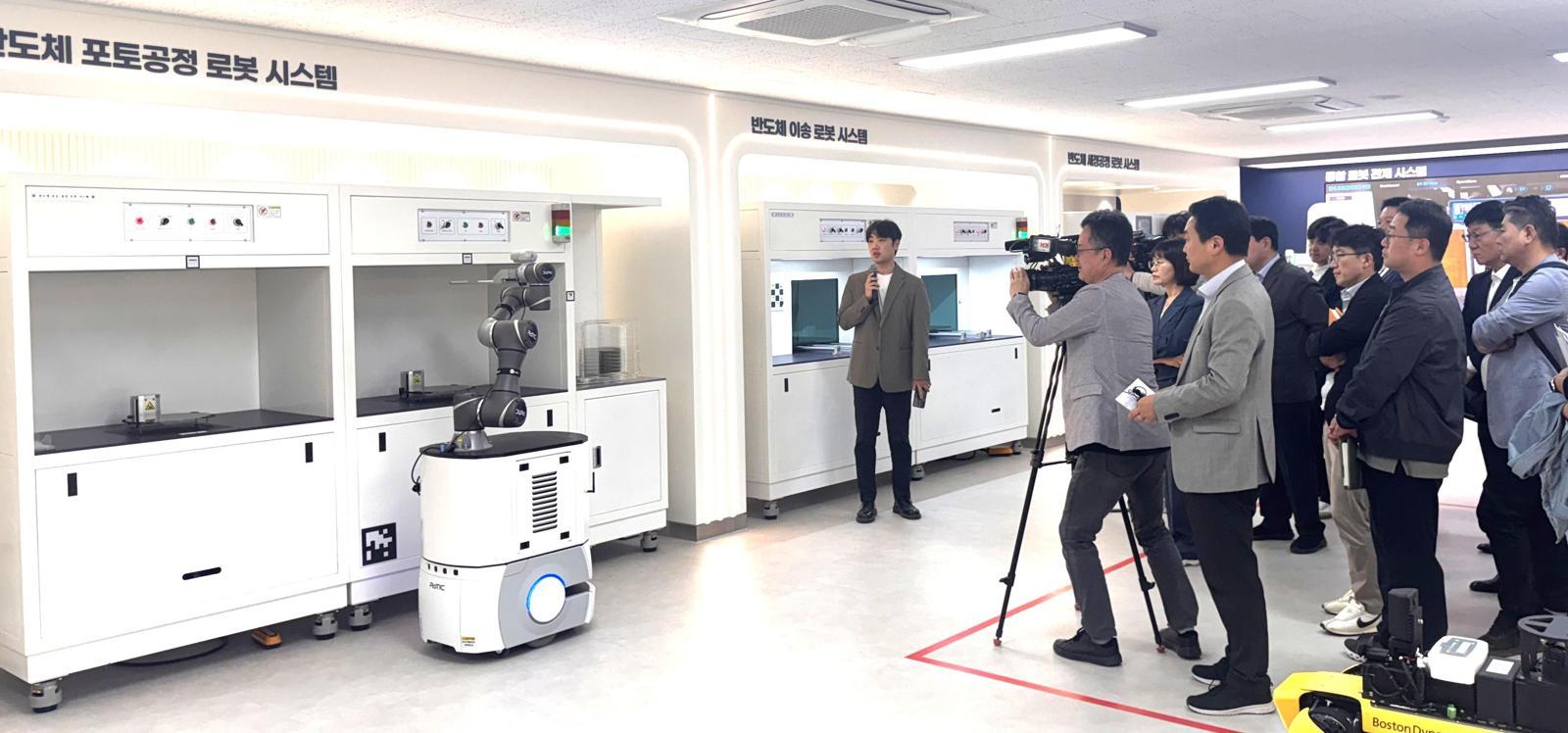
On the 22nd at the Wearable Smart Device Commercialization Support Center in Geumo Technovalley, Sinpyeong-dong, Gumi-si, Gyeongsangbuk-do, the “Gyeongbuk Robot Flagship Hub Opening Ceremony” is held and a semiconductor process robot system is being demonstrated. Provided by Gumi-si
Daegu and North Gyeongsang Province are moving ahead in earnest with demonstration projects for the robotics industry, a core future growth engine. There is an assessment that the creation of a “robot ecosystem” has begun that goes beyond research and development (R&D) to application in actual industrial sites, driving structural transformation across the region’s manufacturing sector.
Gumi-si in North Gyeongsang Province recently established a “transport and logistics robot hub” linked to the semiconductor industry, creating a bridgehead for industrial expansion. The “Gyeongbuk Robot Flagship Hub,” jointly promoted by North Gyeongsang Province, Gumi-si, and the Ministry of Trade, Industry and Energy, was created with a total investment of KRW 2.1 billion in a dual structure at Geumo Technovalley and the logistics center in the national industrial complex. Its distinguishing feature is a full-cycle system that covers everything from testing transport robots within processes to indoor and outdoor logistics demonstrations.
These hubs are meaningful in that they function not merely as simple experimental spaces but as “demonstration platforms” directly connected to industrial sites. Because robot technologies specialized for semiconductor manufacturing processes and logistics environments can be verified in real operational settings, companies can reduce development burdens and accelerate commercialization.
Based on this, Gumi-si plans to combine robots with the region’s key industries such as defense and secondary batteries to simultaneously enhance productivity and competitiveness. The city also plans to expand cross-industry convergence by linking the push to have the area designated as a national high-tech strategic industry specialized complex in the robotics field with an artificial intelligence (AI) factory project centered on this hub.
Jeong Seong-hyun, acting mayor of Gumi-si (vice mayor), said, “The establishment of this hub will be an important turning point in which Gumi’s robotics industry shifts from the demonstration stage to the industrial expansion stage,” adding, “We will focus our efforts on fostering robotics as a core future industry so that Gumi can become the leading robot city representing the Republic of Korea.”
Daegu Metropolitan City has also fired a starting signal for industrial structural transformation through the “field deployment” of robots. The city recently began full-scale demonstration by deploying, for the first time in the country, a “mobile dual-arm collaborative robot” in an actual manufacturing process. This equipment, which combines a dual-arm collaborative robot on an autonomous mobile platform, is a next-generation form that performs processes in collaboration with humans.
The current demonstration is being conducted at the production facilities of SL, a local automotive parts company. It performs the entire sequence from transporting workpieces to processing, handling by-products, and stacking finished products. Unlike conventional fixed robots, it secures both mobility and collaboration capabilities and is expected to dramatically improve process efficiency. Robot specialist companies such as Neuromeka are participating in the development to enhance technological completeness.
As Gumi’s “demonstration hub” and Daegu’s “on-site application” come together in this way, a robotics industry belt is taking shape across the Daegu–North Gyeongsang region. There is an assessment that a virtuous cycle structure linking “testing–demonstration–commercialization” is becoming established beyond simple technology development, which will set in motion a full-scale overhaul of the region’s manufacturing base.
The outlook is relatively positive. Robots are regarded as a key means of driving productivity innovation when combined with the region’s mainstay industries such as semiconductors, automobiles, defense, and logistics. In particular, within regional industrial structures grappling with population decline and labor shortages, robots are positioning themselves not just as “substitutes” but as “essential infrastructure.” Daegu’s push to become the “AI Advanced Robot Capital” and North Gyeongsang Province’s drive to build a “robot industry specialized complex” are also in this context.
However, there are considerable challenges. The key task is to establish an industrial ecosystem that can move beyond the demonstration phase to attract private investment and expand markets. The cost burden for small and medium-sized enterprises adopting robots, the shortage of skilled personnel, and safety regulations are also cited as issues that must be addressed. Jeong Eui-gwan, Director General for Future Innovation and Growth at Daegu Metropolitan City, said, “Through this demonstration, we will lay the groundwork for successfully embedding mobile dual-arm robots in the field,” adding, “We will work to ensure that Daegu, as the center of the Republic of Korea’s robotics industry, can expand the new industry ecosystem and inject fresh vitality into the regional economy.”
ⓒ dongA.com. All rights reserved. Reproduction, redistribution, or use for AI training prohibited.
Popular News