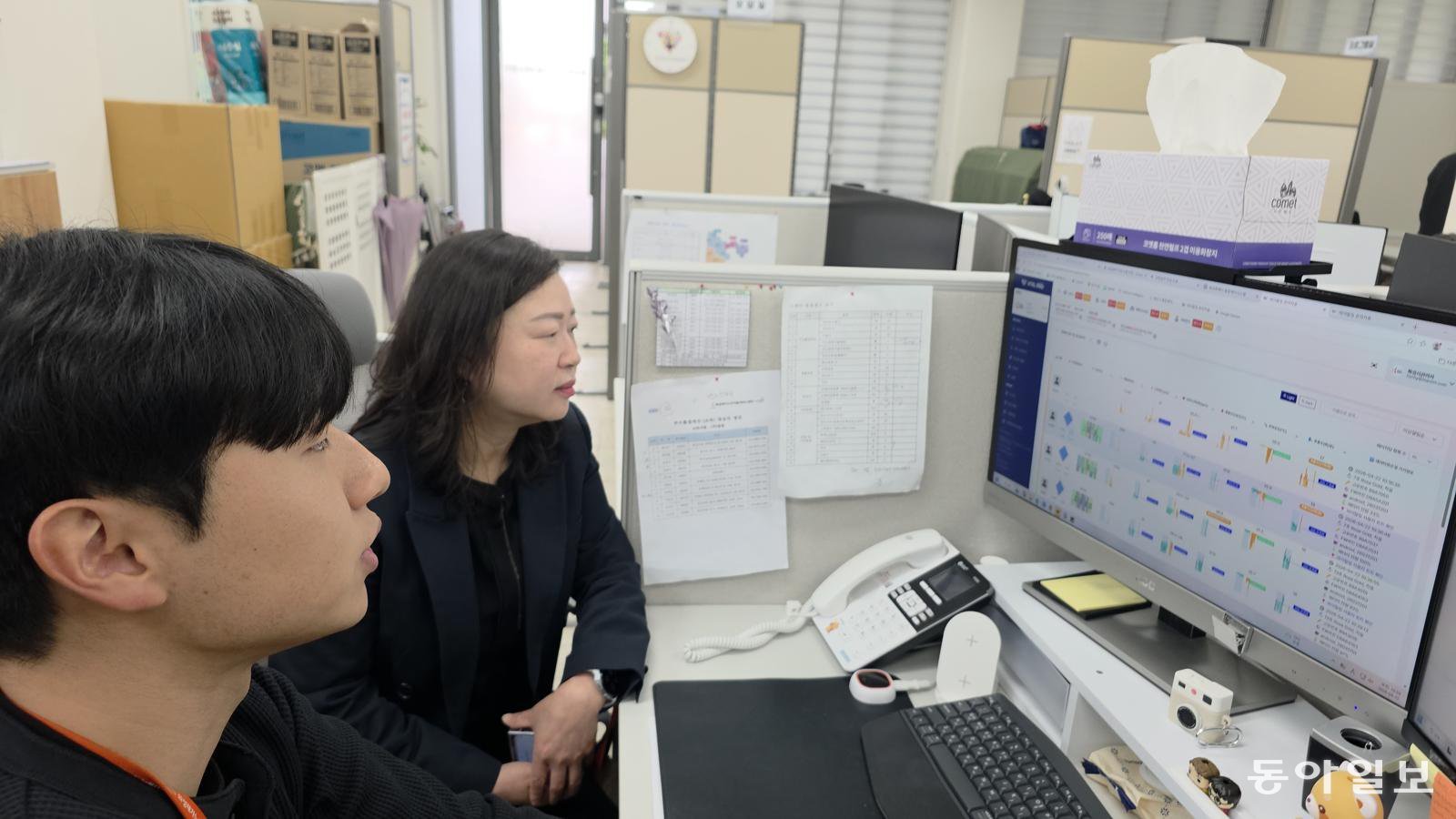
On the 22nd, Kim Hee-sook (right), head of the Hwaseong Home-based Elderly Support Service Center, checks the location and health status of a resident wearing a smart ring together with a staff member. Recently, the center also identified an elderly person living alone who had been bedridden at home due to a severe herniated disc and transported the person to a hospital. Hwaseong = Medical Correspondent and Physician Jin-han Lee, likeday@donga.com
Since Korea entered a super-aged society in 2024, its care paradigm has been undergoing rapid change. Beyond the mere increase in the elderly population, demand for care spanning medical treatment, long-term care, and housing has surged, fueling criticism that the existing fragmented service system cannot respond adequately.
In particular, as elderly people and persons with disabilities increasingly wish to spend old age not in facilities but in their “own homes,” building a community-based integrated care system has become a necessity rather than a choice. Local governments are focusing efforts on creating systems that allow residents to resolve medical and care needs at once while remaining where they live. In this context, so-called “digital care,” which combines information and communications technology (ICT) with healthcare, is being expanded nationwide.
Kim Heon-ju, president of the Korea Health Promotion Institute, said, “As interest in health grows and technology advances, diverse health promotion solutions are yielding results at the local government level,” adding, “This year, we plan to implement services that combine online and offline channels in connection with public health centers’ home-visit health projects.” In line with these changes, three local governments that are filling welfare gaps with data and technology are examined below.
● Around-the-clock detailed emergency call care with smart rings On the 22nd, at the Hwaseong City Home-based Elderly Support Service Center in Gyeonggi Province. Although the facility is located within an apartment complex, elderly people who do not live in the complex also visit to receive care services. The center is equipped with various health measurement devices and facilities for hobby activities. Through the “Hwaseong-type Home-based Elderly Integrated Care Pilot Project,” implemented since July last year, Hwaseong City is strengthening its capabilities to prevent lonely deaths and respond to emergency patients.
What particularly stands out at the center is an artificial intelligence (AI) emergency call care solution that utilizes smart rings worn on the finger. The smart ring monitors key vital signs 24 hours a day, including heart rate, oxygen saturation, body temperature, sleep patterns, and stress levels. Going beyond simple welfare checks, when an abnormality in vital signs is detected, the AI immediately calls the individual to check their condition. If the elderly person does not answer the phone or a crisis situation is suspected, the system sends location information and alert notifications to guardians and relevant institutions via KakaoTalk and AI automated calls.
This system is evaluated as having eliminated blind spots in care by using a wearable device in the form of a ring, which causes little resistance. A Hwaseong City official said, “By adding people-centered values to technology, we will continue to develop an integrated care model that protects the lives and safety of the elderly.”
● Minimizing rural healthcare gaps through real-time data management Pyeongchang County in Gangwon Province is overcoming the limitations of low healthcare accessibility in rural areas by integrating ICT into the management of chronic diseases such as hypertension and diabetes. The core of the “Smart Chronic Disease Management Project” being promoted by the Pyeongchang County Public Health Medical Center is real-time data transmission and feedback.
When patients, who have been provided with home-use Bluetooth blood pressure monitors, blood glucose meters, and scales, measure their own readings, the data are transmitted in real time to the medical center via an application (app). Health coordinators continuously monitor this information to detect warning signs. Rather than merely checking figures, a “hybrid online-offline management service” is provided, organically linking data-based customized counseling, educational text messages, and in-person medical consultations.
The results have been demonstrated in indicators. According to a study conducted in cooperation with Seoul National University College of Medicine in 2024, among patients who participated for nine months, glycated hemoglobin levels decreased by an average of 0.3 percentage points and systolic blood pressure by 8.9 mmHg. This case shows that even elderly people unfamiliar with digital devices can achieve sufficient treatment effects in rural areas when intensive management is combined. From 2025, Pyeongchang County is accelerating efforts to establish a “multidisciplinary patient management standard model” by introducing AI that learns individual patient data, in partnership with Hallym University, to provide exercise and nutrition counseling.
Park Geon-hee, head of the Pyeongchang County Public Health Medical Center, said, “To provide high-quality services, continuous education and support for nursing staff who connect smart technology with local residents are essential,” adding, “We will continue to take the lead in creating a ‘Healthy Pyeongchang’ through data-based, scientific public health administration.”
● ‘Hybrid care’ combining ICT and human touch Busan City is working to prevent lonely deaths through a “hybrid care bell” model that combines digital technology with face-to-face welfare services. Centered on districts such as Yeongdo-gu and Geumjeong-gu, this service is a preventive care system that utilizes Internet of Things (IoT) sensors and big data to detect abnormal signs in daily life in advance. On the ground, it is being evaluated as a digital care solution that makes “aging in place (AIP)” possible.
The care bell model is characterized by multidimensional management that combines technology with human care, adding regular check-in calls by professional counselors and medical linkage. Busan City plans to expand the number of beneficiary households to 750 this year. The model is spreading nationwide, including to Seoul, Gwangju, Gyeonggi, Jeonnam, and Gyeongbuk, and overseas expansion to countries such as Japan and the United Kingdom is also being pursued. In addition, by combining a monitoring service that manages patients at home after hospital discharge, it is expected to contribute to building an integrated medical, long-term care, and social care system, which has been implemented since last month. Care experts have evaluated it as “a model that can simultaneously achieve the prevention of lonely deaths, reduction of medical costs, and improvement of quality of life.”
ⓒ dongA.com. All rights reserved. Reproduction, redistribution, or use for AI training prohibited.
Popular News