Provided by LG AI Research
LG, which is focusing on developing artificial intelligence (AI) that will transform people’s lives, is announcing achievements in the bio-convergence field in the United States.
LG Group stated on the 21st that LG AI Research will unveil research results for the “cancer agentic AI” it is jointly developing with Vanderbilt University Medical Center through the American Association for Cancer Research (AACR) conference being held in San Diego, California.
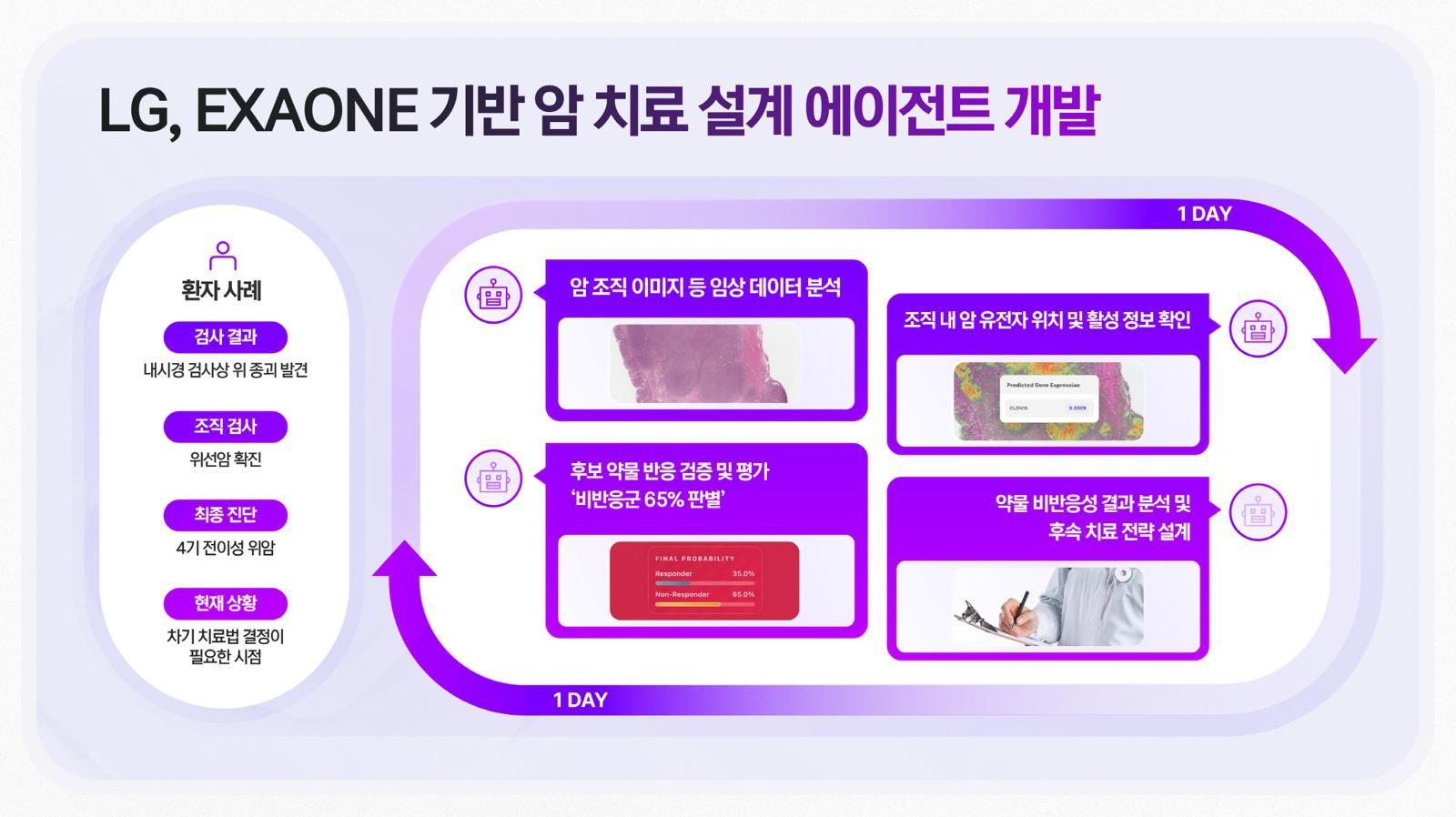
The core of the cancer agentic AI that LG AI Research is co-developing is that it is designed to perform the entire process from analysis of a cancer patient’s tissue to the design of a treatment strategy within a single day.
Operating concept of cancer agentic AI based on LG EXAONE. Provided by LG AI Research
LG builds the “brain” of precision oncology with AI technology
The starting point of the cancer agentic AI is the pathology AI “EXAONE Path,” which predicts oncogene activity within tissue in under one minute from a single histopathology image. LG AI Research explained that it has raised EXAONE Path’s accuracy in predicting oncogene activity within tissue to a world-class level, thereby laying the foundation to reduce unnecessary tests for patients and to identify at an early stage the patient groups that can benefit from targeted therapies.
In July last year, LG AI Research and a research team led by Professor Tae Hyun Hwang at Vanderbilt University Medical Center announced plans to advance technology for predicting treatment effectiveness and to develop a multimodal medical AI platform to realize personalized precision medicine. The cancer agentic AI research results disclosed this time constitute the first outcome of that initiative.
Jongseong Jang, head of the Bio Intelligence Lab at LG AI Research, said, “LG is developing a ‘brain’ in which AI agents collaborate with medical specialists to revolutionize personalized anticancer treatment,” adding, “By shortening the time from cancer diagnosis to treatment decision, which has taken an average of more than four weeks, to just one day, it will help secure the golden time for treating cancer patients.”
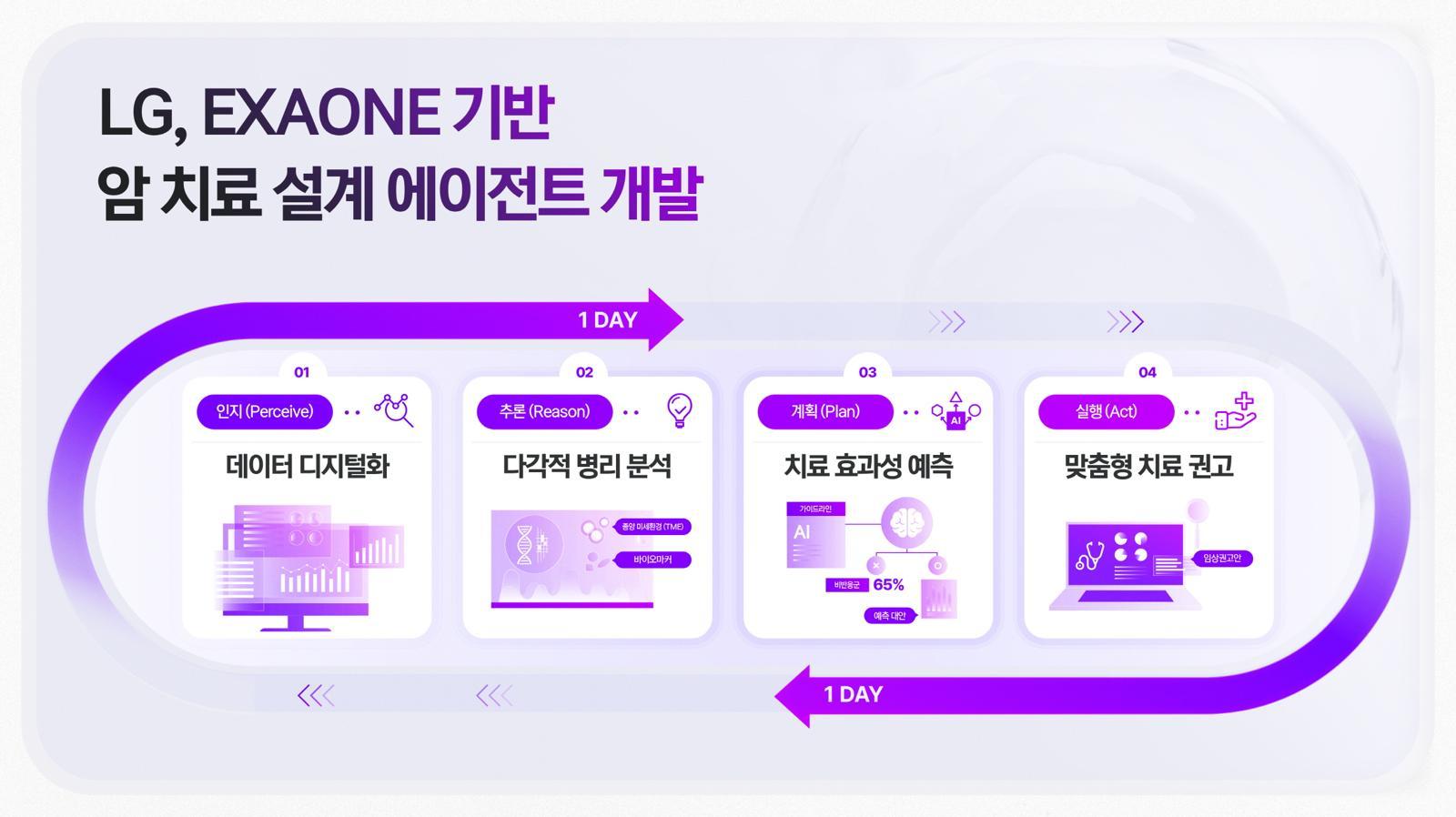
Operating concept of cancer agentic AI based on LG EXAONE. Provided by LG AI Research
Multi AI agents based on LG EXAONE design cancer treatment from analysis to planning
According to LG AI Research, the cancer agentic AI operates through the collaboration of multiple AI agents built on LG EXAONE and cancer pathology-specialized AI. Each AI agent carries out, step by step, the preparatory process for cancer treatment, from analyzing cancer tissue images and identifying the location and activity information of oncogenes within the tissue, to comparing and validating the AI’s predictions against actual measurements, verifying and evaluating responses to candidate drugs, designing treatment strategies, and supporting the final decision.
Professor Tae Hyun Hwang said, “Whereas existing medical AI has responded in a fragmented way to single queries, the agentic AI jointly developed with LG has a structure in which multiple AI agents collaborate to connect analysis, verification, design, and decision support,” and added, “A collaborative model in which AI processes vast amounts of data and medical professionals make the final decisions is expected to achieve significant outcomes in clinical settings.”
The research team led by Professor Hwang explained that the cancer agentic AI operates by deriving results through cyclical processes of perceiving, reasoning, planning, and action, and then handing off tasks to the next agent.
LG AI Research also stated that, to establish a safe and reliable personalized treatment system, the platform incorporates safeguards that enable sharing and verifying opinions between medical specialists at key decision-making stages and AI agents. Medical specialists review the patient’s medical history and particular conditions, compare predicted and measured oncogene activity in tissue, validate drug response data, and make the final treatment decision, collaborating with AI across four stages of decision-making.
In the case of AI agents, they review and synthesize the results by checking, at each step, segments with a high degree of uncertainty among the outcomes generated, including safety and guideline compliance, comparison and analysis against actual validation results, and correlation analysis of drug responses, and then explain these to the medical specialists.
LG AI Research added that, as the number of patient cases increases, all agents are updated, meaning that predictions and recommendations become more sophisticated over time. The company plans to expand the scope of agentic AI applications from gastric cancer to colorectal cancer, lung cancer, and other cancer types.
The research results are scheduled to be jointly presented on the theme of “Collaboration Between Humans and AI: AI as a Decision-Making Partner for Medical Specialists” at the AACR 2026 Technology Innovations session on the 22nd (local time). The two sides plan to introduce EXAONE-based cancer research methodologies and approaches for applying AI agents in clinical practice to global pharmaceutical companies and university hospitals and to discuss related collaboration opportunities.
An LG AI Research official said, “Based on these cancer agentic AI research results, hospitals are expected to be able to analyze biopsy results in real time at the clinical site, provide customized treatment, and improve treatment success rates,” adding, “In the pharmaceutical field, it is expected to contribute to shortening the cost and duration of new drug development and improving success rates through optimal patient group selection and adaptive clinical trials.”
ⓒ dongA.com. All rights reserved. Reproduction, redistribution, or use for AI training prohibited.
Popular News