[South Korea–India Summit] Joint press statement following bilateral summit
India pledges stable supply of naphtha
Order placed for 400 ships worth USD 25 billion… Building shipyards in India and expanding entry of Korean companies
Lee: “Let us open the way as in Queen Heo Hwang-ok’s time of exchange” … Expanding cooperation with the leader of the Global South
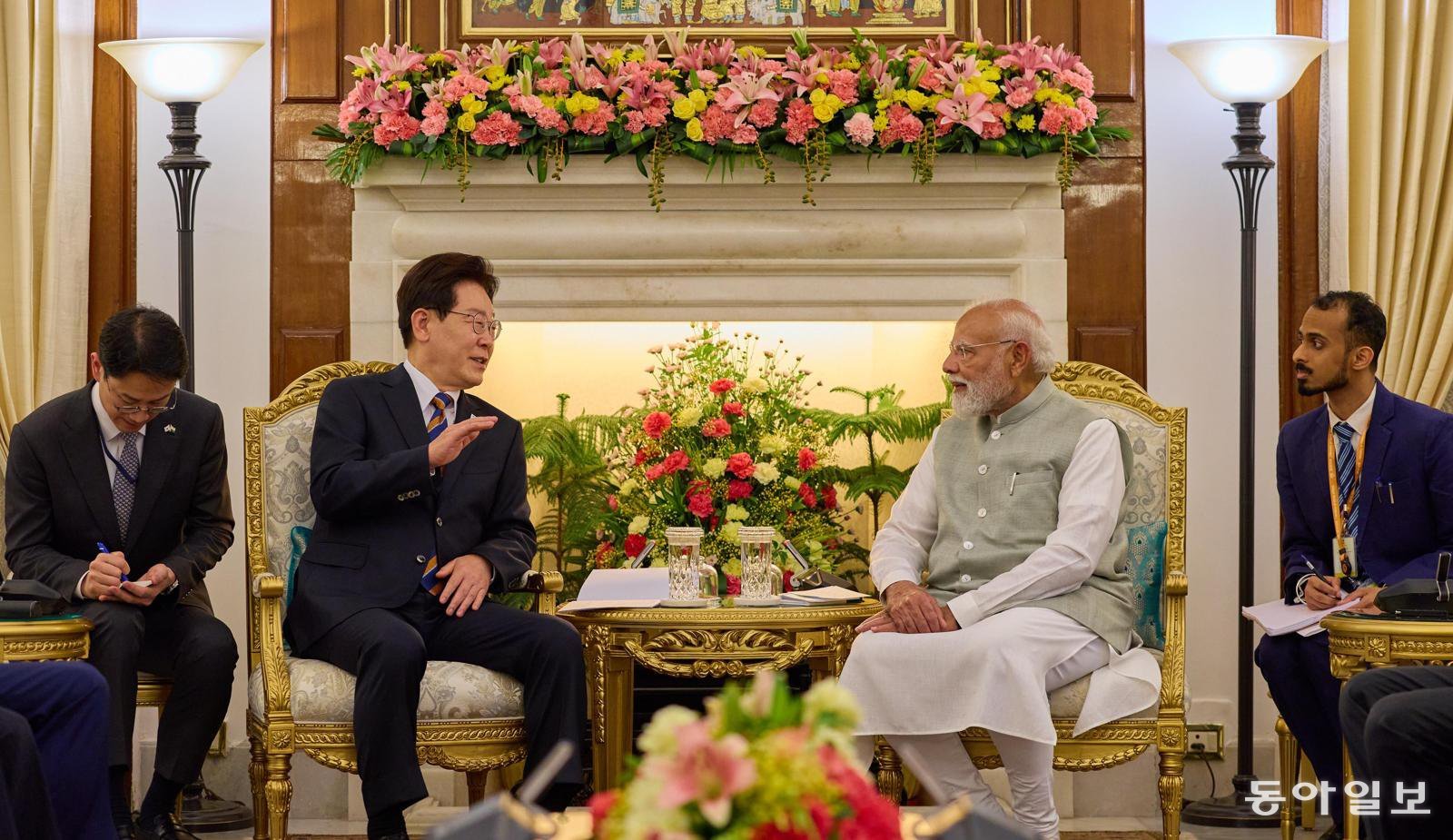
President Lee Jae-myung (second from left), who is on a state visit to India, holds a summit meeting with Prime Minister Narendra Modi at Hyderabad House in New Delhi, India, on the 20th (local time). After the summit, the two leaders adopted a joint statement titled “Joint Strategic Vision for the Special Strategic Partnership between the Republic of Korea and the Republic of India” and announced that they “welcomed the decision to accelerate negotiations to improve the Comprehensive Economic Partnership Agreement (CEPA) and to conclude them at an early date in order to promote mutually beneficial exchanges in new trade areas such as digital trade, supply chain cooperation, and the green economy.” New Delhi = Reporter Kim Jae-myeong base@donga.com
“The two countries are now entering a new decade of their ‘Special Strategic Partnership’.” (President Lee Jae-myung)
“With President Lee’s visit to India, the relationship between our two countries, which has been a trusted partnership, has transformed into a future-oriented relationship.” (Indian Prime Minister Narendra Modi)
President Lee and Prime Minister Modi held a summit meeting on the 20th (local time) and agreed to expand bilateral economic cooperation from automobiles and home appliances to strategic industries such as shipbuilding and marine, finance, artificial intelligence (AI), and defense and defense industry. Amid growing uncertainty over trade, supply chains, and security due to tariff shocks originating from the United States and war in the Middle East, the two sides agreed to strengthen cooperation with India, which has the world’s largest population and is regarded as a leader of the “Global South” (emerging countries in the Southern Hemisphere and beyond).
● “Korea-India to strengthen cooperation on stable naphtha supply” At a joint press announcement at Hyderabad House, the state guesthouse in New Delhi, President Lee stressed that “the two sides agreed to expand cooperation in strategic industrial sectors including shipbuilding, finance, artificial intelligence (AI), and defense and defense industry, and to further deepen cultural and people-to-people exchanges.”
Prime Minister Modi responded, “Our two countries share perspectives and a vision for the Indo-Pacific,” adding, “From talent exchanges and cooperation in shipbuilding to collaboration related to environment and energy, we will expand cooperation opportunities across a range of sectors.”
President Lee and Prime Minister Modi presented a goal of doubling the current bilateral trade volume of USD 25 billion (approximately KRW 37 trillion) to USD 50 billion (approximately KRW 74 trillion) by 2030. To this end, the two countries signed 15 memorandums of understanding (MOUs), including the establishment of an Industrial Cooperation Committee, an industrial ministers’ consultative body aimed at identifying joint projects in areas such as shipbuilding, nuclear power plants, critical minerals, and clean energy.
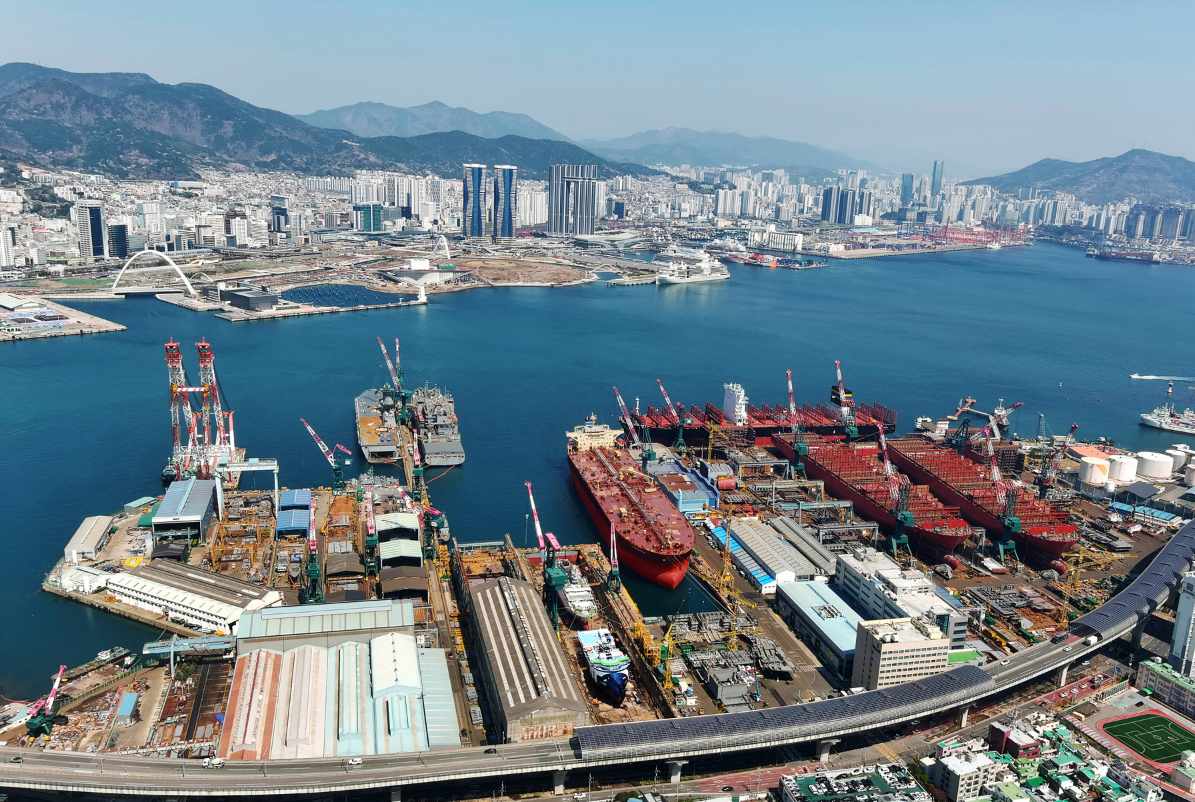
In the shipbuilding sector, they also agreed to discuss ways for Korean shipbuilding companies to enter the Indian shipbuilding market through support from the Indian government for the construction of shipbuilding facilities. MOUs were also signed on “port cooperation” for port infrastructure development, “financial hub activation” to lay the foundation for entry into India’s rapidly growing financial market, now the world’s third largest, and “steel cooperation” to support the expansion of Korean steel companies such as POSCO into India.
An MOU was signed as well on a joint declaration to resume negotiations to improve the bilateral Comprehensive Economic Partnership Agreement (CEPA), which entered into force in 2010. Targeting conclusion in the first half of 2027, the two sides agreed to hold the 12th round of improvement negotiations in May and to make the talks a regular process. They also agreed to strengthen cultural and people-to-people exchanges, including the creation of the “Mumbai Korea Center,” a permanent performance venue for K-pop.
Four joint statements, including the “Joint Statement on Energy and Resources Security,” encompassed supply chain cooperation to address the energy supply crisis stemming from the Middle East and collaboration in shipbuilding and defense industry. India, one of Korea’s top five naphtha suppliers, agreed to maintain a stable supply of naphtha to Korea. In addition, in connection with India’s plan to soon place orders for 400 vessels worth a total of USD 25 billion, the two countries agreed to support cooperation between their shipbuilding industries and to strengthen collaboration in areas such as the construction of shipyards and the modernization of existing shipyards in India.
Presidential Policy Office Chief Kim Yong-beom said at a briefing, “Prime Minister Modi stated that ‘the Indian Prime Minister’s Office will serve as a control tower and establish a dedicated Korea desk,’ and proposed that ‘the Korean Presidential Office also create a task force dedicated to economic cooperation with India.’”
● Lee: “One must not abandon a voyage for fear of waves” This summit marked the third meeting between President Lee and Prime Minister Modi. They previously met twice at the Group of Seven (G7) summit in June last year and at the Group of Twenty (G20) summit in November last year. President Lee, who once worked as a teenage factory laborer, expressed a sense of affinity with Prime Minister Modi, who started out as a “Chaiwala” (Indian-style tea seller), saying they “share a common life trajectory.” President Lee also said he had invited Prime Minister Modi to visit Korea and added, “Prime Minister Modi has promised to visit Korea by next year at the latest.”
At a business forum on the same day, President Lee introduced the legend of Queen Heo Hwang-ok, which symbolizes the ancient history of exchanges between the two countries. He said, “When Queen Heo Hwang-ok’s ship encountered rough seas, the Pasa Stone Pagoda calmed the waves and opened a path,” and added, “If the voyage had been abandoned out of fear of the waves, the bond between us could never have begun.” He went on to stress, “I look forward to building many more Pasa Stone Pagodas in the future.”
ⓒ dongA.com. All rights reserved. Reproduction, redistribution, or use for AI training prohibited.
Popular News