Chazm brings transparency to the opaque car lease and rental market
An unreliable lease-rent quote market… same car and terms, yet different monthly payments
Real-time price comparison to find the optimal combination, scaling up to minimize distribution fees
“As car prices rise, financial products become essential… aiming to be an infrastructure company for the era of driving by subscription”
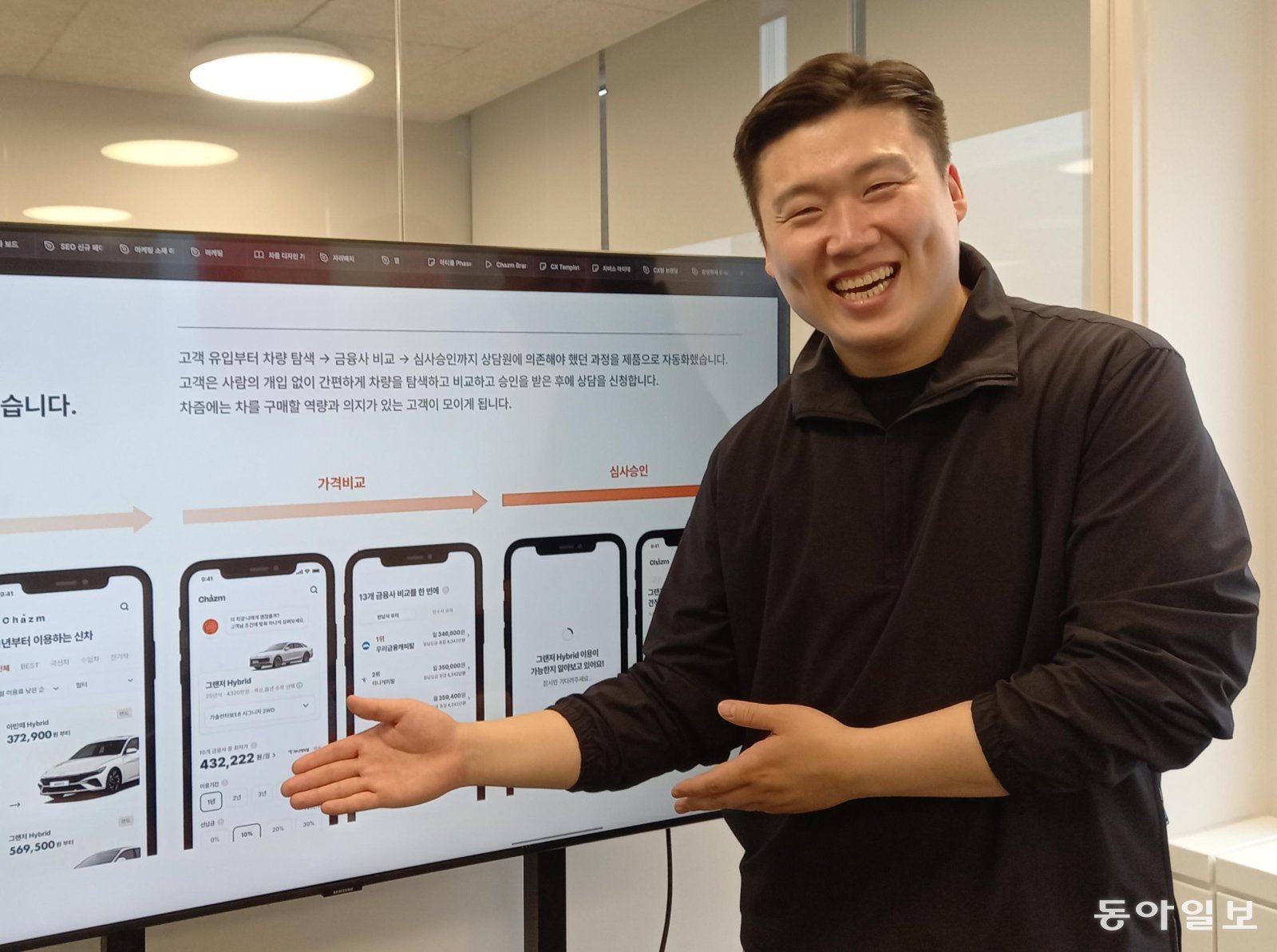
On April 10, CEO Jung Sang-yeon of Design & Practice introduces the “Chazm” app service at the company’s office in Gangnam District, Seoul. Jung said, “Unlike existing practices, customers do not need to wait for a consultant’s call; they can immediately check lease and rental prices themselves.” Photo by reporter Heo Jin-seok, jameshur@donga.com
There is a type of post frequently seen on automobile community sites: “Seniors, is this long-term rental quote reasonable?” The writer is asking experienced users whether the monthly payment amount is appropriate. Because monthly payments often differ even for the same car under the same conditions, consumers worry they might be overpaying. CEO Jung Sang-yeon (38) of Design & Practice launched his business thanks to such questions.
According to the Financial Statistics Information System of the Financial Supervisory Service, in 2024 the domestic auto lease market size is KRW 23 trillion, and the rental market comprises more than 1.3 million vehicles (about KRW 40 trillion), totaling roughly KRW 50 trillion. Yet this market operates with practices that the general public does not fully understand. When a customer looking at cars at a dealership wants a lease or rental, a salesperson without the required license passes the customer’s information to a broker. The broker then reassigns the case to a contracted consultant. Fees are added at each step. There are no regulations on fee ceilings, floors, or disclosure.
Jung said, “By industry convention, referral fees for sales staff are added into the commission, and brokers determine the commission rate as they assess the customer through consultations.” While preparing to start the business, Jung collected and analyzed quotes for 138 vehicle models. He found that even for the same car and identical usage conditions, the monthly payment could be KRW 517,000 in one case and KRW 626,000 in another, depending on the commission rate set by the broker.
The opacity of screening processes also confuses users. Even in an era when mortgage loans can be processed on mobile devices, screening for auto leases and rentals still largely depends on human underwriters at financial institutions. As a result, outcomes can vary with the subjective judgment of the examiner. Depending on which examiner reviews the case, a customer may receive approval, conditional approval requiring a security deposit, or rejection. Jung sensed that if such unease and anxiety among customers could be eliminated, the market would expand further.
● Competing with transparent pricing and fully remote automated screening Typically, to get an auto lease or rental, a customer leaves their name and contact details and waits for a consultant’s call. Opening Design & Practice’s “Chazm” app, however, provides a different experience. The moment a user selects a vehicle of interest, real-time monthly payment quotes from 15 financial institutions are compared and displayed on the screen. Tags such as “Lowest price” and “High approval rate” are shown, and when the user adjusts the contract period, down payment, or annual mileage, the price changes instantly.
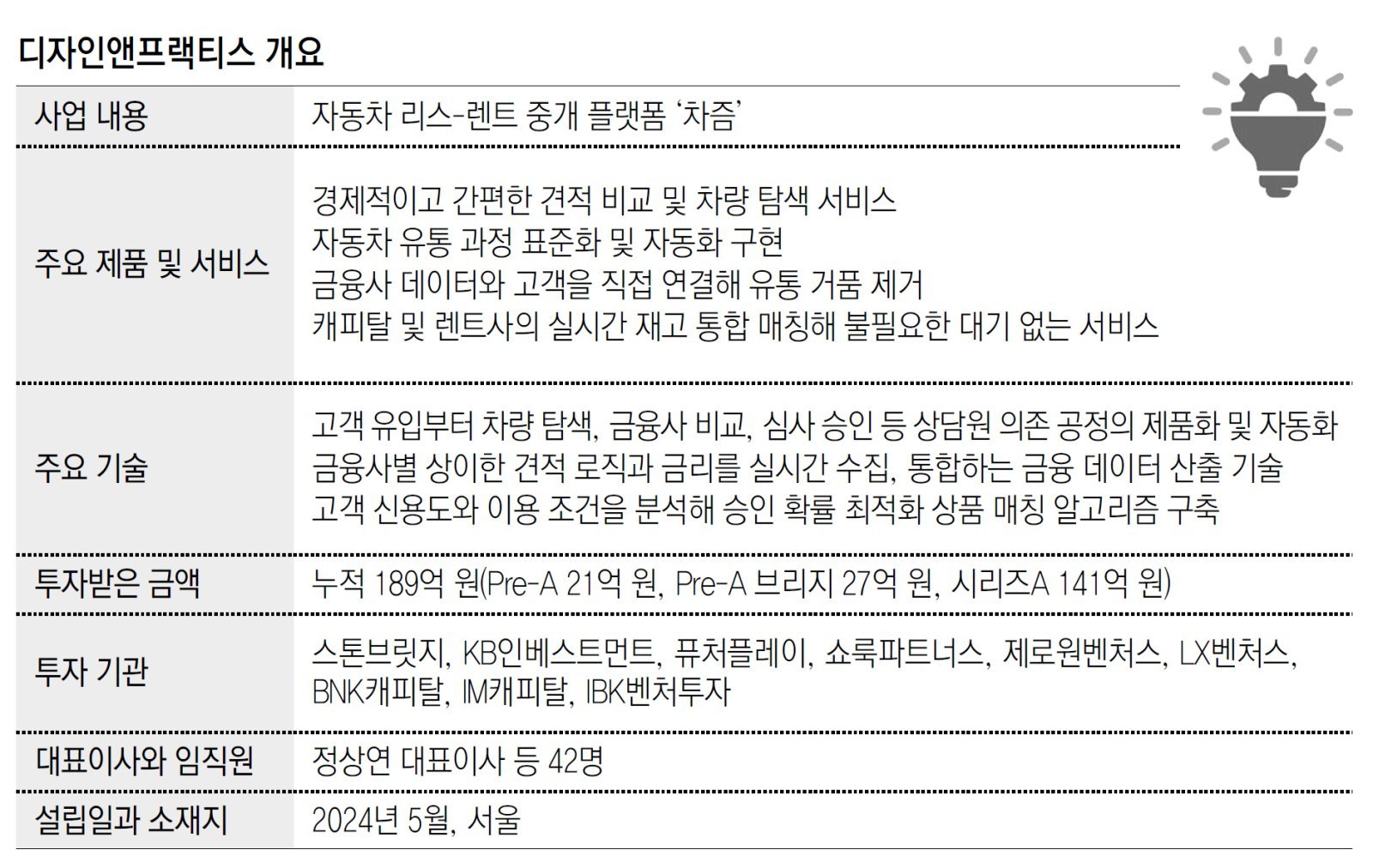
Chazm’s core competitiveness lies in the combination of three technologies. The first is a standardized price comparison engine. Each financial institution has its own criteria for residual value assessments and its own strong model lines. Capital Company A offers the most competitive quotes for the Grandeur, while Capital Company B is strongest for the Carnival. Chazm links this data in real time so that customers can find the optimal combination.
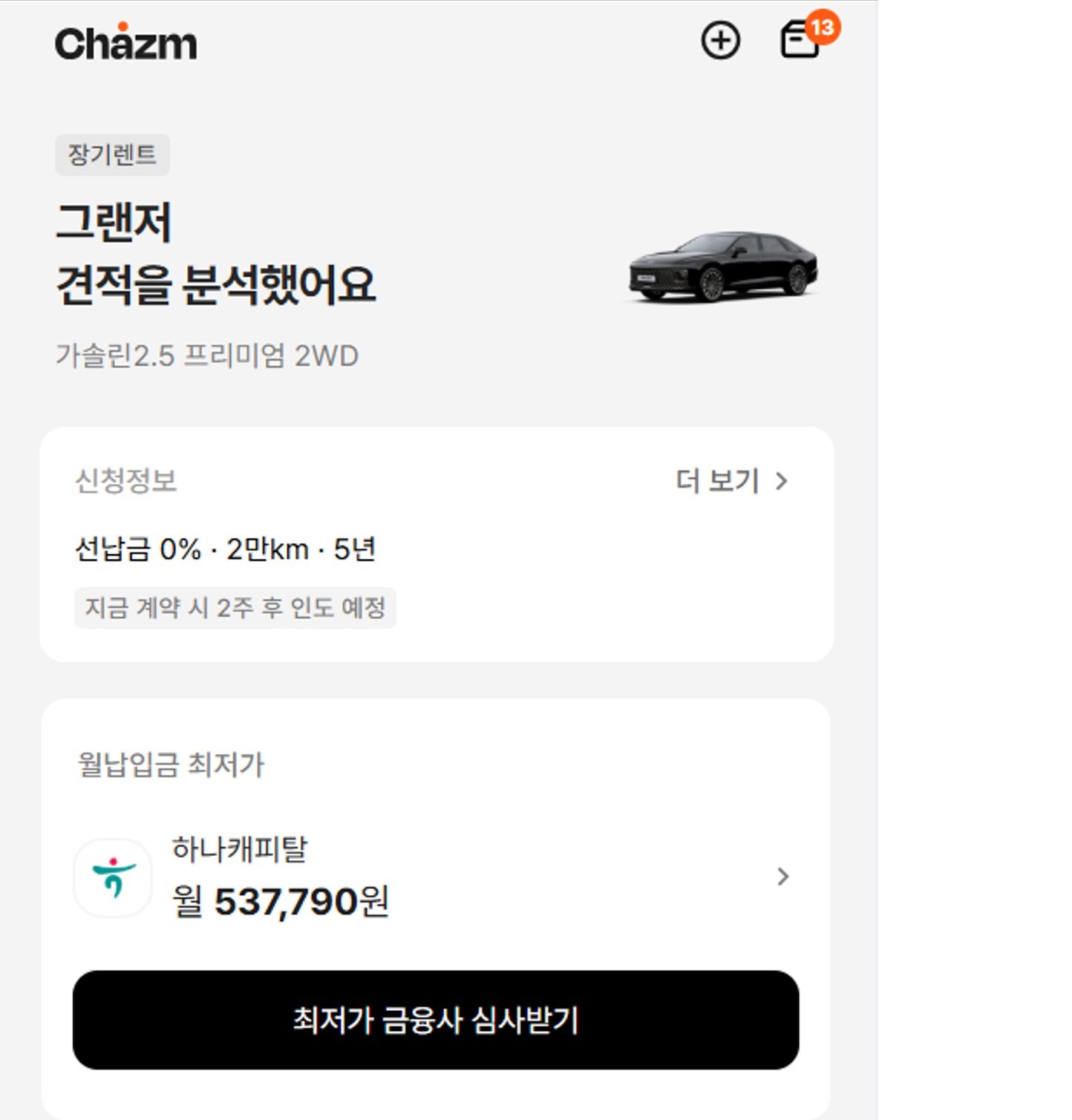
Example screen when selecting the Grandeur on the Chazm app. A button to proceed directly to screening is visible. Screenshot from the Chazm app
The second is a fully remote automated screening system. With a single “Apply for screening” button, the user can initiate non-face-to-face screening with linked financial institutions and easily check whether approval is likely.
The third is a specialized operations system. As a result, monthly sales per person are 40 times higher than those of sales staff in the existing industry. Jung said, “If someone has to sell only two or three cars a month to make a living, they need a profit of KRW 2 million per car. But if they can sell 500 cars, they only need to earn KRW 4,000 per car. We are essentially playing a game of minimizing distribution commissions in the value chain through an efficient and transparent system.” The strategy is to radically reduce per-vehicle distribution margins through productivity innovation, negotiate lower vehicle prices, and thereby expand the market in a virtuous cycle. Through this system alone, the company sold 1,058 vehicles last month.
● Ten years of preparation from entry-level banker to entrepreneur
Jung studied economics at Hanyang University and worked as a credit officer at Hana Bank. He was enthusiastic enough to achieve strong results in fund sales, but the desire to start a business was always there. Yet he did not want to fail. He worked hard to learn how the banking system generates stable profits and accumulated experience. At the bank, he led a project for unmanned branches, catching the attention of the vice president in charge of the Future Finance Strategy Division. At the vice president’s suggestion—“We will support you as an in-house venture, but first go learn at a fintech startup”—he was seconded in July 2020 for six months to Finda, a fintech company specializing in loan brokerage and management. There he planned, launched, and oversaw a lease and rental platform business. He returned to Hana Bank’s Future Finance Strategy Division in February 2021, but promptly submitted his resignation. His first child was born in June that year. Even so, his drive to launch a business did not fade.
On May 8, 2024, Parents’ Day in Korea, the division at Finda was spun off as an independent corporation. The team of six recorded revenue of KRW 2.03 million in its first month. Seven months later, monthly revenue surpassed KRW 100 million. By this point, earnings from brokering each vehicle already exceeded direct costs, generating a contribution margin (profit after subtracting variable costs that rise with sales volume) per unit. In the 14th month after launch, the company achieved operating profit, and in the 16th month it recorded monthly net profitability.
Jung said, “Fintech platforms are commonly thought of as money pits. I wanted to prove that a well-prepared team can generate profits even in the early stages.” Over a total of 19 months through last December, the company raised KRW 21 billion in Pre-A funding, KRW 27 billion in a Pre-A bridge round, and KRW 141 billion in a Series A round, securing a total investment of KRW 189 billion across three funding stages.
● “Becoming core infrastructure for automobile distribution”
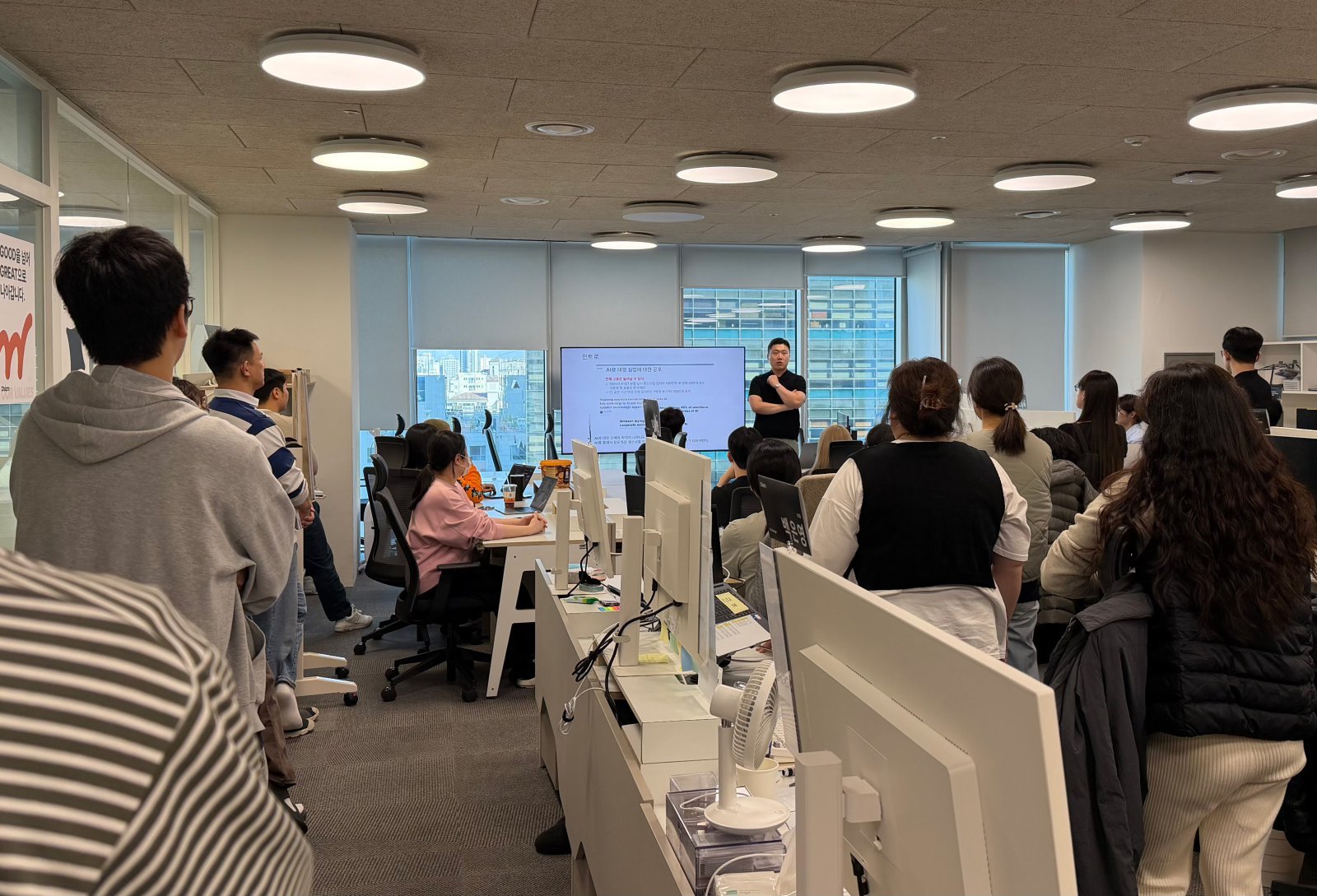
A meeting to improve the Chazm service. Photo provided by Design & Practice
Chazm’s current top priority is productivity. The goal for this year is for each consultant to reach 200 contracts per month, further strengthening price competitiveness. At the same time, the company is working to build bargaining power with financial institutions and automakers to regularly create lease and rental products that are cheaper than outright purchases. Jung said, “We are already on the verge of launching a lease and rental product for the Grandeur Hybrid Calligraphy trim that will be cheaper than installment financing.”
As a medium-term roadmap, the company is preparing to launch services for brokering returned used cars and for taking over existing lease and rental contracts. In 2027, it plans to develop storage facilities, internalize logistics functions, and establish a structure in which it directly handles delivery and after-sales service. The roadmap also includes a business exporting older used cars to Central Asia and Southeast Asia. The company envisions global expansion starting with Japan. Because Japan’s market environment is similar to Korea’s, it expects to be able to enter with a comparable business model relatively easily.
Chazm is confident that as transaction volumes grow, it will be able to lower both vehicle procurement costs and funding rates, enabling the business to operate on minimal commissions.
Design & Practice anticipates that, just as many people now use pricey smartphones by paying monthly installments, a new era is opening in which more people will use cars by paying monthly fees. Jung said, “As vehicles shift to electric, their prices are rising sharply, so the development of financial products is inevitable,” adding, “We aim to become an infrastructure company for the era of driving cars on a rental basis.”
ⓒ dongA.com. All rights reserved. Reproduction, redistribution, or use for AI training prohibited.
Popular News