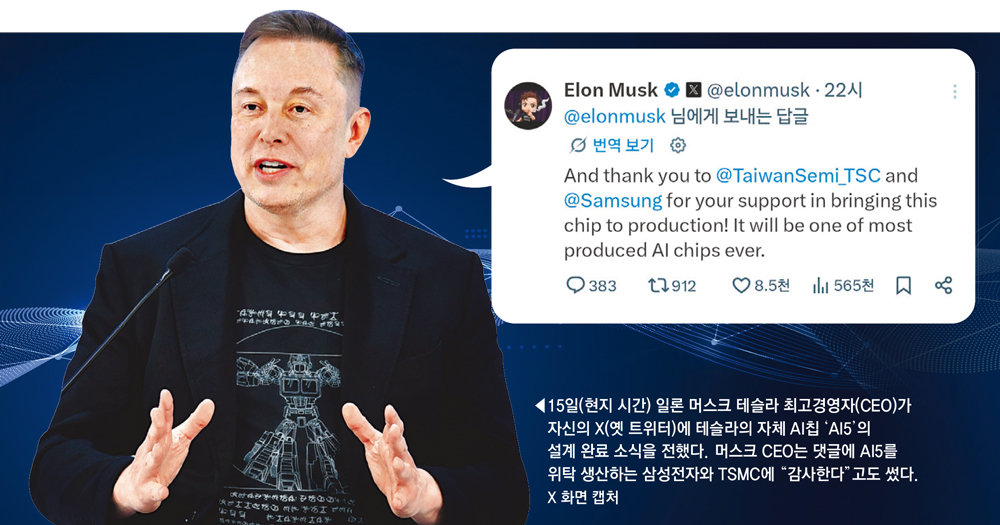
“I would like to thank Samsung Electronics for helping make it possible to mass-produce this chip.”
On the 15th (local time), Elon Musk, CEO of Tesla, stated that Tesla has completed the design of its in-house developed artificial intelligence (AI) chip “AI5,” and mentioned Samsung Electronics in the process. AI5 will be produced jointly by Samsung Electronics’ foundry and Taiwan’s TSMC, the world’s largest foundry (semiconductor contract manufacturer). Samsung Electronics’ foundry is also scheduled to exclusively produce AI5’s successor, AI6.
In March, Jensen Huang, CEO of Nvidia, also said that Samsung would take on production of a new inference chip and expressed his “thanks to Samsung.” As the status of Korean semiconductors in the AI ecosystem rises, big tech companies are successively seeking cooperation.
● “Completed in-house AI chip design… thanks to Samsung” On the day, CEO Musk posted on his X (formerly Twitter) account, saying, “Congratulations to Tesla’s AI chip design team on the tape-out of AI5.” Tape-out refers to the stage where semiconductor design is completed and the design layout is handed over to the foundry for full-scale contract manufacturing. It can be seen as the first step toward mass production. The AI5 chip is expected to be widely used in Tesla’s Full Self-Driving (FSD) system, as the brain of its humanoid robot “Optimus,” and in xAI’s data centers.
Once mass production of AI5 begins as early as the second half of this year (July–December), Samsung Electronics’ presence in the foundry market is expected to grow further. Samsung Electronics’ foundry business had already raised expectations of emerging from its long-running deficit by winning orders to produce the inference semiconductor “Groq3 Language Processing Unit (LPU),” which will be mounted on Nvidia’s latest AI accelerator “Vera Rubin.”
Samsung Electronics is reportedly moving forward with staffing and equipment installation targeting year-end operation of its Taylor fab (plant) in Texas, USA, which will be dedicated to AI6 production. Until now, TSMC had effectively monopolized production of Tesla’s AI chips, but Samsung Electronics’ foundry has been winning orders in succession, creating cracks in TSMC’s dominant position.
● Successive big tech partnerships… Korean semiconductors gain value
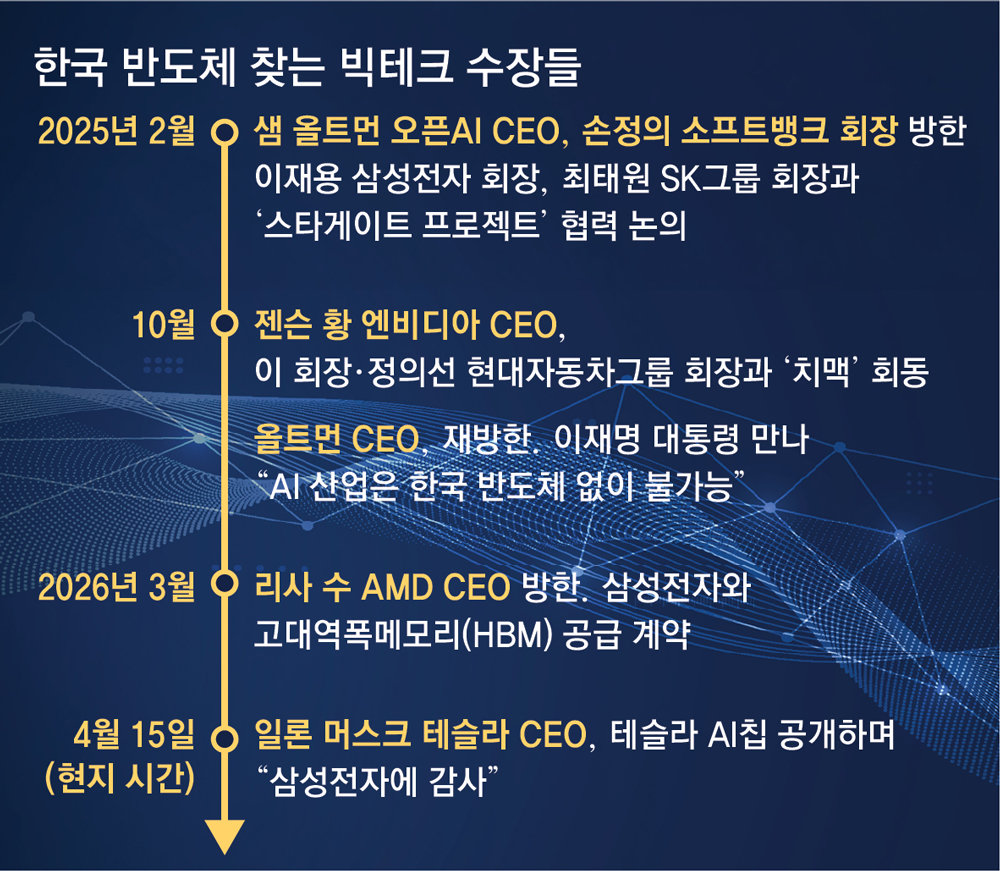
Musk’s separate mention of Samsung alongside TSMC is interpreted as a sign that the standing of Korean semiconductors in the AI ecosystem is rising. As memory shortages intensify and each big tech company embarks on designing its own customized chips, collaboration with foundries has become indispensable. When OpenAI CEO Sam Altman visited Korea in October last year and met President Lee Jae-myung, he remarked that “the spread of AI is impossible without Korean semiconductors.”
Altman visited Korea twice last year, in February and October, to discuss the hyperscale AI infrastructure project “Stargate” with Samsung Electronics Chairman Lee Jae-yong and SK Group Chairman Chey Tae-won. Korean memory chips are essential to the project’s success. Masayoshi Son, chairman of Japan’s SoftBank, also visited Korea in relation to this in February and December last year.
Nvidia CEO Huang met with Chairman Lee and Hyundai Motor Group Chairman Chung Euisun in what became known as the “chicken restaurant meeting” in October last year, and in March this year, Lisa Su, CEO of Nvidia’s rival AMD, also visited Korea to secure supplies of high-bandwidth memory (HBM).
With cooperation with big tech accelerating, the performance of the Korean semiconductor industry is also expected to improve significantly this year. According to securities firms’ consensus (average of earnings forecasts), Samsung Electronics’ operating profit for the year is projected to reach KRW 300 trillion, and SK hynix’s operating profit is projected to reach KRW 200 trillion. Ahn Ki-hyun, executive director of the Korea Semiconductor Industry Association, said, “The number of companies designing AI chips is increasing rapidly, but the structure makes it difficult for additional manufacturers to emerge,” adding, “The value of Korean semiconductor companies with manufacturing capabilities will rise further.”
ⓒ dongA.com. All rights reserved. Reproduction, redistribution, or use for AI training prohibited.
Popular News