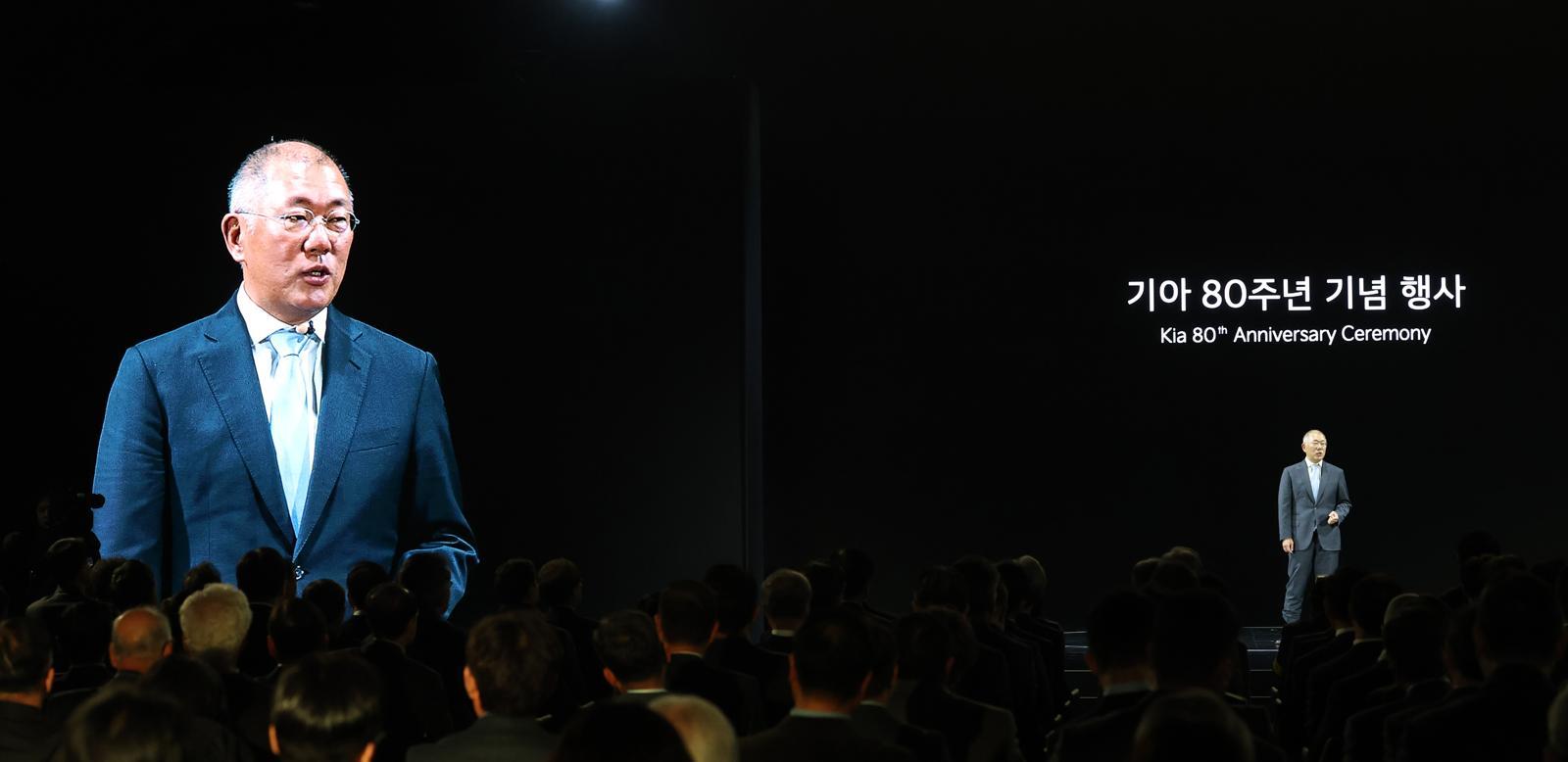
Hyundai Motor Group Executive Chair Chung Euisun delivers remarks at the “Kia 80th Anniversary Ceremony” held at Kia Vision Square in Cheoin-gu, Yongin-si, Gyeonggi-do, on the 5th. 2025.12.5 ⓒ News1
Hyundai Motor Group Executive Chair Chung Euisun expressed his ambition to drive the group’s growth with a focus on robotics, physical artificial intelligence (AI), and hydrogen. He reiterated the plan to invest USD 26 billion in the United States by 2028, underscoring the importance of the US market.
In an interview with US online media outlet Semafor on the 12th (local time), Chung stated, “Robotics and physical AI are core elements in the evolution of Hyundai Motor Group beyond mobility,” adding, “We aim to realize this vision through robots that collaborate with humans.” In particular, Chung emphasized that the group will deploy Boston Dynamics’ humanoid robot “Atlas” in its production processes by 2028. He said, “We will produce up to 30,000 Atlas units per year by 2030, and robotics and AI will play a crucial role in achieving top-tier quality.”
He also pledged to expand investment in the United States. Chung said, “For Hyundai Motor Group, the United States is a key foundation for long-term resilience and sustainable growth,” and added, “We will invest a total of USD 26 billion (KRW 38 trillion) by 2028 to strengthen our base for long-term growth.”
Since its initial entry into the United States more than 40 years ago, Hyundai Motor Group has invested USD 20.5 billion (KRW 30.5 trillion) to date. Most recently, it built HMGMA (Hyundai Motor Group Metaplant America), a next-generation smart plant, in the state of Georgia.
Hyundai Motor Group is also reinforcing its “hydrogen value chain” as a solution to future clean energy demand. Chung said, “As energy demand surges due to the expansion of AI infrastructure and data centers, hydrogen can become an important alternative,” adding, “Hydrogen is not a competing technology to electric vehicles but a complementary one, and providing customers with a variety of options is a source of competitiveness in the era of energy transition.”
Finally, Chung expressed his intention to pursue both “global expansion” and “localization” in response to geopolitical uncertainty. He said, “Customers, regulations, and supply chains are becoming fragmented by region. We will build a competitive edge by combining global expansion with localized agility.”
ⓒ dongA.com. All rights reserved. Reproduction, redistribution, or use for AI training prohibited.
Popular News