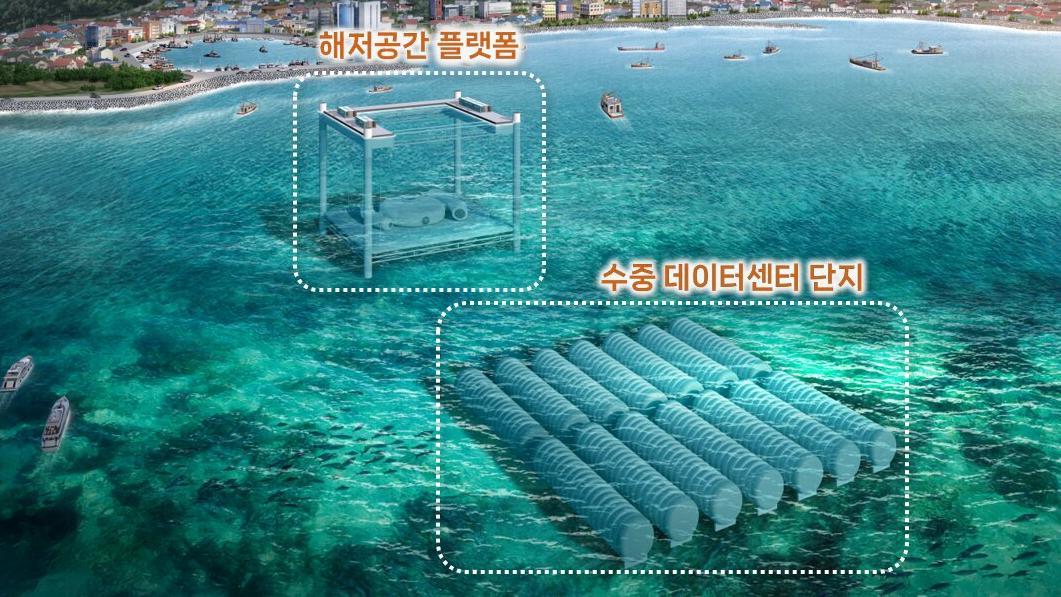
Bird’s-eye view of the “carbon-zero underwater data center” to be built at a water depth of 20 meters off the coast of Ulsan. Utilizing seawater-based cooling to enhance power efficiency, it is a next-generation data infrastructure expected to serve as a foundation for Ulsan’s AI industry. Provided by the Korea Institute of Ocean Science and Technology
Development of an underwater data center that can overcome the limitations of artificial intelligence (AI) data centers, whose power consumption is rapidly increasing, will be fully launched off the coast of Ulsan. Ulsan City plans to use this project as an opportunity to build next-generation data infrastructure and emerge as a “sustainable AI capital.”
Ulsan City announced on the 9th that it has been selected as the site for the Ministry of Oceans and Fisheries’ “Carbon-Zero Underwater Data Center Standard Model Development Project” and will invest a total of KRW 51.1 billion in the project over the next five years, including KRW 40.0 billion in national funding. The project, to be jointly carried out with the Korea Institute of Ocean Science and Technology (KIOST), aims to simultaneously address the surging data processing demand and power consumption arising from the expansion of AI and big data industries.
The core of the project is a “seawater cooling” method that uses seawater with an average annual temperature of 13.3 degrees Celsius off the coast of Ulsan. Conventional land-based data centers consume large amounts of power for cooling and face difficulties in securing large sites. In contrast, underwater data centers can leverage seawater for natural cooling, significantly improving energy efficiency. Ulsan City plans to combine pressure-resistant vessel design technology with hybrid cooling technology to verify performance at a power usage effectiveness (PUE) level of 1.2 at a depth of 20 meters.
The city also plans to develop servers and substation/distribution facilities as modular standards to secure scalability and cost-effectiveness when large-scale data center complexes are built in the future. The standardized structure is expected to enhance installation and operational efficiency and help reduce maintenance and management costs.
The project will be implemented in stages. Starting this year, Ulsan City will carry out site analysis and basic design, followed by ground surveys and upgrades to cooling performance. By 2030, it aims to complete the construction and demonstration of a performance test site, and from 2031, it plans to begin building underwater data center complexes for commercialization.
The project is being promoted based on a public-private-academic-research collaboration framework. Prior to its selection through the public competition, Ulsan City established a cooperative system and formulated R&D strategies with 12 institutions and companies, including the Korea Institute of Ocean Science and Technology (KIOST), Ulsan National Institute of Science and Technology (UNIST), POSCO, GS Engineering & Construction, Korea Hydro & Nuclear Power, LS ELECTRIC, and SK Telecom. With a broad range of industry players participating, the initiative is being evaluated as having laid a foundation that can extend beyond data center construction to the wider AI industry.
Ulsan City plans to use this project not merely for technology development but as core infrastructure for future industrial transformation. Its strategy is to secure data processing and storage capabilities centered on the underwater data center and, based on this, to build a structure that leads to attracting AI, big data, and cloud industries. In particular, constructing data centers with both energy efficiency and locational competitiveness is expected to be an important foundation for attracting global companies in the future.
A city official said, “Underwater data centers are core infrastructure for the AI industry,” adding, “Through this, we will expand the marine digital industry and elevate Ulsan into a sustainable AI-centered city.”
ⓒ dongA.com. All rights reserved. Reproduction, redistribution, or use for AI training prohibited.
Popular News