After news of a two-week ceasefire agreement between the United States and Iran broke, the KOSPI, which had risen sharply, is again aiming to reclaim the 6,000 mark. The index appears to have been driven higher by relief over the ceasefire combined with expectations of a further rally following Samsung Electronics’ “earnings surprise” the previous day.
Foreign investors, who had been selling KOSPI shares, turned to net buying in the trillion-won range for the first time in about a month, pushing the KRW-USD exchange rate below KRW 1,500 for the first time in 10 trading days. However, with uncertainty persisting until the war is fully concluded, a highly volatile market is expected to continue for the time being.
● Recovery of “KRW 210,000 Samsung” and “KRW 1 million Hynix” On the 8th, the KOSPI closed at 5,872.34, surpassing the 5,800 level on a closing basis for the first time in 18 days. The KOSDAQ also rose 5.12%, approaching the 1,100 level. Immediately after the opening, stock prices surged, triggering buy-side sidecar mechanisms on both the KOSPI and KOSDAQ. At one point during the session, the KOSPI jumped to 5,919.60, breaking through the 5,900 level. The KOSPI is now again within reach of the 6,000 mark.
The relief rally was led by the information technology (IT) sector. Despite Samsung Electronics’ record-high earnings the previous day, the market had been weighed down by geopolitical tensions, but it climbed sharply on relief over the ceasefire. Samsung Electronics, which had risen only 1.76% the previous day, closed up 7.12% at KRW 210,500, regaining the “KRW 210,000 Samsung” level. SK hynix (+12.77%), Samsung Electronics preferred shares (+6.65%), and SK Square (+15.83%) also rebounded. SK hynix returned to the KRW 1 million range for the first time in 12 trading days since 20 March. Han Ji-young, a researcher at Kiwoom Securities, analyzed, “Although uncertainty related to the reopening of the Strait of Hormuz remains, the KOSPI rose sharply on the back of the earnings surprise effect from Samsung Electronics announced the previous day.”
Investor sentiment recovered as the United States and Iran avoided the worst-case scenario by agreeing to a two-week ceasefire just 88 minutes before the negotiation deadline expired. Expectations that energy supplies will improve as the Strait of Hormuz reopens were reflected in the market. International oil prices plunged after the agreement was reported, and government bond yields fell across the board. The U.S. Dollar Index (the value of the dollar against six major currencies) also declined by about 1% from the previous trading day, indicating dollar weakness.
● Foreign investors return, exchange rate falls to the KRW 1,470 range Additional net buying by foreign investors in the Korean stock market helped push the KRW-USD exchange rate down by KRW 33.6 to close at KRW 1,470.6 in the Seoul foreign exchange market. On a weekly closing basis (market closes at 3:30 p.m.), this was the lowest level in about a month since 11 March (KRW 1,466.5). It was the first time in 10 trading days since 25 March that the exchange rate fell below KRW 1,500.
On the 8th, foreign investors recorded net purchases of approximately KRW 1.9089 trillion on the KOSPI, the largest amount since 12 February (net purchases of KRW 2.9954 trillion). Foreign investors also posted net purchases of around KRW 240 billion on the KOSDAQ.
However, the market generally expects the weakness of the won to continue. Lee Min-hyuk, an economist at KB Kookmin Bank, forecast, “Even if the United States and Iran agree to end the war, the policy uncertainty during the presidency of Donald Trump will keep the KRW-USD exchange rate at a high level going forward.”
● “A ceasefire is not the end of the war; beware of excessive optimism”
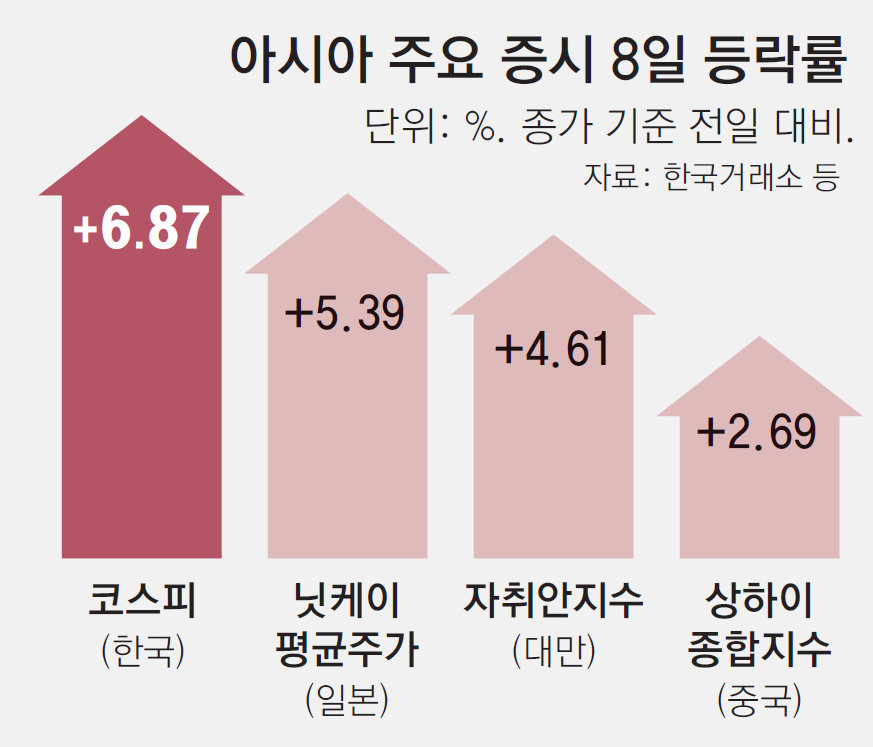
Major Asian stock markets also turned to a collective strong trend. Japan’s Nikkei Stock Average rose 5.39%, and Taiwan’s Taiex gained 4.61%. Korea, Japan, and Taiwan have high dependence on Middle Eastern energy and were significantly affected by the closure of the Strait of Hormuz and the rise in international oil prices. Share prices of companies in the Asian artificial intelligence (AI) value chain rebounded, including Japan’s SoftBank (+7.21%) and Taiwan’s TSMC (+4.84%). The Chinese and Hong Kong markets also closed up 2–4%.
Some experts, however, warn against excessive optimism. Kim Seok-hwan, a researcher at Mirae Asset Securities, said, “This ceasefire should be viewed coolly as it does not mean the end of the conflict,” adding, “Variables such as whether the Strait of Hormuz is effectively reopened, disputes over transit fees, and the possibility of unilateral action by Israel need to be examined.”
ⓒ dongA.com. All rights reserved. Reproduction, redistribution, or use for AI training prohibited.
Popular News