Samsung Electronics posts KRW 5.7 trillion in Q1 operating profit
‘AI effect’ drives up DRAM prices and fuels rapid HBM growth
Likely to rank 3rd–4th in operating profit among global big tech
Memory boom expected to continue: “KRW 400 trillion possible next year”
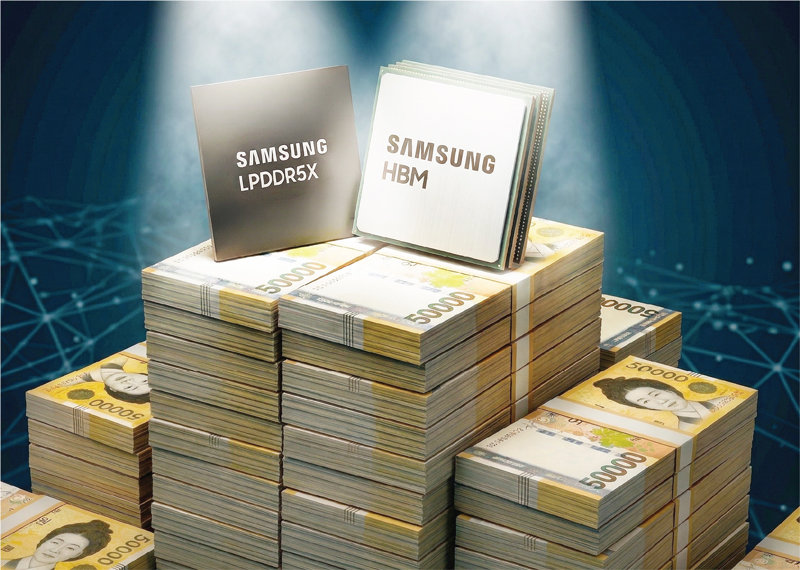
Samsung Electronics posted the largest quarterly earnings in its history in the first quarter (January–March), breaking its own records for the highest revenue and operating profit ever achieved by a Korean company. Despite external turbulence such as the war in the Middle East and tariff measures originating from the United States, the company is seen as having restored its technological competitiveness in line with the AI-driven “semiconductor ultra-super cycle.”
As the shortage in memory supply is prolonged, some analysts project that Samsung Electronics’ annual operating profit could reach KRW 300 trillion this year and KRW 400 trillion next year. Expectations are also growing that Samsung Electronics will deliver top-tier earnings even among global big tech companies going forward.
● Soaring semiconductors, annual operating profit estimated at KRW 300 trillion
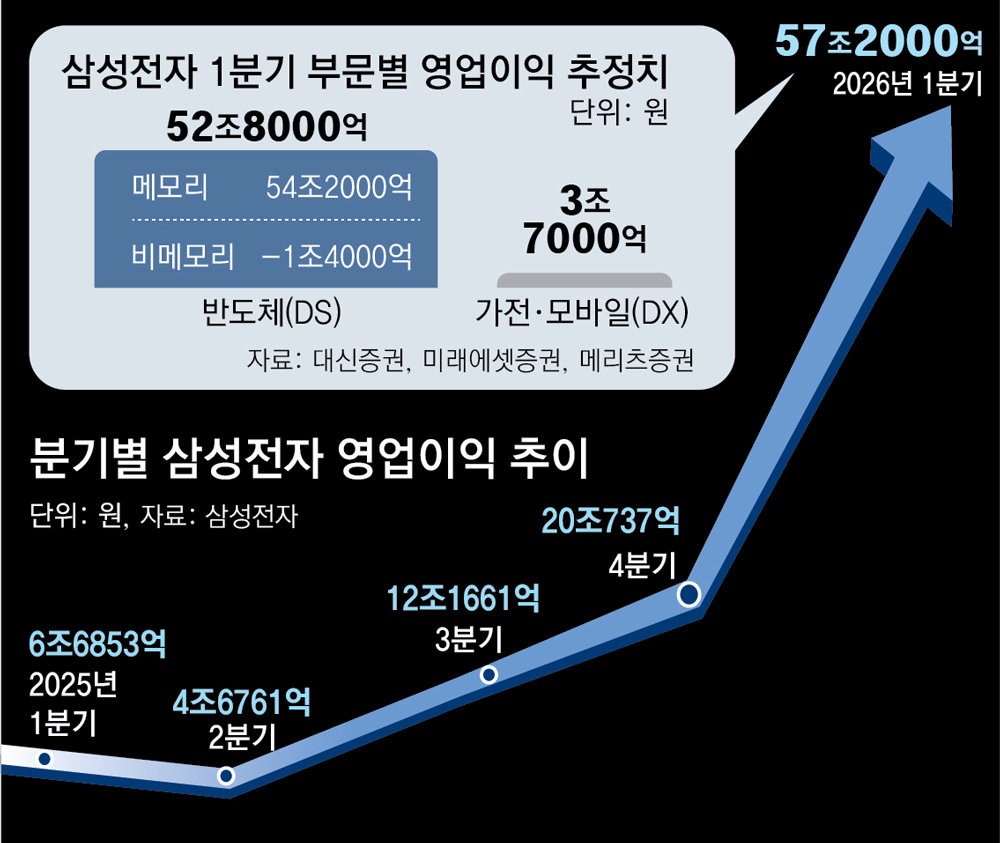
On 7 April, Samsung Electronics’ first-quarter operating profit came in at KRW 57.2 trillion, far exceeding market expectations. The consensus of securities firms (average of brokerage estimates over the past three months) was KRW 40.1923 trillion. Even the highest forecast, from Meritz Securities at KRW 53.9 trillion, fell short of the actual operating profit. Samsung Electronics’ first-quarter operating margin was 43%, and some projections suggest that the margin for the semiconductor (DS) division alone may have reached 60–70%.
Although the figures announced that day by Samsung Electronics were preliminary and results by business segment were not disclosed, there is no disagreement that semiconductors were clearly the main driver of this record-breaking performance. The securities industry estimates that the DS division alone generated operating profit in the KRW 52–53 trillion range. The DX Division, which handles mobile, home appliances, and TVs, is projected to have recorded approximately KRW 3.7 trillion in operating profit.
Behind this earnings surprise lie a surge in sales of high bandwidth memory (HBM) driven by growth in the AI market and the sharp increase in prices of standard DRAM. In February this year, Samsung Electronics became the first in the world to begin mass production of sixth-generation HBM4, securing leadership in the next-generation market.
In particular, prices of general-purpose DRAM memory semiconductors have been rising for 11 consecutive months, and a shortage of NAND flash has also emerged. The market estimates that DRAM alone generated about KRW 41 trillion in operating profit. KB Securities stated, “Memory prices in the first quarter exceeded expectations and are expected to strengthen further toward the second half of the year,” adding, “Operating profit is likely to enter a full-fledged acceleration phase starting from the first quarter.”
As Samsung Electronics’ earnings momentum steepens, there are projections that operating profit will surpass KRW 300 trillion this year and KRW 400 trillion next year. This is because big tech companies are going all out to secure memory, even by paying a premium, thereby creating a market structure that favors memory suppliers such as Samsung Electronics and SK hynix. Market research firm DRAMeXchange previously analyzed that “in long-term agreement (LTA) negotiations for 2027 as well, memory manufacturers may demand additional terms such as advance payments or higher price floors, backed by supply shortages.”
Accordingly, some forecast that Samsung Electronics’ annual operating profit will exceed KRW 400 trillion next year, allowing it to overtake Nvidia and become the world’s No. 1 company in operating profit. According to financial information provider MarketScreener, Nvidia’s operating profit forecast for next year is USD 318.257 billion (approximately KRW 478 trillion). KB Securities projects Samsung Electronics’ operating profit at KRW 327 trillion for this year and KRW 488 trillion for next year. Noh Geun-chang, an analyst at Hyundai Motor Securities, said, “The upward trend in prices of semiconductor products including memory is expected to continue through next year,” and projected, “Samsung Electronics can achieve operating profit of KRW 300 trillion this year and KRW 400 trillion next year.”
● Earnings on par with U.S. ‘Big Tech Top 3’ Samsung Electronics’ latest operating profit of more than KRW 57 trillion is also being assessed as being on the scale of global big tech companies. Even when compared with the fourth quarter (October–December), which is generally the peak season for big tech with high operating profits, Samsung’s operating profit translated into dollars (about USD 37.9 billion) exceeded that of Google. Among big tech firms, only Apple (USD 50.9 billion, approximately KRW 76.69 trillion), Nvidia (USD 44.3 billion, approximately KRW 66.77 trillion), and Microsoft (USD 38.3 billion, approximately KRW 57.68 trillion) posted higher operating profits in the previous fourth quarter than Samsung Electronics did in this first quarter, and Microsoft’s profit was almost the same as Samsung’s. Alphabet, Google’s parent company (USD 35.9 billion, approximately KRW 54.12 trillion), reported a lower figure than Samsung’s first-quarter operating profit.
Based on first-quarter consensus estimates for this year, Samsung Electronics’ operating profit is expected to rank third or fourth globally. According to MarketScreener, Alphabet’s operating profit consensus for January–March this year is USD 36 billion, while Microsoft’s stands at USD 36.2–38.3 billion. If Samsung Electronics’ annual operating profit actually exceeds KRW 400 trillion next year, some see a possibility that it could rise to No. 1 in the world.
Ahn Ki-hyun, executive director of the Korea Semiconductor Industry Association, said, “Both Samsung Electronics and SK hynix have already secured memory orders through next year,” and forecast, “Considering the upward trend in memory prices, the earnings upturn is likely to continue through next year.”
ⓒ dongA.com. All rights reserved. Reproduction, redistribution, or use for AI training prohibited.
Popular News