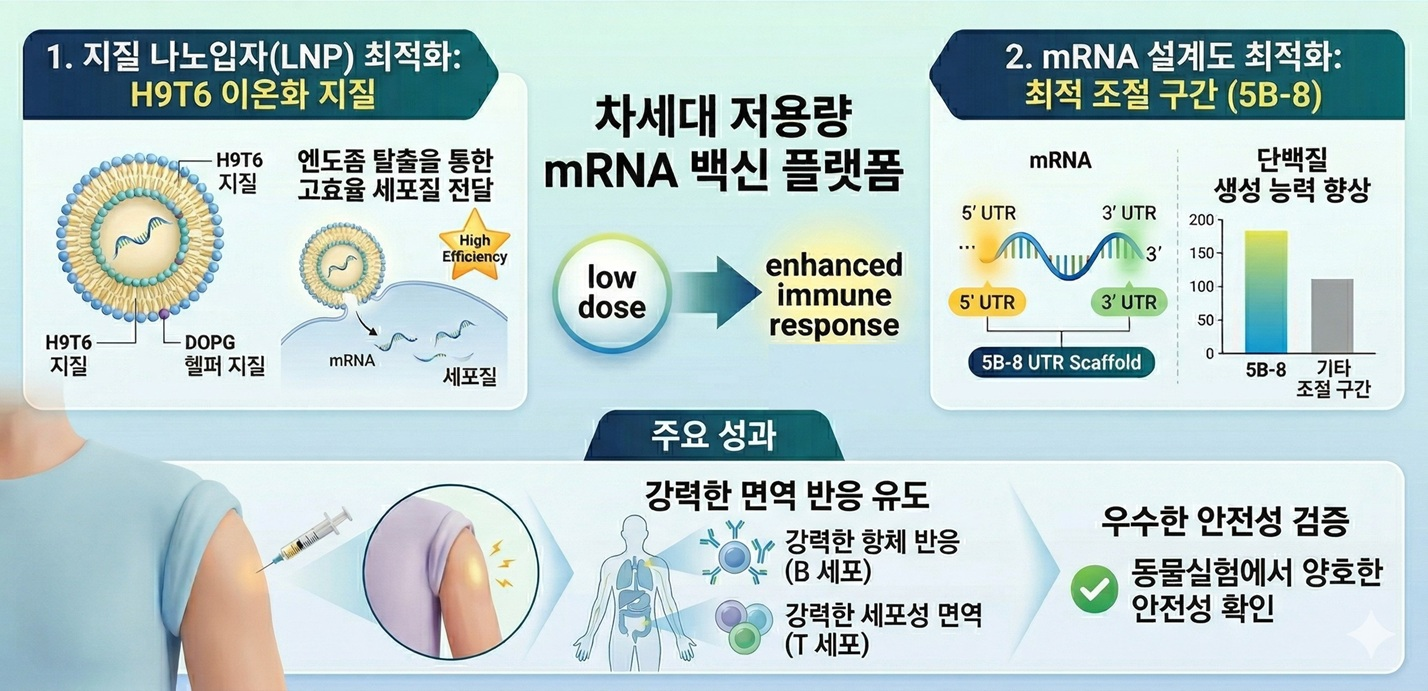
Schematic diagram of a next-generation low-dose mRNA vaccine platform. Provided by the Korea Research Institute of Bioscience and Biotechnology (KRIBB)
The Korea Research Institute of Bioscience and Biotechnology (KRIBB) announced on the 7th that it has developed a design method for a next-generation messenger ribonucleic acid (mRNA) vaccine platform capable of inducing a strong immune response with a small dose.
The research team led by Dr. Cha Hyun-Joo improved both lipid nanoparticles, which effectively deliver mRNA to cells in the body, and the genetic design structure that supports the function of mRNA. mRNA vaccines work by delivering a blueprint for protein production into human cells, enabling them to directly produce antigen proteins and thereby enhance immunity. However, because mRNA is easily degraded in the body and cannot readily pass through cell membranes on its own, nanoparticle technology that protects it and delivers it into cells is essential.
The team first developed a new nanoparticle that improves mRNA delivery efficiency. A comparison of 96 candidate substances confirmed that a substance named H9T6 exhibited higher intracellular mRNA delivery efficiency than existing materials.
The mRNA design structure was also enhanced. mRNA contains untranslated regions (UTRs) at the front and back that regulate the amount and duration of protein production. The research team analyzed hundreds of thousands of candidates to identify the most effective structure, thereby greatly improving protein production capacity. Applying this technology, the team confirmed that strong antibody and immune responses occurred simultaneously even with lower doses than before.
In safety tests (toxicological evaluation) assuming multiple administrations, the vaccine showed recovery after transient reactions without notable side effects, confirming its safety. The institute stated that the study is significant in that it goes beyond simply improving vaccine performance and presents a new strategy for designing mRNA vaccines more efficiently. The findings are expected to be extended to various mRNA-based vaccines and therapeutics, including cancer vaccines, as well as responses to emerging infectious diseases.
Dr. Cha Hyun-Joo, the principal investigator, said, “This study is a case demonstrating that it is possible to overcome the limitations of existing vaccines by simultaneously optimizing mRNA delivery technology and genetic design,” adding, “As this has established a foundation for developing vaccines that can achieve high efficacy even with low doses, it is expected to be widely utilized in next-generation vaccine development.” This research was carried out with support from the Convergence Research Center Program of the National Research Council of Science & Technology (NST), the Nano and Materials Technology Development Program of the Ministry of Science and ICT, and KRIBB’s major institutional program.
Lee Jeong-hun
AI-translated with ChatGPT. Provided as is; original Korean text prevails.
ⓒ dongA.com. All rights reserved. Reproduction, redistribution, or use for AI training prohibited.