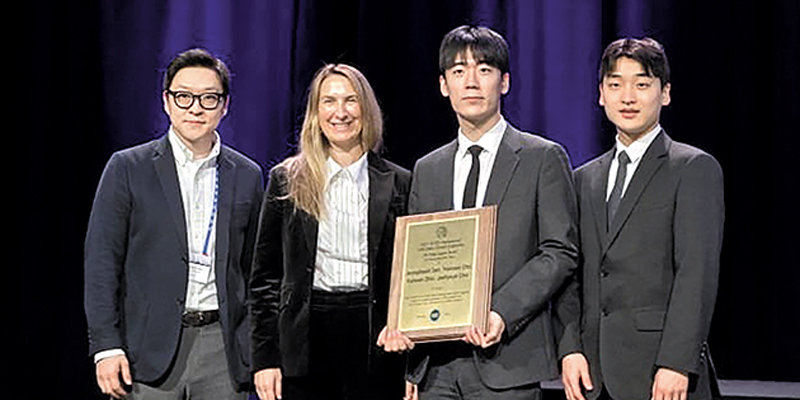
The team led by Professor Choi Jae-hyuk (left) of the Department of Electrical and Computer Engineering at Seoul National University, which won first place in the Asia-Pacific region at this February’s International Solid-State Circuits Conference (ISSCC). Provided by Professor Choi Jae-hyuk
At the International Solid-State Circuits Conference (ISSCC), known as the “Olympics” of semiconductor design, held in San Francisco, United States, this February, a paper by the research team led by Professor Choi Jae-hyuk of the Department of Electrical and Computer Engineering at Seoul National University took first place in the Asia-Pacific region.
ISSCC is the premier global stage in semiconductor design, attended by more than 3,000 researchers from industry and academia worldwide. In semiconductor design, an area long cited as a relative weakness for Korea, a Korean study that reduced high bandwidth memory (HBM) power consumption to one-tenth was ranked first in the Asia-Pacific region.
Of the approximately 250 papers accepted at this year’s ISSCC, 165—more than half—came from Asia. Professor Choi, the advising professor for the paper ranked first in the Asia-Pacific region, said, “Ten years ago, the United States was ahead in both quantity and quality, but now China has the largest number with 96 papers, and Korea also had 46 papers accepted, indicating that Asia is leading,” adding, “Korea has shown that it does not lag at all in terms of quality.”
● K-semiconductors: ‘Architecture’ like urban planning is the key
Artificial intelligence (AI) lies behind the reason a Korean paper received the top Asia-Pacific award. Professor Kim Jeong-ho of the School of Electrical Engineering at KAIST explained, “As AI agents have gained attention, the inference process has come to require far more data, and memory has become more important than other elements.” For decades, system semiconductors responsible for computation played the leading role while memory semiconductors were in support; with the rise of AI, that relationship has been reversed.
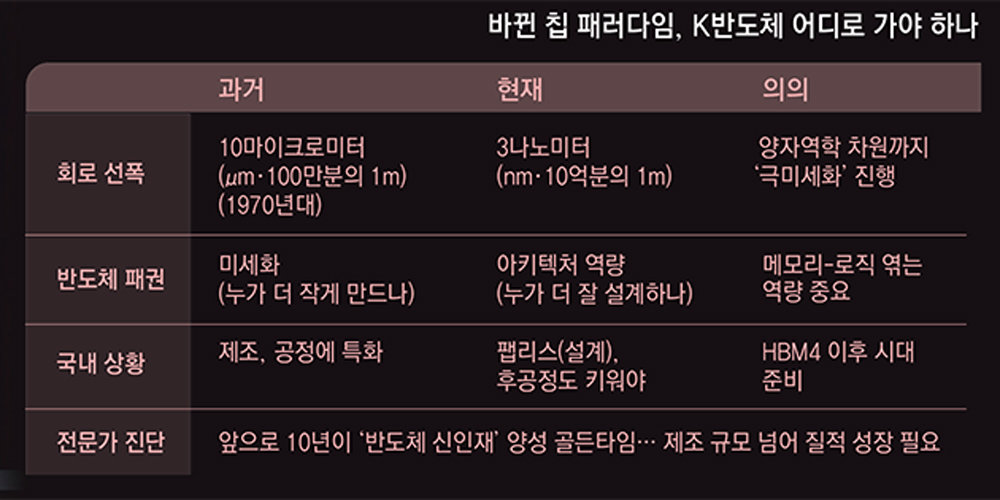
There is another shift under way. As semiconductors become increasingly “ultra-fine,” established formulas are breaking down. Semiconductor advancement has followed “Moore’s Law,” which states that the number of transistors in an integrated circuit doubles approximately every two years. The line width of semiconductor circuits, which was 10 micrometers (μm, one-millionth of a meter) in the 1970s, has shrunk over about 50 years to the current level of 3 nanometers (nm, one-billionth of a meter). As semiconductors enter an extreme domain, a new challenge—“quantum mechanics”—has emerged. Professor Yoo Hoi-joon of the School of Electrical Engineering at KAIST explained, “When semiconductor circuit line widths fall below 2 nm, quantum-mechanical tunneling, in which electrons penetrate through barriers, becomes unavoidable.”
Experts therefore predict that the core of future semiconductor hegemony will shift from “miniaturization” to “architecture.” Professor Kim said, “Architecture is like urban planning: it encompasses everything from how to build the pillars of each building to the overarching philosophy for designing the entire city,” adding, “NVIDIA has built its dominance because its technology that connects the graphics processing unit (GPU), memory, and surrounding infrastructure in a single sweep is at the highest level.” While manufacturing individual chips well remains important, the capability to interconnect those chips is now even more critical.
To ensure that Korea is well prepared for what comes after the fourth “super cycle” of the semiconductor industry built around memory semiconductors, experts commonly argue that the country must pursue a transformation from a “good manufacturing nation” led by memory semiconductors to a “good designing nation.”
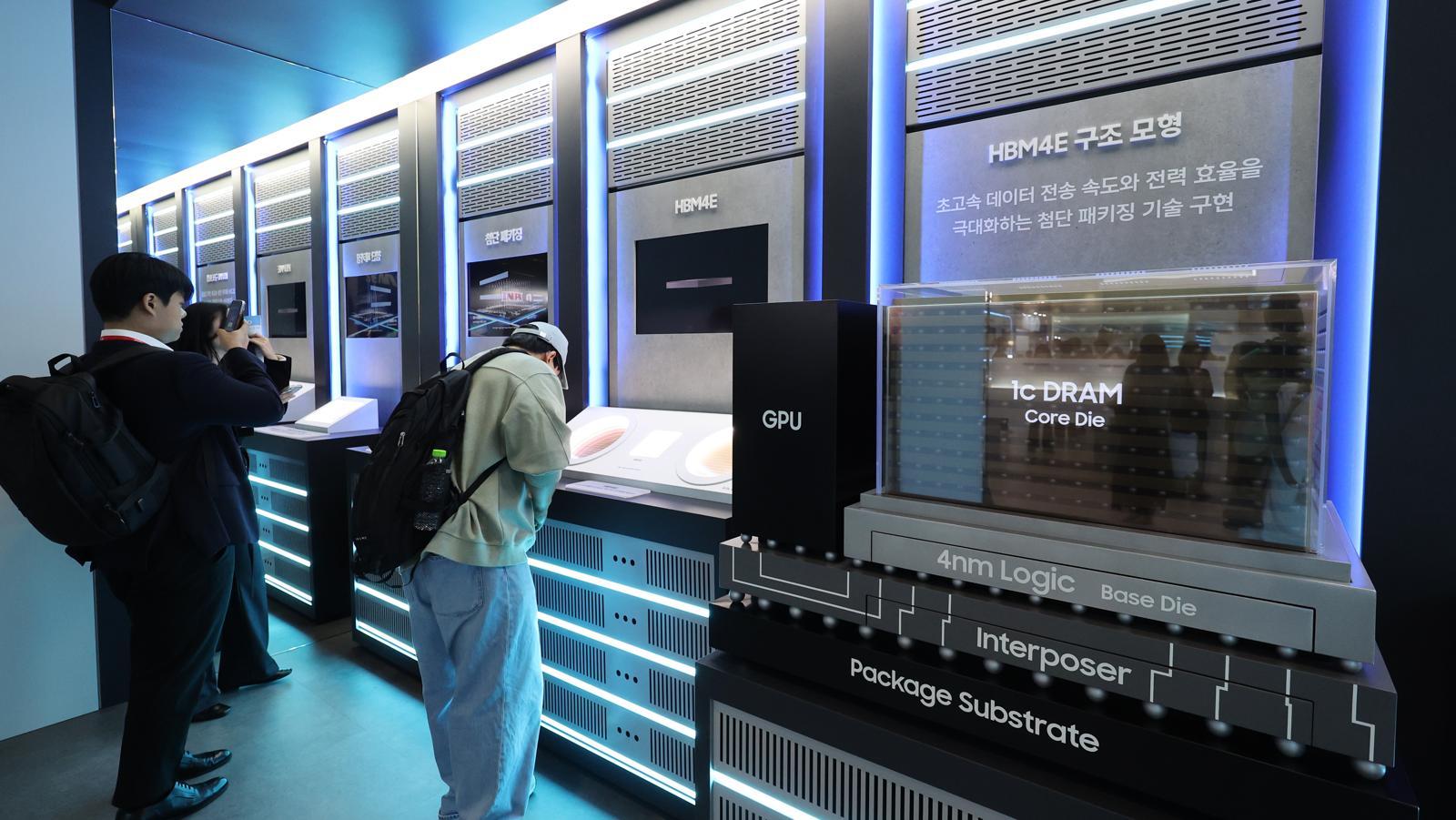
● Only about 10 architecture experts worldwide… urgent need for talent development Starting with HBM4, scheduled for release in mid-2026, logic processes will be introduced beneath the memory, effectively merging system semiconductors and memory semiconductors into a “single body.” This starkly illustrates the growing importance of architectures that connect heterogeneous memories. Professor Choi said, “In the past, the competition was about ‘who can make it smaller,’ but now the decisive factor is ‘who can better integrate memory and logic into one.’”
The challenge is talent. Global big tech companies are already engaged in fierce competition to secure Korean talent. On 17 February, Tesla CEO Elon Musk posted a Taegeukgi (Korean flag) emoji on X (formerly Twitter), sending an open call to Korean semiconductor talent. Analysts interpret this as a recognition that the current upheaval in the semiconductor landscape will determine future hegemony.
Within Korea, talent development strategies are being pursued to seize this “golden time.” Korea is currently working to secure talent through corporate contract departments and national human resources development programs. Experts point out that securing “qualitative expertise,” beyond simple quantitative expansion, is now more urgent than anything else. To date, Korea has focused relatively more on nurturing talent specialized in manufacturing and process technology.
Professor Jeong Hong-sik of the Graduate School of Semiconductor Materials and Parts at Ulsan National Institute of Science and Technology (UNIST) said, “Korea must systematically cultivate experts in areas where it is relatively weak, such as fabless (design-specialized) and back-end processes,” emphasizing, “Fostering qualitative talent that understands everything from design to manufacturing processes in an integrated manner will determine who holds the initiative over the next 10 years.”
Ultimately, the next-generation semiconductor hegemony is expected to be decided not by the external growth of manufacturing scale, but by the “soft power” of orchestrating and designing the flow of the entire system. Experts forecast that whether Korea can reinvent itself as a “good designing” nation will determine the fate of its semiconductor industry over the coming decade. Professor Kim stressed, “Even globally, there are still only about 10 architecture specialists,” adding, “Korea must produce such experts within the next 10 years.” Professor Choi said, “Now that memory and system semiconductors are in the same boat through HBM, building on memory, where we have strengths, can provide a breakthrough.”
ⓒ dongA.com. All rights reserved. Reproduction, redistribution, or use for AI training prohibited.
Popular News