[South Korea–France Summit] Agreement reached on cooperation in nuclear power at summit
Fierce bidding war between the two countries in UAE and Czech Republic
Cooperation expected in technology and other areas excluding construction
Macron invites Yoon to G7 summit… Yoon expresses “gratitude”
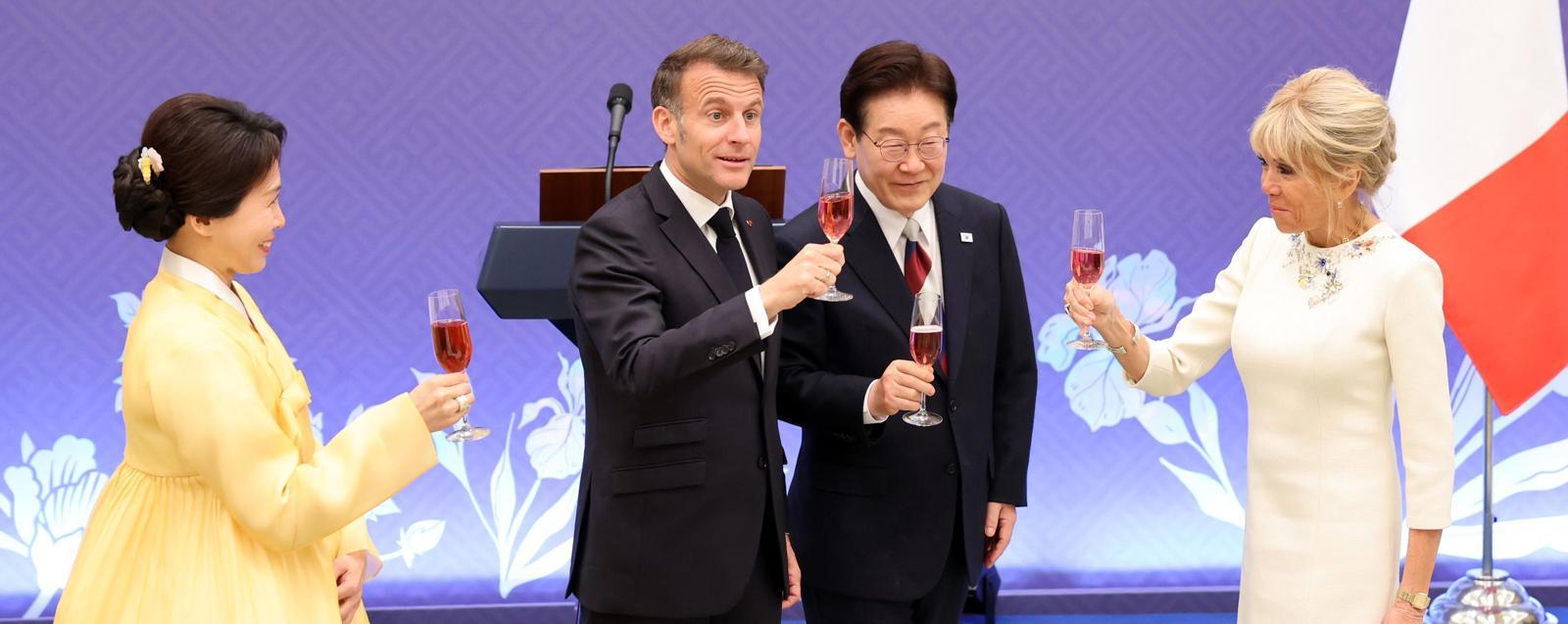
Toast at state luncheon by the two heads of state and their spouses President Lee Jae-myung and First Lady Kim Hye-kyung and French President Emmanuel Macron and First Lady Brigitte Macron make a toast at a state luncheon held at the Cheong Wa Dae State Guest House on the 3rd. Kim Hye-kyung (left) and Brigitte Macron (right) also visited the National Museum of Korea in Yongsan-gu, Seoul, together that day and viewed exhibitions including the “Room of Quiet Contemplation.” Cheong Wa Dae Photo Press Corps
President Lee Jae-myung held a summit on the 3rd with French President Emmanuel Macron, who is paying a state visit to Korea as the first French president to do so in 11 years, and agreed to cooperate in the nuclear energy sector. This is raising expectations that the two countries, which have been engaged in fierce bidding wars in the global nuclear power plant market, will use the occasion to build a relationship of competitive cooperation. After the meeting, President Lee referred to the signing of a memorandum of understanding (MOU) between Korea Hydro & Nuclear Power (KHNP) and French state-owned company Orano, saying, “This will enable us to ensure a stable supply of fuel for our nuclear power plants while laying the groundwork for joint entry into the global nuclear energy market.”
● Cheong Wa Dae: “Strengthening cooperation on nuclear fuel supply chains”
France, a traditional nuclear power stronghold, has long clashed fiercely with Korea in bidding competitions for projects such as the Barakah nuclear power plant in the United Arab Emirates (UAE) and the Dukovany nuclear power plant in the Czech Republic. Currently, Korea and France are also competing in nuclear power plant tenders in Poland, Vietnam, and other countries.
The nuclear power bidding rivalry between Korea and France has at times escalated into espionage and legal disputes. After Korea beat France in 2009 to win the Barakah project in the UAE, competition between the two countries intensified; when KHNP last year secured the Dukovany nuclear power plant project in the Czech Republic, Électricité de France (EDF) responded by filing a lawsuit. According to local Czech media, France at the time engaged in espionage activities in an attempt to defeat Korea, including stealing information and recruiting local experts to wage a public opinion campaign.
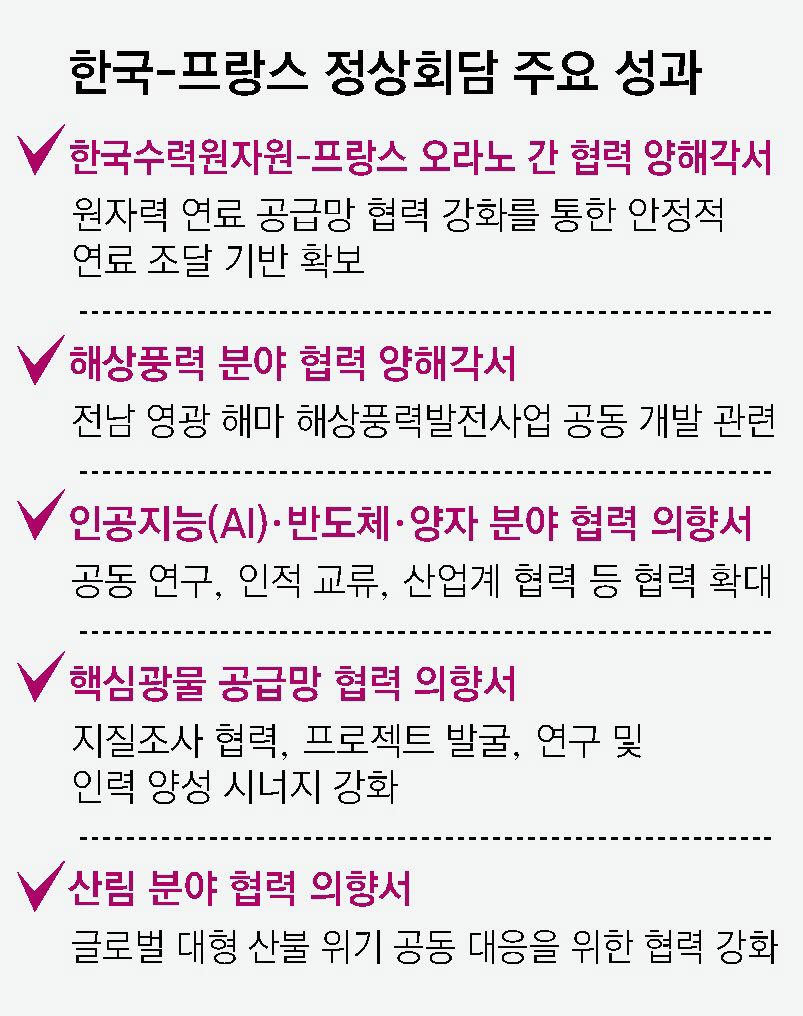
In the presence of the two heads of state, KHNP and Orano signed an “MOU on comprehensive cooperation for the full nuclear fuel cycle” that day. Due to the Korea-U.S. Nuclear Agreement, Korea is not permitted to carry out the uranium enrichment process, which produces fuel for nuclear power plants. As a result, Korea imports nuclear fuel from France and other countries, and the intent of the agreement is to work with the French company to further advance the technology for processing imported fuel. Cheong Wa Dae stated, “The purpose is to strengthen cooperation on nuclear fuel supply chains to secure a stable fuel procurement base and to consolidate the foundation for cooperation in the global nuclear energy market.”
However, the government explained that this does not mean the two countries will make joint entries into the global market. Because the nuclear power technology systems of the two countries differ and they still compete in the global market, any cooperation is likely to focus on secondary technologies such as research and development (R&D) or decommissioning technologies rather than core technologies like construction. A senior government official said, “There is no immediately concrete cooperation; the symbolic significance is greater,” and assessed it as “a positive development.”
On the occasion of the summit, three amendment agreements to strengthen bilateral cooperation and 11 MOUs and letters of intent for cooperation were signed. In particular, amid the strengthening of U.S. protectionism and instability in the Middle East, the two countries signed a letter of intent on cooperation in critical mineral supply chains and agreed to cooperate on geological surveys, the identification of cooperative projects related to critical mineral supply chains, and sustainable mining.
● Lee: “Middle East war shaking international order”; Macron: “Violence must subside” The two leaders agreed to respond jointly to the economic and energy crisis arising from the war between the United States and Iran. In the expanded summit, President Lee assessed, “The repercussions of the Middle East war are shaking the international order,” and added, “The impact on the world economy and the energy sector is widening by the day.” He went on to say at the joint press announcement, “We reaffirmed our commitment to cooperate in securing safe maritime transport routes in the Strait of Hormuz.”
President Macron, who previously rejected President Trump’s request for troop deployment, said that day, “(Navigation) through the Strait of Hormuz must be restored,” while stressing the need for a multilateral approach, in remarks seen as directed at President Trump. He stated, “I believe countries concerned about the current unpredictable situation can work together,” and added, “In the Middle East situation, we can play a role in stabilizing this situation. Including in the Strait of Hormuz, we must ensure that the violence can subside.”
President Lee said he “gratefully accepts” President Macron’s invitation to attend the Group of Seven (G7) summit to be held in Évian-les-Bains in June.
ⓒ dongA.com. All rights reserved. Reproduction, redistribution, or use for AI training prohibited.
Popular News