Semiconductor exports surge 151% in ‘supercycle’ phase
Now 38% of total exports, deepening polarization
Refining and petrochemicals hit hard by war damage
Government vows to “pursue measures to stabilize export conditions”
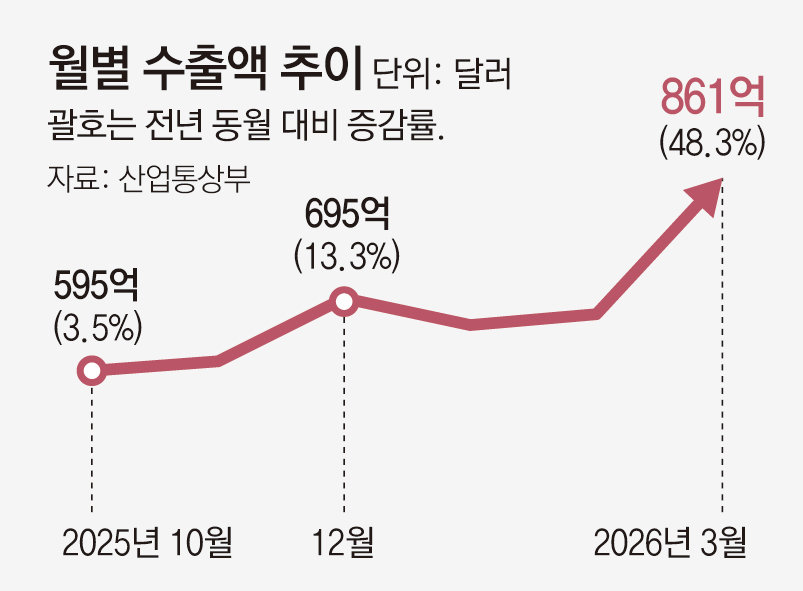
Last month, Korea’s exports exceeded USD 80 billion, setting a new all-time monthly record. This result was driven by continued growth in semiconductor exports, which have entered a so‑called “super cycle” despite the fallout from the war in the Middle East.
However, concerns are mounting as damage from the Middle East conflict is increasingly concentrated in the energy and petrochemical sectors. Another problem is the deepening industrial polarization, with semiconductors accounting for around 40% of total exports.
According to the “Export and Import Trends for March” released by the Ministry of Trade, Industry and Energy on the 1st, Korea’s exports in March came to USD 86.13 billion, up 48.3% from a year earlier. This surpassed the previous all‑time monthly record of USD 69.5 billion set in December last year. In value terms, monthly exports skipped over the USD 70 billion mark and moved straight into the USD 80 billion era. Since turning to year‑on‑year growth in June last year, Korea’s monthly exports have recorded all‑time highs for 10 consecutive months.
The increase in exports was led by semiconductors. Semiconductor exports in March totaled USD 32.83 billion, up 151.4% from the same month a year earlier. This broke the previous record of USD 25.1 billion set just one month earlier in February. It was the first time ever that monthly semiconductor exports exceeded USD 30 billion.
Kang Gam‑chan, Director General for Trade Policy at the Ministry of Trade, Industry and Energy, said, “With high DRAM prices being maintained, the number of working days and export volumes increased significantly in March, the end of the quarter,” adding, “There are various variables, but at least through the first half (January–June), we expect (semiconductor exports) to remain on a positive trajectory.”
Automobile exports were reported at USD 6.37 billion, up 2.2%. Despite logistics disruptions caused by the Middle East conflict, exports of eco‑friendly vehicles such as electric vehicles (32%) and hybrid vehicles (38%) continued to grow.
Although exports far exceeded expectations, concerns are being raised that the concentration in semiconductors is excessive. Because overall export performance fluctuates with semiconductor market conditions, the broader Korean economy could become heavily dependent on the “semiconductor cycle.” Last month, the share of semiconductors in total exports expanded to a record 38.1%. After hovering around 20%, the share rose to 24% last year and has been increasing more steeply this year.
The damage from the Middle East war is also spreading across industries. In particular, the refining and petrochemical sectors, which are affected by export controls and price caps, are being hit hard. In March, exports of petroleum products rose 54.9% in value terms due to higher export prices driven by a sharp rise in oil prices. However, after export controls took effect on the 13th of last month, exports of gasoline, diesel, and kerosene declined by 5%, 11%, and 12%, respectively. Petrochemical product exports also saw a 17% drop in volumes in the fourth week of March, when the impact of the Middle East war began to be felt in earnest.
Minister of Trade, Industry and Energy Kim Jeong‑gwan said, “As the prolonged war in the Middle East is increasing uncertainty in export conditions, the government will activate a pan‑government response system and promptly implement stabilization measures.”
ⓒ dongA.com. All rights reserved. Reproduction, redistribution, or use for AI training prohibited.
Popular News