Plans to allocate KRW 1.5 trillion for debt repayment and KRW 900 billion for solar technology investment
Korea Ratings: “Capital increase and debt repayment expected to ease financial burden”
If the rights offering is not completed, refinancing pressure will rise… potential credit rating downgrade risk
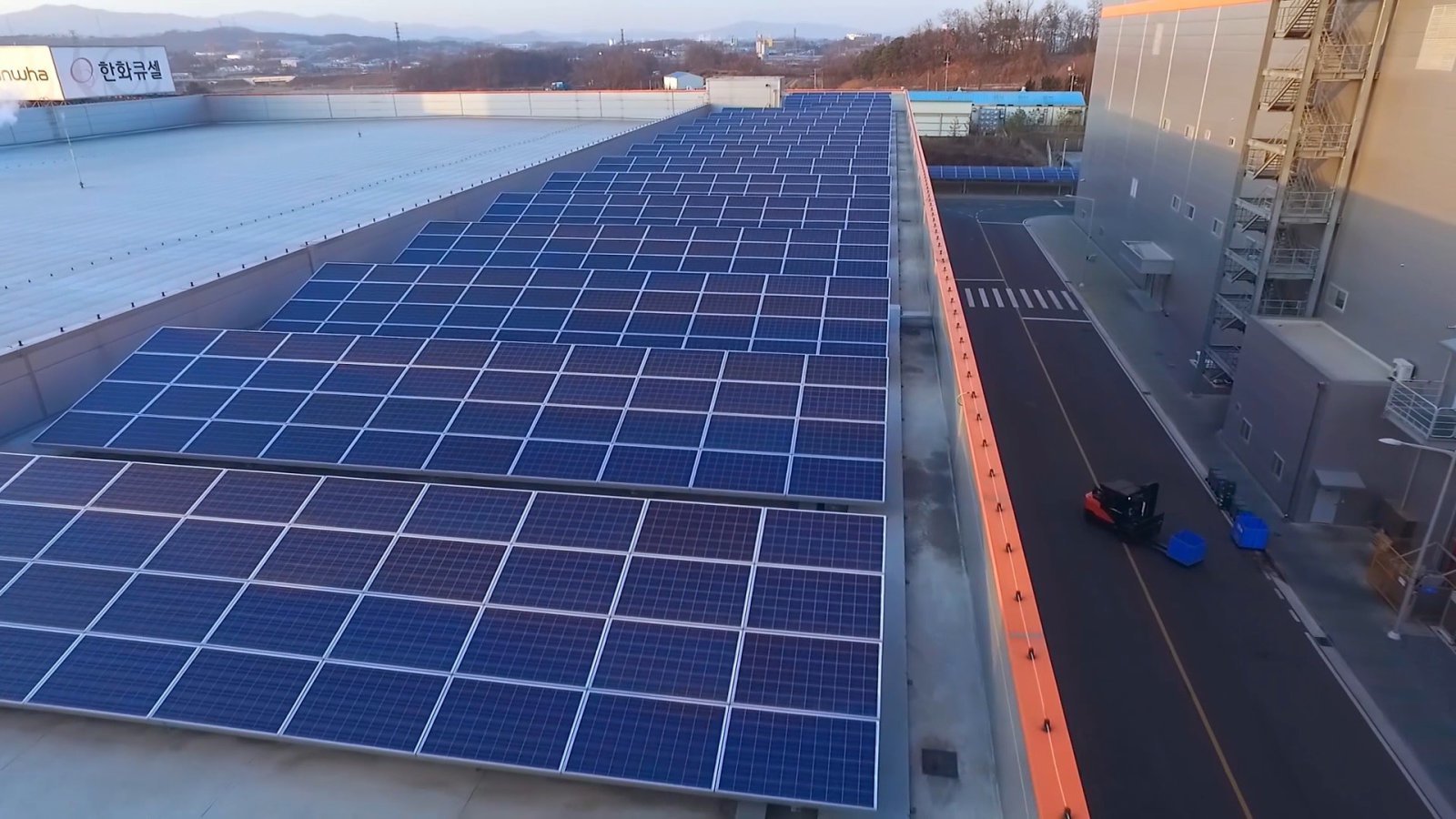
Rooftop solar power plant installed on an idle site at Hanwha Q CELLS’ Jincheon plant. Provided by Hanwha Solutions
Hanwha Solutions is pushing ahead with a rights offering worth KRW 2.4 trillion. The move comes as prolonged weakness in the solar and petrochemical sectors has deteriorated its financial structure, and the company plans to allocate a substantial portion of the funds raised to the repayment of borrowings as a priority.
Of the proceeds from the rights offering, KRW 1.5 trillion will be used for debt repayment and the remaining KRW 900 billion will be used for facility investment. The detailed breakdown of facility investment is KRW 100 billion for building a perovskite tandem pilot line and KRW 800 billion for expanding TOPCon (Tunnel Oxide Passivated Contact) production capacity and establishing a large-scale mass-production line.
Hanwha, the largest shareholder with a 36.31% stake, is considering participating in at least 100% of its allotment in the rights offering, and plans to raise the participation funds through the sale of assets it holds and securitization of bonds.
Korea Ratings stated, “It is positive that capital expansion and debt repayment will alleviate the financial burden.” However, it added that if the rights offering is not completed within the first half of the year, the burden of refinancing KRW 1.8 trillion of debt and the risk of a credit rating downgrade could materialize.
Upon completion of the rights offering, the company expects its consolidated debt-to-equity ratio for this year to decline to below 150%, and net debt to be managed at around KRW 9 trillion. As a long-term target, it presented a debt-to-equity ratio of 100% and net debt of about KRW 7 trillion by 2030.
The company projects operating cash flow of KRW 13.8 trillion over the next four years, and plans to allocate KRW 600 billion for shareholder returns, KRW 6 trillion for improving its financial structure, and KRW 7.2 trillion for operating and capital expenditures (OPEX and CAPEX).
Domestic cases of rights offerings aimed at restoring financial soundness are not uncommon. SKC used KRW 410 billion of its KRW 1 trillion rights offering in January this year to repay debt, while Hanon Systems, after receiving KRW 983.2 billion in proceeds at the end of last year, used KRW 883.4 billion—about 90%—to repay borrowings. Subsequently, Hanon Systems’ credit rating was adjusted to AA- (stable).
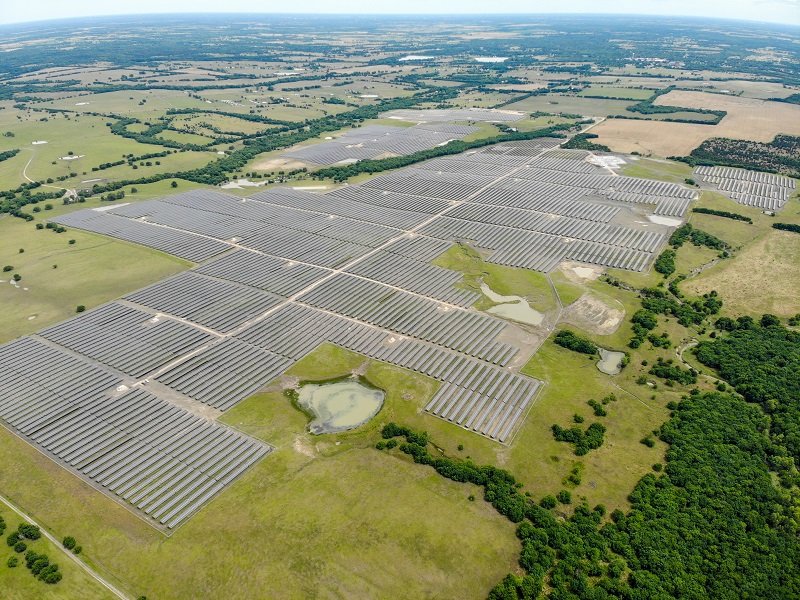
Solar power plant in Texas, United States, built by Hanwha Solutions. Hanwha Solutions
U.S. plant operations normalized… Q1 turnaround to profit expected
On the business side, the customs clearance issues related to cells in the United States were resolved at the end of last year, and the module plants in Dalton and Cartersville, Georgia, have begun normal operations. Since the beginning of this year, module sales volumes have increased and selling prices have risen due to the impact of regulations on Chinese products.
The CFO of Hanwha Solutions said during an earnings conference call earlier this year, “The normalization of operations and an increase in sales volume and selling prices at the U.S. module plants are expected in the first quarter, and the renewable energy business is projected to turn to profit.” The chemical segment is expected to reduce its losses due to base effects from scheduled maintenance.
The Cartersville plant is expected to secure production capacity of 3.3 GW in ingots, wafers, and cells by the end of 2026. Combined with the existing 5.1 GW module production capacity at the Dalton plant, total production capacity in Georgia will reach 8.4 GW. In the second half of the year, the Advanced Manufacturing Production Credit (AMPC) is scheduled to be applied across the entire value chain.
Hanwha Solutions is also investing in the development of perovskite tandem technology, a next-generation solar technology. Tandem technology combines silicon and perovskite materials to achieve higher energy conversion efficiency than conventional silicon-only methods, and is a technology that has not yet reached commercialization.
Since 2024, Hanwha Solutions has been operating a commercial-scale pilot plant at its Jincheon plant in North Chungcheong Province, and at the end of last year obtained certification for cell efficiency based on commercial large-area standards from a third-party research institute in Germany. It is also in the process of obtaining cell reliability certification from a global certification body. Hanwha Solutions stated that it is considering future business expansion into areas such as space applications.
An industry official said, “The actual impact of this rights offering and investment plan is expected to be determined by future business performance.”
ⓒ dongA.com. All rights reserved. Reproduction, redistribution, or use for AI training prohibited.
Popular News