Interview with Hannam-Sik Han, Professor of Quantum Information Science at Yonsei University
Classical computers that compute with 0s and 1s
Cannot handle the “at least 3 billion pairs” of genetic information
Quantum computers to accelerate precision medicine
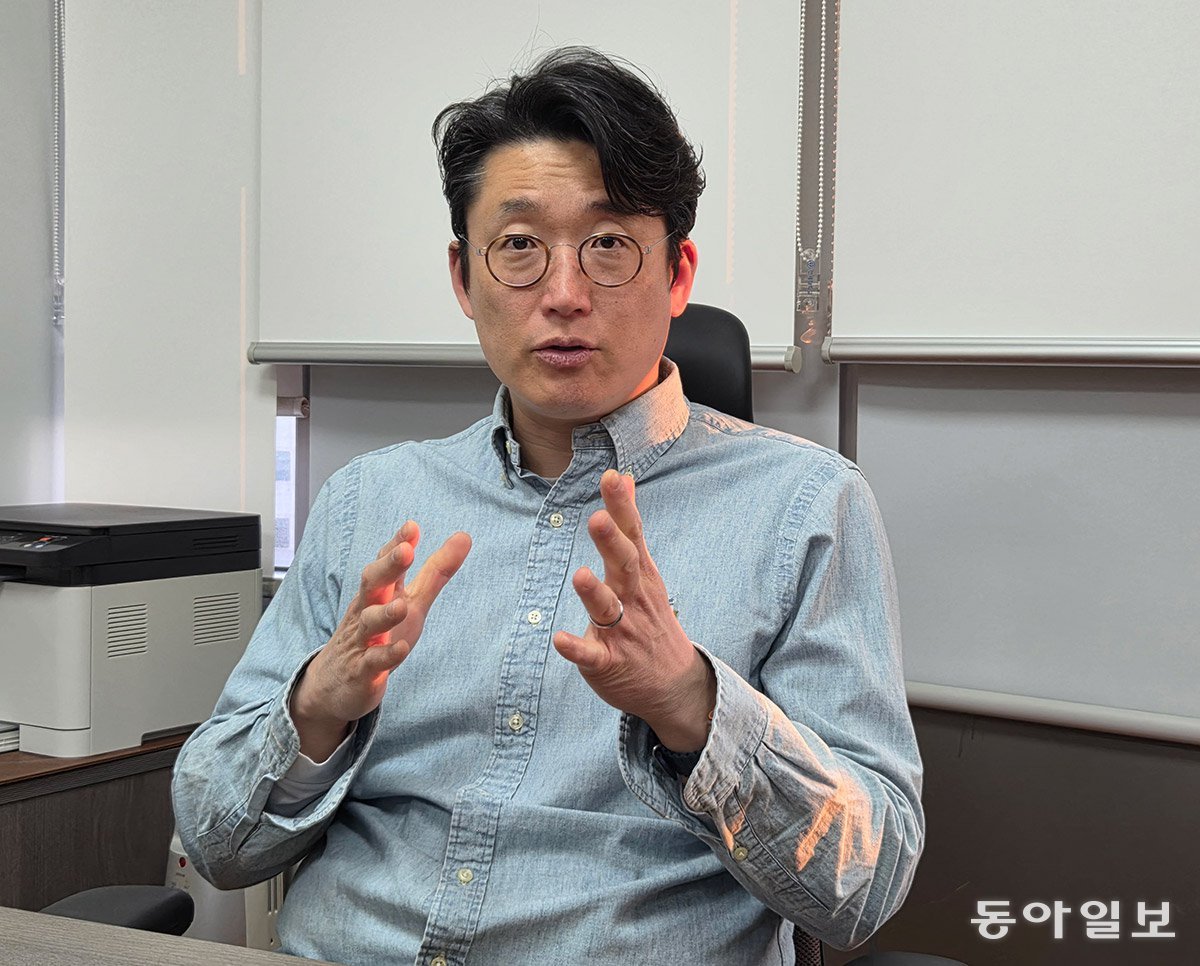
On the 12th at Yonsei University’s Sinchon Campus in Seoul, Professor Hansik Han of Yonsei University’s Department of Quantum Information Science (Director of the AI Research Center at the Milner Therapeutics Institute, University of Cambridge, UK). Photo by Byunggu Lee, Dong-A Science reporter 2bottle9@donga.com
“In biology, where there are many variables and networks are complex, 1+1 can become 1.9 or even exceed 2. Even powerful artificial intelligence (AI) ultimately computes only with 0s and 1s, so it has limitations. To increase the speed and accuracy of diagnosis and treatment, quantum technology is needed to express concepts that are neither 0 nor 1.”
In a recent interview, Hansik Han, Director of the AI Research Center at the Milner Therapeutics Institute of the University of Cambridge in the UK, assessed AI for new drug development—one of the core missions of the government’s “K-Moonshot” project launched to strengthen science and technology competitiveness in the AI era—as “a powerful tool with still much room for growth,” while also diagnosing that it has fundamental limitations. Director Han was appointed as an adjunct professor in the Department of Quantum Information Science at Yonsei University in September last year.
Professor Han explained that current human medicine is at the “Medicine 2.0” stage. Compared with past “Medicine 1.0,” which was based solely on trial and error and experience, diagnoses and treatments are now carried out using various medical test results as evidence, but are still considered to rely substantially on physicians’ experiential knowledge. Medicine 3.0 refers to the “precision medicine” phase, in which all individual-specific characteristics, including genes, are reflected and used as the basis for clinical decisions, thereby reducing dependence on physicians’ experience.
The vast majority of diseases are heavily influenced by the different genetic backgrounds of individuals. Some people who have never smoked a single cigarette develop lung cancer, while others remain with healthy lungs even as centenarian heavy smokers.
The base sequence containing all of an individual’s genetic information exceeds 3 billion pairs. To derive meaningful commonalities that can be applied clinically, it is necessary to analyze and compare the base sequences of hundreds of thousands to millions of people. With existing computers, the computation time is so long that this approach is effectively inaccessible.
Quantum computers perform calculations using “qubits,” information-processing units that exploit quantum superposition, a phenomenon in which a physical state is not fixed to one state but exists probabilistically in multiple states at the same time. They can compute many variables in parallel at once. They are suitable for solving specific types of problems that are effectively impossible to compute with classical computers because they would take too long. This is why quantum technology is essential to achieving Medicine 3.0.
Professor Han’s team used a type of quantum computing algorithm known as “Quantum Walk” to identify biomarkers associated with long-term sequelae of COVID-19 infection, or “long COVID,” more accurately and rapidly than traditional methods. The research findings were published on 15 February (local time) in the international journal “Bioinformatics Advances.”
The quantum algorithm precisely pinpointed key mechanisms of long COVID that classical computers had missed, such as mitochondrial dysfunction and neuroinflammation. Mitochondria are organelles responsible for energy production in cells. Two groups of proteins that regulate mitochondrial function were identified as new therapeutic targets for long COVID.
Professor Han stated, “This demonstrates that quantum algorithms can deliver results of clinical and medical value that go beyond mere enhancement of computational power.”
Professor Han is a researcher who has studied broadly from computer engineering to biology and leads new drug development research at the Milner Therapeutics Institute. More than 10 years of collaborative research based on clinical data from Yonsei University’s Severance Hospital led to his current appointment as an adjunct professor.
Professor Han plans to actively use the IBM quantum computer installed in 2024 on Yonsei University’s Songdo Campus in Incheon to continue innovative research. He said, “The ultimate goal is to implement and analyze the human neural network, regarded as the most complex biological network, on a quantum computer.”
ⓒ dongA.com. All rights reserved. Reproduction, redistribution, or use for AI training prohibited.
Popular News