64 Mongolian aviation professionals trained… a proven education model
Approved by China’s Ministry of Education… from cooperation to ‘exporting degrees’
Extending to India and Indonesia… global expansion linking education and industry
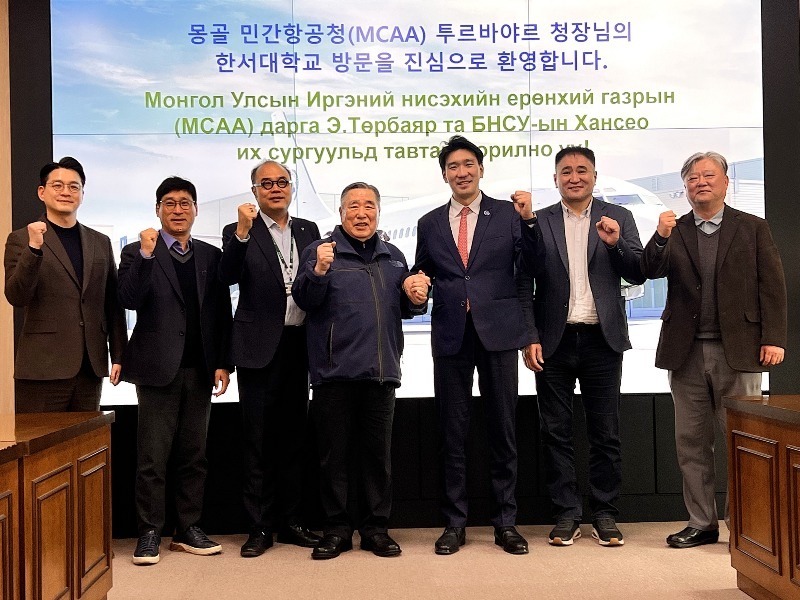
A delegation from the Mongolian Civil Aviation Authority visited Hanseo University to discuss cooperation in aviation education. The fourth from the left is Hanseo University President Ham Ki-seon. Courtesy of Hanseo University
Mid-March, Hanseo University Taean Campus in South Chungcheong Province.The eyes of the Mongolian delegation, touring the aviation-specialized campus with its runway and control tower, moved busily. As they looked around inside the hangar, their gaze lingered for a long time on the Boeing aircraft used for actual training, various practice equipment, and the explanation of the curriculum. It was not a simple inspection tour. It was an occasion to confirm “how to expand this system together with Hanseo University.”
Led by Director General Turbayar of the Mongolian Civil Aviation Authority (MCAA), the delegation visited Hanseo University from the 13th to the 15th of this month. The purpose was to review cooperation in aviation education and discuss plans for future expansion. The core of the conversations exchanged on site was clear: “Let us create education together.”
The relationship between Hanseo University and the Mongolian Civil Aviation Authority dates back to 2017. At that time, Hanseo University obtained its first certification as an aviation education institution and received a second certification in 2022. The two institutions have been operating programs that combine theoretical education and practical training. Hanseo’s Departments of Aeronautics, Aeronautical Mechanical Engineering, Aviation Transportation and Logistics (major in Air Traffic Management), and Aviation Tourism, along with affiliated institutes such as the Flight Education Institute, Aviation Technology Education Institute, and Air Traffic Control Education Institute, have taken part. Since the first designation, the number of Mongolian international students has increased. Mongolian aviation personnel receive the latest aviation education at Hanseo, while Hanseo students enhance their on-site adaptability through practice-oriented education.
As a result, 64 Mongolian graduates from Hanseo University have entered their country’s aviation industry and are working in key positions such as pilots, air traffic controllers, flight dispatchers, and cabin crew. On site, President Ham Ki-seon of Hanseo University stressed that “this cooperation is not just an exchange but a process of jointly creating an educational model.” Director General Turbayar also responded, saying, “Hanseo University’s education system has already been verified,” and “we will further expand our cooperation.” What was confirmed on site was a trend that went beyond a simple visit. Cooperation that began in the specialized field of aviation is now expanding into a structure of “exporting education.” This trend is even clearer in China.
The joint master’s program in design and engineering convergence promoted by Hanseo University and Anhui University of Technology in China recently received official approval from the Chinese Ministry of Education. Starting from the 2026 academic year, this program, which will select 50 students annually, goes beyond a simple exchange program to become a regular degree course recognized by both governments.
Students will receive education in a 2+1 format. They will study in Korea for at least one year, and upon graduation, they will simultaneously obtain a master’s degree from Anhui University of Technology in China and a Master of Design Engineering from Hanseo University. By entering a stage where educational content and degree systems are jointly designed and operated, practice- and research-oriented talent that meets industrial demand in both Korea and China will be cultivated.
This differs in nature from existing university internationalization strategies. Most universities have focused on attracting international students. Hanseo University, by contrast, is expanding education itself overseas. It is focusing more on a “structure in which education goes abroad” rather than a “structure in which students come to Korea.”
The scope of global cooperation is also expanding rapidly. Last month, a signing ceremony for an agreement with India’s KIIT and KISS universities was held at Hanseo University’s Seosan Campus. The agreement includes the establishment of a joint department for robotics, educational cooperation in aviation MRO (maintenance, repair, and operations), joint research, and restructuring of student exchange programs. It is a structure that links education, industry, and research beyond simple exchange. KISS is the world’s largest educational institution for indigenous peoples, providing free education and housing to tribal communities. The cooperation is especially meaningful in that it addresses not only technical education but also social value.
Cooperation with Indonesia is also in full swing. In December last year, Hanseo University signed a memorandum of understanding (MOU) on exchange and cooperation with the Universitas Indonesia and established a system for recruiting international students and providing Korean language education in connection with local education platforms. An “overseas hub model” is also in operation, under which students are selected and educated locally through Global Kita and Makara UI Academy.
In this way, Hanseo University’s global strategy has built a multidimensional structure that leads to ▲export of education programs ▲joint operation of degree programs ▲and establishment of overseas talent selection systems. The university is pushing this as a key driving force in its innovation goal of leaping forward as a global university that leads the world from its regional base.
The change felt on the ground is clear. Universities are shifting from being institutions that wait for students to platforms that take education into the field. President Ham said, “For a glocal university to carry out global tasks, international partnerships are not optional but essential,” adding, “We will create tangible outcomes through cooperation that links education, industry, and research.”
Amid declining school-age populations and intensifying competition among universities, the role of universities is being rapidly redefined. At the center of this trend, Hanseo University is testing a significant path. Education cooperation that began in the skies of Mongolia has now extended to campuses in China, classrooms in India, and online platforms in Indonesia. From a university that receives international students to a university that exports education, the “glocal education model” being built by Hanseo University is taking shape on the ground.
ⓒ dongA.com. All rights reserved. Reproduction, redistribution, or use for AI training prohibited.
Popular News