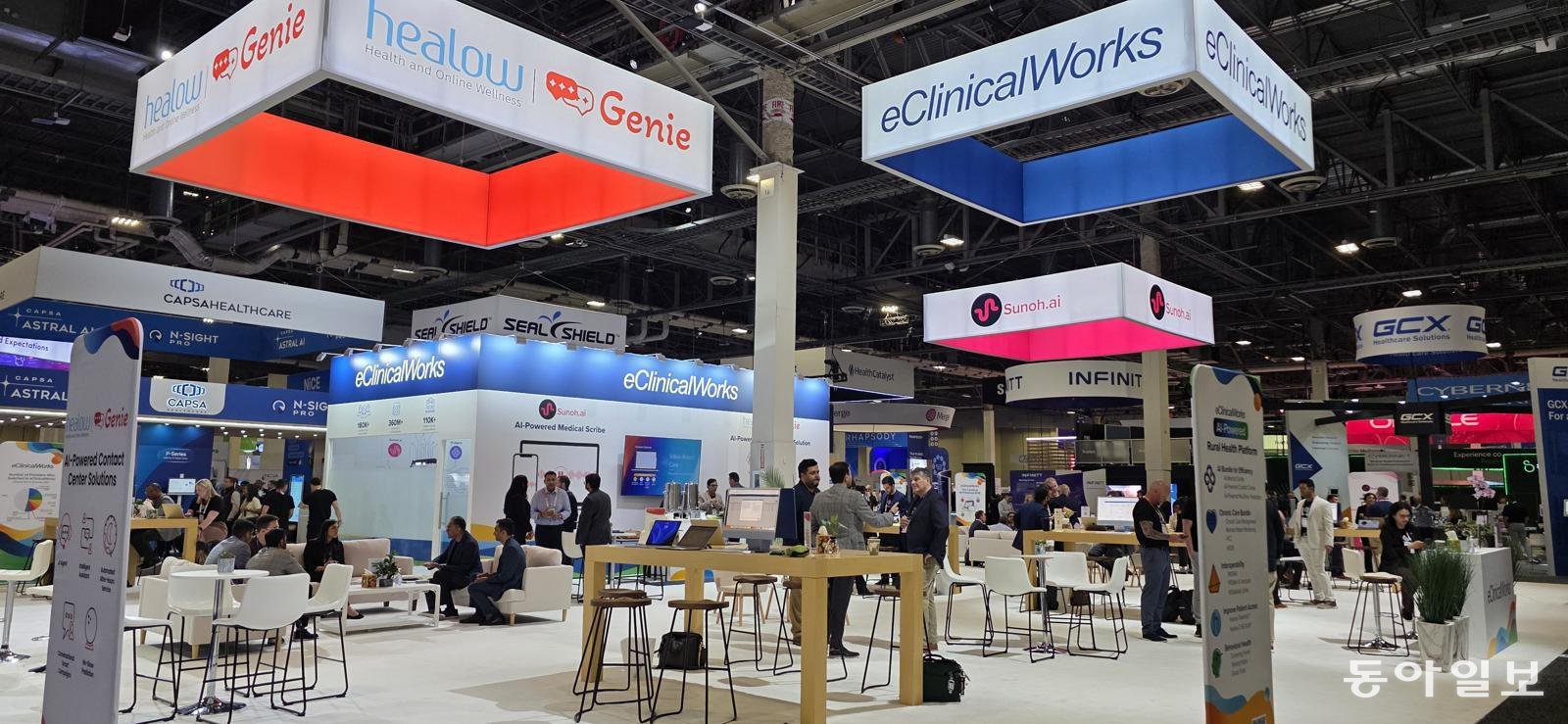
Since the 9th, “HIMSS (Healthcare Information and Management Systems Society) 2026” held in Las Vegas, USA, has drawn about 25,000 participants, achieving great success. There were about 1,100 registered company booths. Las Vegas = Medical Specialist Reporter and Physician Jinhan Lee likeday@donga.com
Global consulting firm McKinsey has defined the “smart future hospital” as “a hospital that maximizes treatment outcomes and patient experience by applying cutting-edge technologies to the fullest, while at the same time reducing costs.” As artificial intelligence (AI) is transforming not only industry but every aspect of daily life, hospital settings are changing even faster than anticipated.
“Advanced AI gives time back to focus on patients” “HIMSS (Healthcare Information and Management Systems Society) 2026,” which serves as a barometer for the direction of global digital healthcare, was held in Las Vegas from the 9th for four days with the participation of about 25,000 experts. The most striking development was the realization of “agentic AI (execution-type AI)” that independently assesses situations and completes tasks.
Global big tech companies such as Microsoft, Google, Oracle, and Amazon Web Services, which took part in the event, unveiled their own new AI-based tools in quick succession, stressing that these “can completely eliminate the administrative burdens previously shouldered by medical staff.” They demonstrated much smoother workflows, including automatically generating clinical documentation based on conversations and supporting follow-up appointment scheduling and insurance claims. This has been made possible by technologies that integrate and analyze various data generated in hospitals within a cloud environment.
John Halamka, President of the Mayo Clinic Platform, who delivered a keynote speech, said, “AI is not a mere technological fad; it improves the quality of care while at the same time addressing various business issues such as deteriorating hospital profitability, clinician burnout, and shortages of specialized personnel in rural areas,” emphasizing that it “will be an essential tool that becomes the standard of future medicine.”
However, experts stressed that even as AI becomes more sophisticated, the need for human clinicians will not diminish. Many predict that it will instead become a tool that enables physicians to provide higher-level care. Park Hong-seok, Head of the Medical Information Intelligence Headquarters at Korea University Medicine, who was interviewed on site, explained, “The ultimate purpose of all technological advancement is to give physicians back the time to focus on their patients.”
United States adopts ‘patient-centered’ smart hospitals Cedars-Sinai Medical Center in Beverly Hills, Los Angeles (LA), has been selected for 10 consecutive years as one of the top 10 hospitals in the United States in various evaluations. In collaboration with the U.S. Department of Defense, it has developed “OR360,” dubbed the operating room of the future, which implements a system that moves walls and equipment according to the patient’s injury site or type of surgery to create optimal workflows.
A new smart hospital is also in preparation. The hospital has previewed a facility that is entirely different from existing concepts, centered not on examination rooms but on a “digital command center.” Like an airline control tower, AI will analyze in real time, down to the second, patient admissions and discharges and the availability of operating rooms, so that when patients arrive, it can secure optimal beds and assign care teams. It also features the world’s first nurse-assistance system, where AI automatically creates electronic medical records through voice input. In the event of a disaster, it has a variable structure that allows immediate and flexible operation without tearing down walls.
The new hospital at the University of California, Irvine (UC Irvine) is also attracting attention. An investment of KRW 2 trillion was made last year, and it opened in December with 144 beds. It is the first hospital in the United States to operate entirely on self-generated electricity. The most notable feature is its innovative layout and structure. Operating rooms, interventional suites, and radiology equipment are located on a garden level underground space the size of three soccer fields, reducing transfer times for critically ill patients. This is intended to secure the golden hour and maximize collaborative efficiency among medical staff. After valet parking at the main entrance, patients can move directly to testing or treatment areas without waiting, and when they require further detailed examinations or hospitalization after consultations, patient flows are designed so that their pathways are never interrupted, realizing a truly patient-centered structure.
Sohn Ho-sung, Director of Medical Planning at Korea University, who visited UC Irvine Medical Center as a partner institution, evaluated, “It is like getting off at the departure level of an airport, moving step by step inside, going through the procedures, and boarding the plane,” adding that “it has patient-centered flows.”
Korea University Dongtan Hospital: “Will drive innovation in care, education, and research” In Korea, there is also a hospital that declared from the conceptual stage that it would be a hospital of the future: Korea University Dongtan Hospital. The “Fourth Korea University Hospital in Dongtan,” which will be built as a 700-bed, top-tier general hospital in Dongtan 2 New Town in Hwaseong, Gyeonggi Province, is envisioned as a next-generation integrated medical campus that combines precision medicine, convergent research, and talent development functions.
The hospital plans to establish a “responsible medical data management system” that safely protects patient data, the core of future personalized precision medicine. It will build a “data mesh” infrastructure in which data are organically interconnected like a net by combining in-house security servers with externally hosted clouds that have flexible scalability. AI-based platforms will also be installed at Korea University Medical Center’s existing Anam, Guro, and Ansan hospitals so that the four hospitals can undertake innovative research through an advanced data hub.
A patient-centered, interoperable smart system, unprecedented in Korea, will also be established. Through an AI-based autonomous monitoring and support system, medical staff will be able to concentrate on patients in optimal conditions. An “interactive dashboard” will be installed on the walls of patient rooms to connect patients and medical staff, enabling patients to instantly check their own care pathways. In addition, an environment will be created in which sensors around the bed detect subtle patient movements and alert nurses to fall risks or send notifications before a patient even presses a call button to request assistance.
Yoon Eul-sik, Executive Vice President for Medical Affairs and President and CEO of Korea University Medicine, said, “Dongtan Hospital will be the most future-oriented hospital while faithfully fulfilling its core role as an advanced general hospital focusing on severe and intractable diseases,” adding, “We will design it to be structurally the most flexible and open hospital so that state-of-the-art AI and smart technologies can be applied immediately.” He continued, “We will achieve unprecedented innovative outcomes in care, education, and research,” and “We will pool the capabilities of Korea University Medicine so that the most advanced hospital can be born, delivering the best patient experience yet seen in Korea.”
ⓒ dongA.com. All rights reserved. Reproduction, redistribution, or use for AI training prohibited.
Popular News