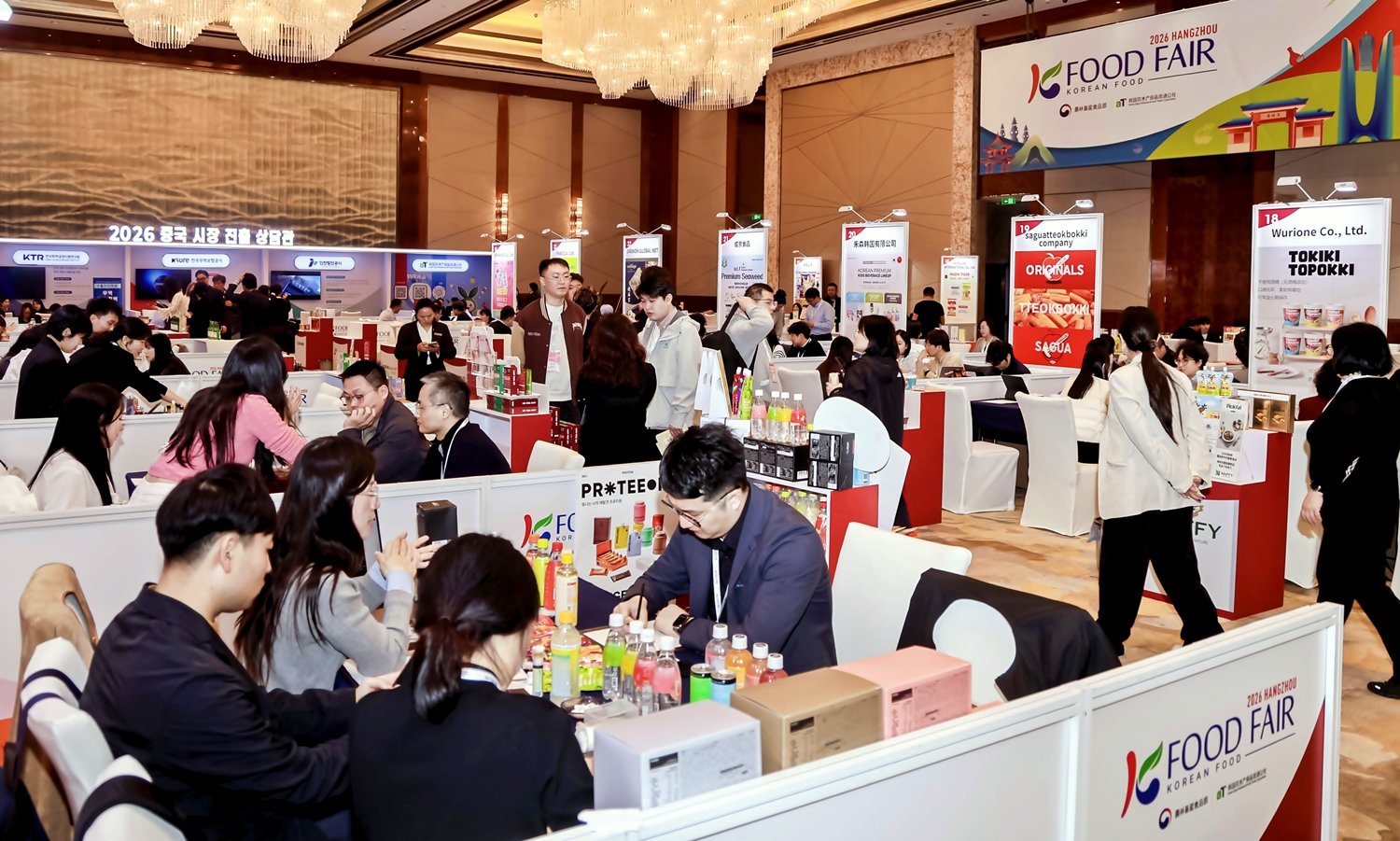
The Ministry of Agriculture, Food and Rural Affairs and the Korea Agro-Fisheries & Food Trade Corporation (aT) announced that they participated in the “2026 Hangzhou K-Food Fair” to expand the export territory of K-Food.
The fair, held in Hangzhou, where the headquarters of Asia’s largest e-commerce company Alibaba Group is located, took place from the 19th to the 22nd. From the 19th to the 20th, a B2B export consultation session and an Alibaba Group familiarization tour were held, followed by a B2C consumer experience event for citizens from the 21st to the 22nd.
At the B2B export consultation session on the 19th, 40 leading Korean K-Food companies and 60 buyers from across China participated, conducting a total of 553 one-on-one matching consultations. To enhance the outcomes, online preliminary consultations were carried out early this month, focusing on promising K-Food categories such as inner beauty foods, ready-to-eat meals, and desserts. This resulted in consultations worth USD 27.5 million and the conclusion of 19 on-site contracts and business agreements totaling USD 9.49 million.
A cross-ministerial “External Cooperation Consultation Desk” was also set up at the consultation venue. Together with the Korea Intellectual Property Protection Agency, Korea Testing & Research Institute, Incheon Port Authority, and Korea Trade Insurance Corporation, it provided advisory services on various support programs, ranging from intellectual property and trademark consultations to product quarantine, customs clearance, logistics, and trade insurance.
On the 20th, export companies participating in the K-Food Fair visited the Alibaba Group headquarters in Hangzhou. The visit included discussions on effective promotion of K-Food using Alibaba’s platforms and on revitalizing the online Korean Food Pavilion on Tmall, China’s leading shopping platform.
This was followed from the 21st to the 22nd by a B2C consumer experience event for citizens. Held at Bao Long Cheng, a popular shopping mall with a high volume of family visitors, the event featured popular themed zones such as the “Hangang Convenience Store,” “K-Detox Jjimjilbang,” and “Korean Snack Bar,” showcasing a wide range of offerings including street foods such as ramen and tteokbokki, functional beverages, and inner beauty foods. Furthermore, to move beyond simple experiences and link directly to actual K-Food consumption, the organizers collaborated with KKV, a leading Chinese lifestyle store that sells food, cosmetics, and household goods. They operated a KKV pop-up store and an online Korean Pavilion live zone featuring wanghong (influencer) invitations, achieving sales of more than KRW 17 million over the two days.
Jeon Ki-chan, Director of Export Food at aT, stated, “The first K-Food Fair of 2026 holds significant meaning as it is being held in Hangzhou, the mecca of China’s future high-tech industries such as e-commerce, robotics, AI, and big tech,” adding, “aT will actively work to help K-Food companies respond to the rapidly changing environment of the global food market, including accelerating online distribution, AI marketing, and unmanned delivery, by discovering promising items, facilitating entry into online markets, and supporting marketing aligned with the latest trends.”
As of the end of last month, exports to China increased by 20.7% year-on-year to USD 341 million. In particular, categories such as ramen (USD 48.93 million), beverages (USD 27.05 million), and confectionery (USD 15.16 million) are driving export growth.
ⓒ dongA.com. All rights reserved. Reproduction, redistribution, or use for AI training prohibited.
Popular News