Reflection AI, a next-generation player in the AI industry, signs strategic partnership MOU in the U.S.
Joint venture to launch within the year… up to 250MW, Korea’s largest
Expected to deliver differentiated “AI commerce”
Draws attention as the first case under U.S. AI export program
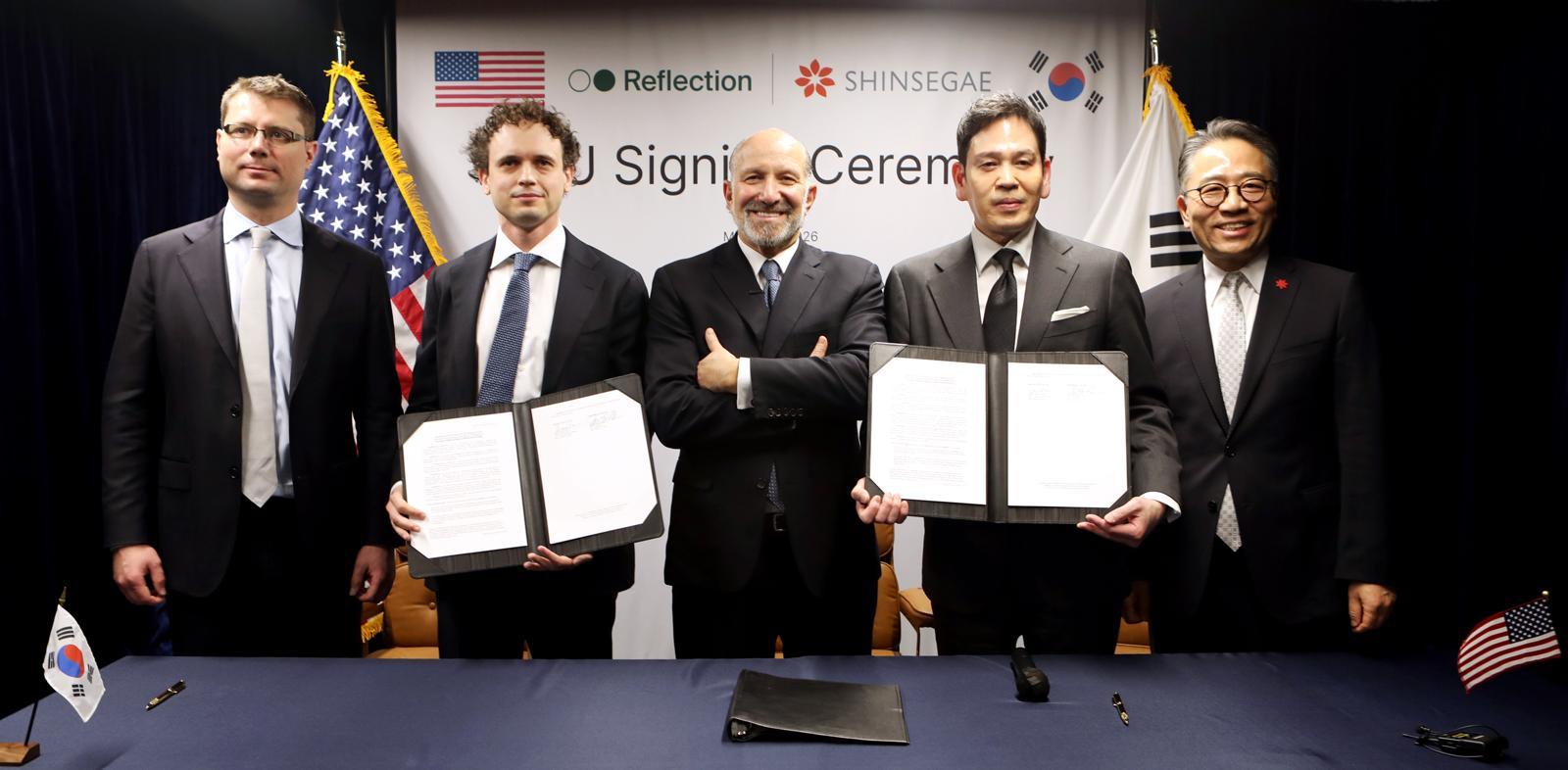
On the 16th (local time) in San Francisco, United States, during the signing ceremony for the “Strategic Partnership MOU for Building the Korea Sovereign AI Factory” between Shinsegae Group and Reflection AI, Shinsegae Group Chairman Chung Yong-jin (second from right) and Reflection AI Co-founder and CEO Misha Laskin (second from left) pose for a commemorative photo. Also attending the ceremony were Reflection AI Co-founder and current CTO Ioannis Antonoglou, U.S. Secretary of Commerce Howard Lutnick (center), and Lim Young-rok, President and Head of Corporate Strategy at Shinsegae Group. Provided by Shinsegae
Shinsegae Group is moving to build the largest artificial intelligence (AI) data center in Korea. This is the first case of a domestic retail company directly entering the AI infrastructure construction business. Analysts say this reflects a trend in which global retail giants are leveraging the transaction data they have accumulated to expand into AI infrastructure and cloud services and to take the lead in the e-commerce ecosystem.
Shinsegae Group announced on the 16th (local time) in San Francisco that it had signed a memorandum of understanding (MOU) with Reflection AI for a “strategic partnership to build the Korea Sovereign AI Factory.” Shinsegae Group Chairman Chung Yong-jin and Reflection AI Chief Executive Officer (CEO) Misha Laskin attended the ceremony.
Reflection AI is an AI startup founded by researchers from Google DeepMind. Last year, it was valued at USD 8 billion (approximately KRW 12 trillion) and attracted USD 2 billion (approximately KRW 3 trillion) in investment from Nvidia and others, drawing attention as a next-generation player in the AI industry.
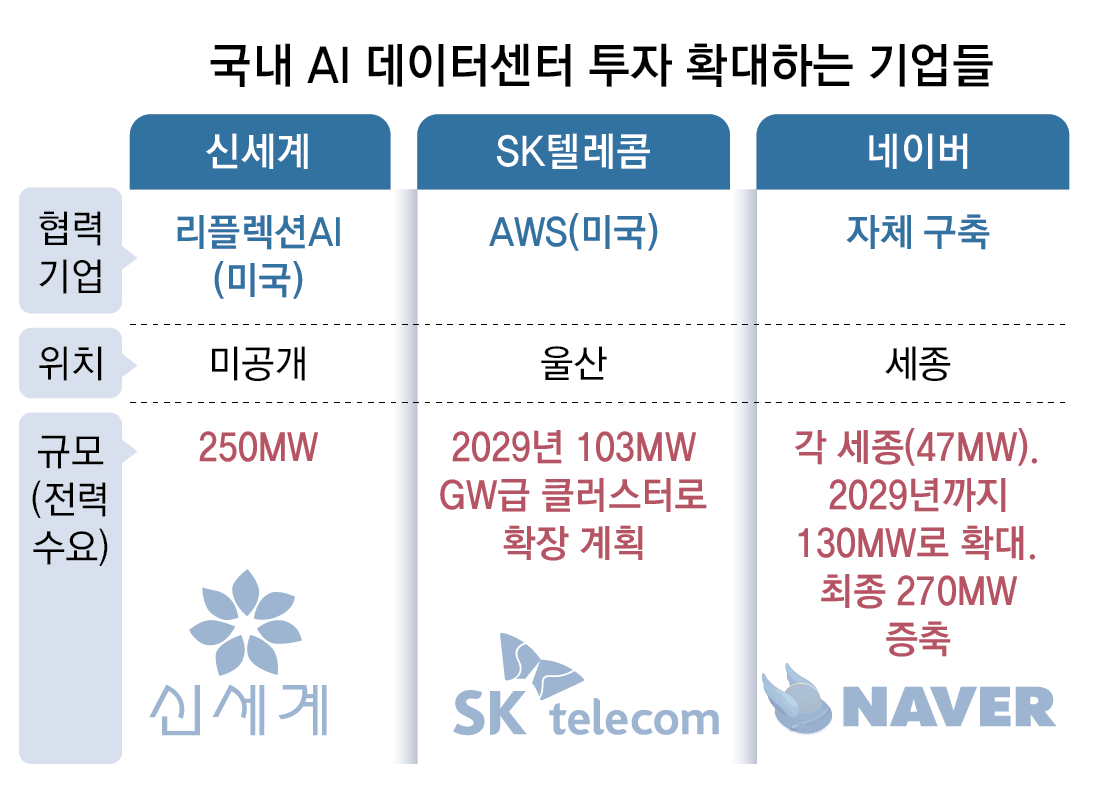
The two companies plan to establish a joint venture (JV) within the year and build an AI data center with an electric power capacity of 250 MW (megawatts) in Korea. Shinsegae explained that this will be the largest among AI-dedicated data centers that have been built or are under development in the country. The graphics processing units (GPUs), which are the core equipment for AI data center computation, will be supplied by Nvidia.
This collaboration is also significant as it represents the first flagship case to be realized through the “AI Export Program” being promoted by the U.S. government. U.S. Secretary of Commerce Howard Lutnick stated, “We will actively support the establishment of the best AI infrastructure in allied countries.” Chairman Chung said, “This collaboration will serve as a future growth engine for Shinsegae while also contributing to the advancement of the domestic AI ecosystem.”
The retail industry views AI as a core technology that will determine competitiveness in e-commerce. Having secured the largest number of customer touchpoints and data in Korea, Shinsegae expects that combining this with AI capabilities will enable it to realize differentiated “AI commerce” compared with other companies. For example, it aims to advance AI agent-based shopping services that recommend customized products to customers in online malls and automatically handle payment and delivery.
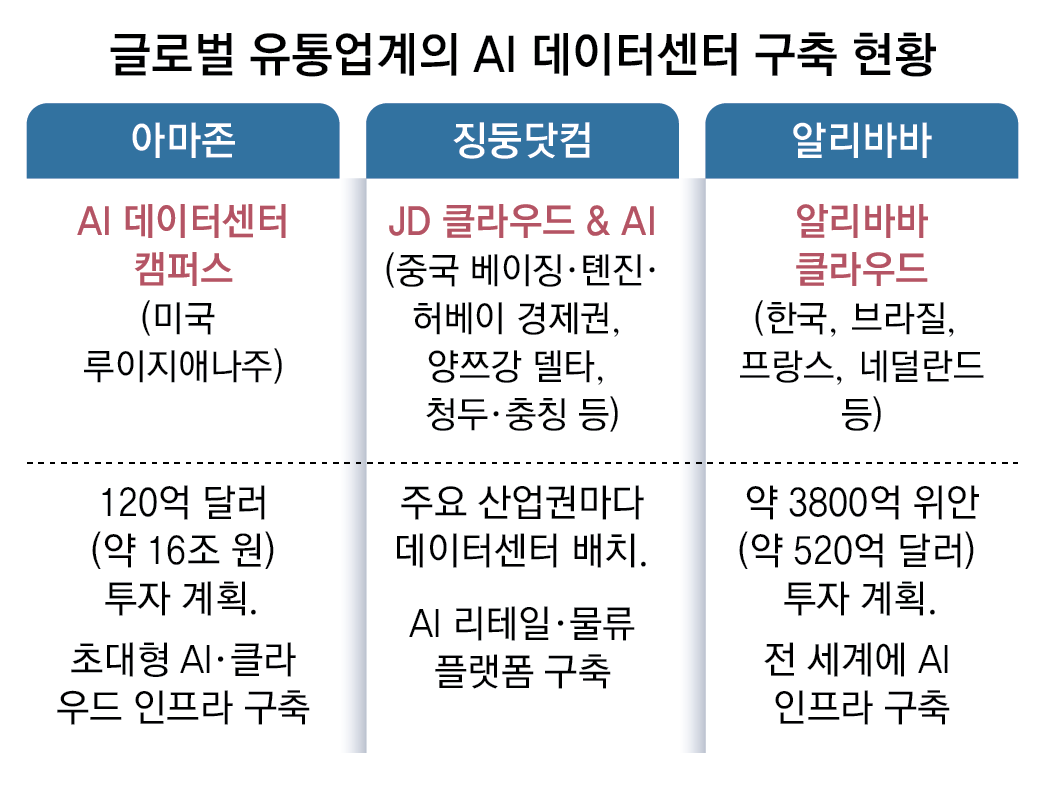
Global retail companies are expanding into AI infrastructure and cloud businesses built on their own customer data and platforms. Amazon, the world’s largest e-commerce company, has established a large-scale data center network around the world through its cloud business, Amazon Web Services (AWS). Amazon is also working to expand AI computing infrastructure, including investing USD 12 billion (approximately KRW 16 trillion) to build a new data center campus in the state of Louisiana in the United States.
Alibaba, China’s largest e-commerce company, is expanding its AI cloud infrastructure through its Alibaba Cloud business. Alibaba recently announced plans to invest CNY 380 billion (approximately KRW 82 trillion) in AI and cloud infrastructure. Chinese e-commerce company JD.com is also building data center infrastructure under its “JD Cloud & AI” business. It operates data centers in major economic hubs such as Beijing, Shanghai, Guangzhou and Chengdu, expanding AI-based logistics and retail services. Through this, it is applying AI technologies across the distribution sector, including demand forecasting, smart logistics operations and automated warehouse management.
Kim Jeong-ho, Professor at the School of Electrical Engineering at KAIST, said, “The ‘AI agent era’ is opening, in which AI agent-based services are spreading beyond the era of generative AI across various industries, including not only retail but also travel and education,” adding, “When retail companies build AI data centers, it is highly likely to lead to enhanced industry competitiveness specialized for the shopping sector and to securing customers.”
ⓒ dongA.com. All rights reserved. Reproduction, redistribution, or use for AI training prohibited.
Popular News