Since COVID-19, the number of people enjoying tennis as a hobby has been increasing. According to the National Sports for All Survey released by the Ministry of Culture, Sports and Tourism in 2023, tennis ranked among the top five sports for club membership along with football, badminton, table tennis, and golf.
As the tennis-playing population grows, demand for lessons has increased, but a shortage of facilities and professional coaches has led to rising dissatisfaction. One-on-one lesson fees easily exceed KRW 50,000–100,000 per session, which is burdensome for many. As a result, many players leave the court without ever knowing exactly “why their swing is wrong.”
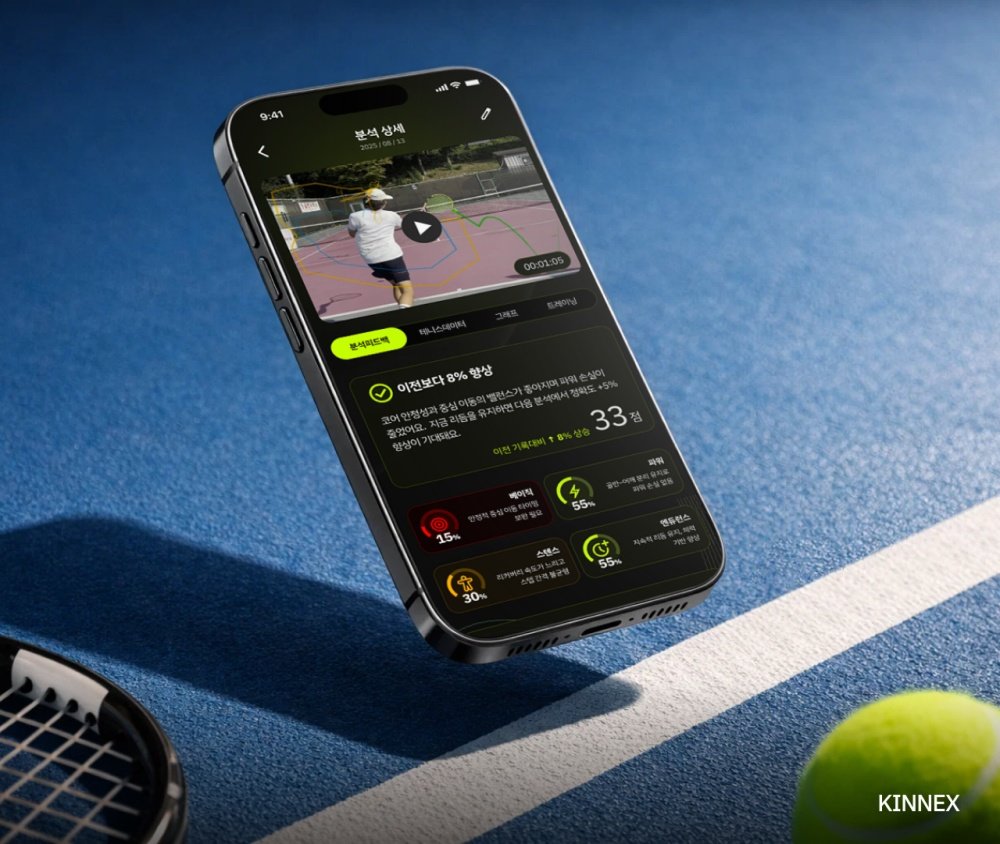
KINEX, developed by Sinsa Yuramdan, is an AI sports coaching platform / Source=Sinsa Yuramdan
Amid growing efforts to apply artificial intelligence (AI) technology to sports training, startup Sinsa Yuramdan has developed an AI sports coaching platform called “KINEX.” KINEX is a compound word of “Kinetic,” meaning human movement, and “Nexus,” meaning connection. It embodies the concept of “a platform that analyzes movement data and connects coaching with user experience.”
Competing with solid dataTennis has a lower entry barrier than golf and offers the advantage of providing both aerobic and strength training in a relatively short time. However, because it requires powerful swings, fast footwork, and repeated changes of direction, correct form is crucial.
In particular, players need to check how much their swing path deviates, at what point their weight transfer breaks, and how wrist acceleration works just before the point of contact (impact). All of these factors can be quantified, but traditionally, players have had no choice but to rely entirely on the coach’s eye and experience. Moreover, because each coach has different criteria, correcting tennis movements is difficult without a data-based approach.
Accessibility is also a major issue. Professional tennis swing analysis has long depended on expensive equipment such as smart rackets, high-speed cameras, and dedicated sensors. Consequently, most beginners and amateur players repeat the same mistakes or give up without knowing what they need to improve.
Sinsa Yuramdan CEO Kang Seong-yeol said, “There is always a gap between the coach’s sense and the player’s physical perception. Only data can bridge that gap,” adding, “We developed KINEX to connect the gap between the coach’s sensory feedback and the user’s lack of experiential understanding with data.”
Tennis at a growth stage in sports techThe global sports tech market has already entered a mature stage in running and cycling. Major platforms such as Nike Run Club and Strava dominate the market and enjoy high user preference. In running and cycling, the market structure makes it difficult for new platforms to enter.
By contrast, tennis remains underserved relative to its demand. According to a global sports tech investment report by market research firm PitchBook, sports tech—having led a mature market focused on running and cycling—is expected to draw the next growth curve in racket sports, including tennis.
Changes in consumer behavior have also played a role. Since COVID-19, trust in online sports training has increased. With the global spread of ChatGPT by AI company OpenAI, psychological resistance to AI-based coaching has also weakened. It has become natural to record workouts with a smartphone and track progress through data.
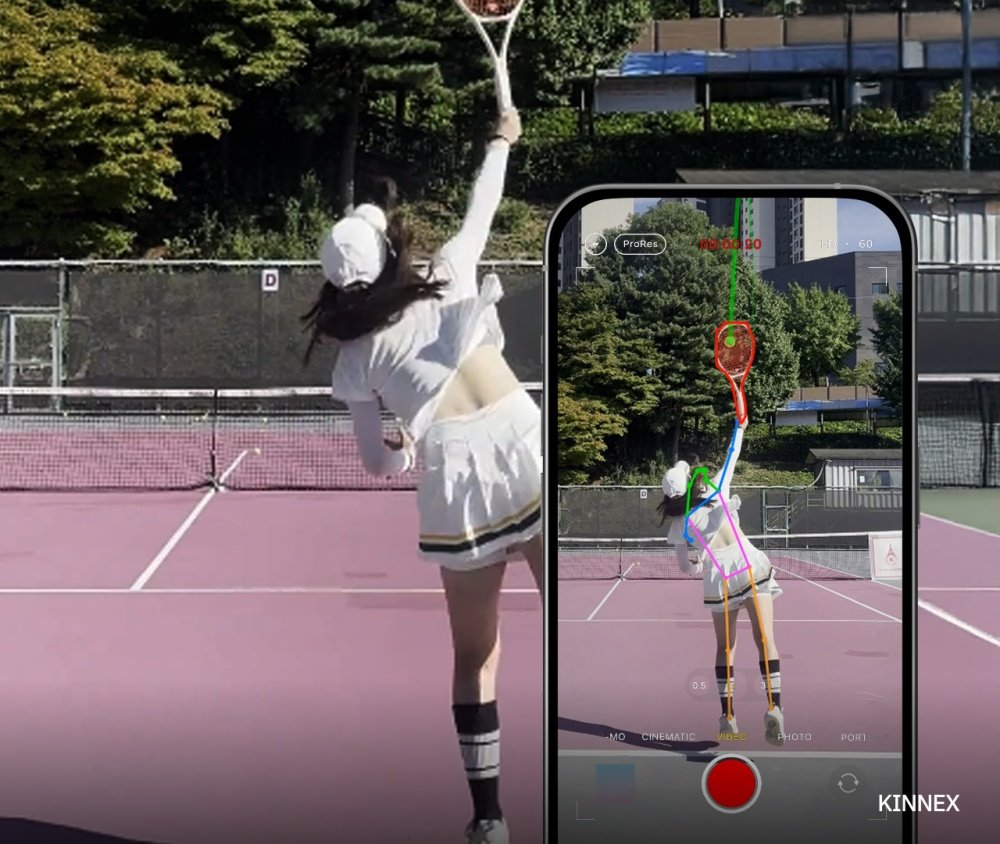
Differentiation from existing solutions through simultaneous tracking of player, racket, and ballThe core of Sinsa Yuramdan’s KINEX is that it delivers professional coaching-level analysis using only videos shot on a smartphone, without any additional sensors or expensive equipment. To minimize variables in smartphone shooting conditions, KINEX applies recommended shooting angle guides, automatic joint correction, and trajectory stabilization filters. Recognition stability has also been verified through a repeated-motion capture dataset.
KINEX delivers professional-level coaching analysis using videos shot on a smartphone / Source=Sinsa Yuramdan
The key technology behind KINEX is the combination of YOLO-based computer vision (CV) and sports physics algorithms. Whereas conventional AI pose estimation technologies have been limited to estimating human joint coordinates, KINEX focuses on multi-object sequence analysis that simultaneously tracks the player, racket, and ball and detects hitting events. It differentiates itself from existing solutions by continuously analyzing movements before and after the impact, the most decisive moment in sports.
The main analysis indicators of KINEX include ▲kinetic chain transfer speed ▲weight transfer ratio ▲rotation angle ▲wrist acceleration ▲impact timing, among others. These measurements are compared with benchmark values from professional players and presented in a way that users can intuitively understand. The average time from uploading a video via smartphone to generating analysis results is 5–10 seconds.
“The core of sports AI is not posture, but the moment of impact,” CEO Kang Seong-yeol said. “Detecting that event is the starting point of KINEX technology. Based on actual coaching theory and sports physics, we developed indicators through comparative analysis with motion data. We also designed indicator definitions and feedback structures in collaboration with on-site coaches and sports instructors.”
In addition, KINEX is not intended to replace coaches. It serves as an auxiliary tool that reduces the burden of repetitive explanations and allows coaches to focus on core corrections. For example, before a lesson, it can provide objective data, and after a lesson, it can automatically generate reports. In pilot testing of KINEX conducted by Sinsa Yuramdan, many coaches responded that “when explaining verbally, students did not get it, but once they saw the data, they understood immediately.”
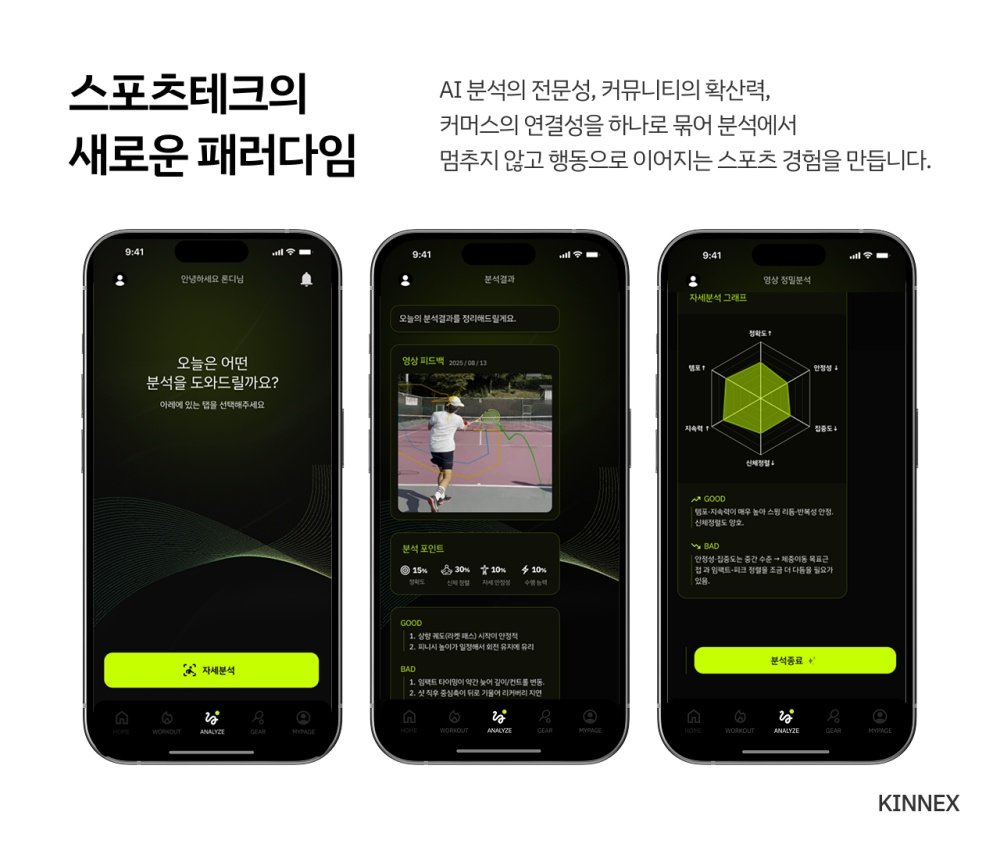
KINEX is designed to pursue a user growth loop structure / Source=Sinsa Yuramdan
KINEX is also designed to pursue a user experience (UX) growth loop in which analysis, understanding, correction, and remeasurement are repeated. Rather than ending with a one-time analysis, users can continuously check how much they have improved based on cumulative reports and growth rate data. During the KINEX pilot test, users showed the most positive reactions at three moments: when they first saw their movements objectively, when they visually confirmed improved metrics, and when the coach’s comments became understandable through data. Based on this, Sinsa Yuramdan expects to achieve strong retention.
The most distinctive concept in KINEX’s business model is Performance-to-Commerce. This refers to a business model that naturally links users’ workout data to commercial purchasing behavior. Beyond motion analysis, KINEX has created a commerce connection structure that recommends optimal rackets, strings, shoes, and other equipment based on users’ workout data. To this end, it is preparing collaborations with sports brands.
Conventional sports shopping has focused on popular products or value for money. Performance-to-Commerce creates a new purchasing context of “products recommended by my swing data.” An AI model that has learned swing style, ball trajectory, weight transfer patterns, and frequency of wrist use suggests optimal products. Because the recommendations are personalized rather than generic, the likelihood of actual purchase is high.
CEO Kang Seong-yeol emphasized, “KINEX aims to go beyond a simple motion analysis app and become AI sports growth infrastructure. Going forward, it can expand into an AI sports ecosystem that connects personalized training, equipment recommendations, sports commerce, and performance data. The ultimate goal of KINEX is to become a ‘shopping agent for movement data.’ We will create a world where personal data selects the optimal equipment.”
The revenue model of KINEX is freemium. The free tier offers basic motion analysis and key error indicators. The paid subscription adds detailed biomechanical indicators, cumulative growth reports, and AI training recommendations. In the mid to long term, the company plans to diversify revenue streams through B2B licenses for coaches and academies and the sale of anonymized sports data. It also plans to expand into other racket sports such as golf and table tennis, similar to tennis.
Meanwhile, KINEX is currently undergoing advancement with the goal of launching a beta version in the second half of this year.
IT Donga reporter Park Gwi-im (luckyim@itdonga.com)
ⓒ dongA.com. All rights reserved. Reproduction, redistribution, or use for AI training prohibited.
Popular News