All-solid-state, ultra-high-nickel, and LFP cathode materials on full display
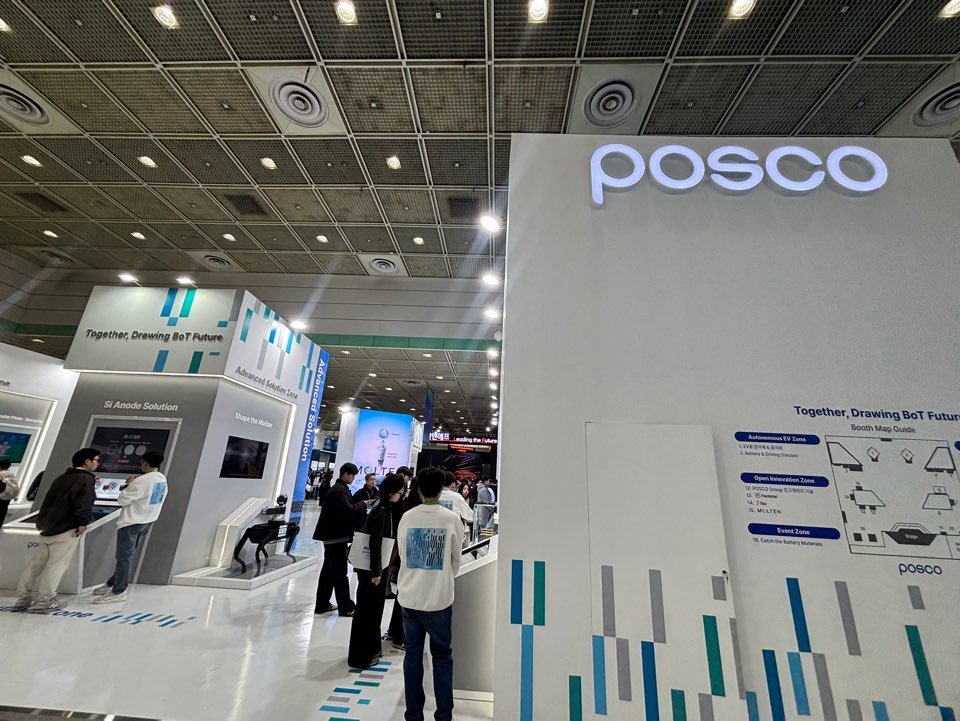
InterBattery 2026 POSCO booth. Reporter Hwang So-young fangso@donga.com
InterBattery 2026 opened on the 11th at COEX in Seoul. The POSCO Future M booth, with an area of 451㎡ (about 136 pyeong), drew a constant stream of industry officials and general visitors from the first day of the exhibition. From all-solid-state battery materials to the global supply chain, it offered a space where visitors could see the present and future of the battery industry at a glance.
“Together, Drawing BoT Future.” The phrase displayed at the booth entrance encapsulates the message POSCO Future M is delivering at this exhibition. It is a declaration to jointly usher in the so-called “BoT (Battery of Things)” era, in which everything from autonomous electric vehicles to data center ESS and humanoid robots is powered by batteries.
The booth was organized into five zones: ▲ Autonomous Driving EV ▲ Data Center ESS ▲ Advanced Solutions ▲ Open Innovation ▲ Sustainable Supply Chain. With POSCO Future M at the center, group affiliates such as POSCO and POSCO International shared a single booth, allowing visitors to directly sense the breadth and depth of the industrial scale surrounding a single battery.
In the Autonomous Driving EV zone, ultra high-nickel (Ultra High-Ni) cathode materials with a nickel content of 95% or higher drew attention. By maximizing energy storage capacity, they are optimized for autonomous vehicles that must continuously power high-consumption equipment such as cameras and radars, and, as explained, are also suitable for humanoid robots that need to carry long-operating batteries within a constrained form factor. Group EV solutions were exhibited together, including POSCO International’s drive motor cores and rare earth permanent magnets for electric vehicles, and POSCO’s cans for manufacturing battery packs and prismatic and cylindrical battery cells.
In the Data Center ESS zone, LFP cathode materials and high-capacity, long-life synthetic graphite anode materials took center stage. In line with surging power demand from data centers driven by AI expansion and the shift to renewable energy, POSCO Future M plans to convert part of its high-nickel production line to LFP-dedicated use this year, begin mass production within the year, and break ground on a dedicated LFP plant with an annual capacity of up to 50,000 tons. POSCO’s specialized steel products were also introduced, including shielding steel plates for ESS facilities and high-corrosion-resistant steel (PosMAC) for offshore wind power.
In the Advanced Solutions zone, battery application cases for future industries such as drones and humanoid robots were presented alongside a quadruped walking robot developed by the POSCO Group. Silicon-carbon anode material (Si-C), which can increase storage capacity by about five times compared with graphite-based anodes, was also unveiled. POSCO Future M has been operating a Si-C demo plant since last year and aims to begin mass production in 2027.
In the Open Innovation zone, U.S. all-solid-state battery company Factorial Inc. and silicon anode company Sila participated alongside POSCO Future M to disclose the status of their joint research and development. It was also reported that POSCO Future M’s materials received high evaluations for quality competitiveness, including output characteristics, in the development of cathode materials for all-solid-state batteries. The zone also showcased the POSCO Group’s development status in all-solid-state battery materials such as solid electrolytes and lithium metal anodes.
In the Sustainable Supply Chain zone, the POSCO Group’s global raw material sourcing status was presented, including lithium brine lakes in Argentina, lithium mines in Australia, and graphite mines in Africa, along with process technology for Direct Lithium Extraction (DLE) that enables economically viable lithium extraction even from low-concentration brine. POSCO Future M receives cathode material feedstock through this supply chain and is also pursuing construction of a domestic spherical graphite plant.
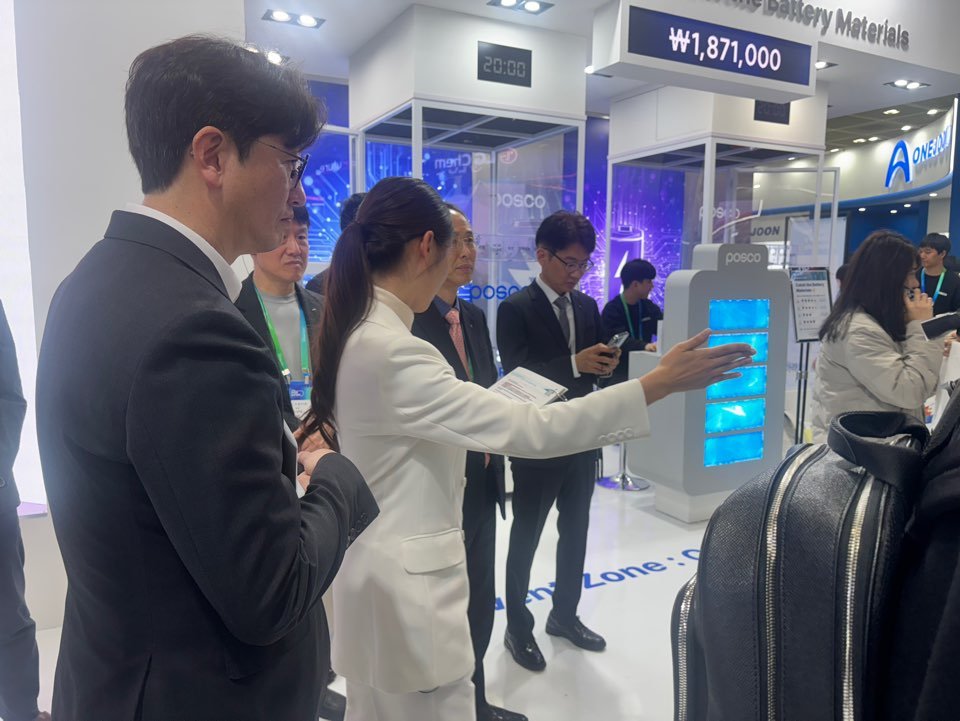
Korea Export-Import Bank Chairman Hwang Ki-yeon (fourth from left) visits and tours the POSCO booth. Reporter Hwang So-young fangso@donga.com
On the same day, Korea Export-Import Bank Chairman Hwang Ki-yeon visited the POSCO Future M booth and personally toured all five zones. From autonomous EVs to the sustainable supply chain, he examined the overall exhibition in detail, showing strong interest in the current state of the battery materials industry.
In one corner of the booth, a game was held in which participants drew balls representing battery materials such as lithium, precursors, and graphite to complete a battery. Visitors continued to line up from the opening day, and giveaways such as auxiliary batteries and portable fans were provided according to their scores. The accumulated scores from participation are converted into a social contribution fund and donated through the POSCO 1% Sharing Foundation.
POSCO Future M and U.S. all-solid-state battery company Factorial plan to hold a joint keynote lecture at 11 a.m. on the 12th, during the exhibition period, to present the two companies’ R&D strategies for battery materials. Hong Young-jun, head of POSCO Future M’s research institute, and Siyu Huang, CEO of Factorial, will speak as lecturers.
The two companies have been jointly developing cathode materials for all-solid-state batteries based on a close partnership. It is also noteworthy that, despite competition with numerous materials companies, POSCO Future M’s materials have received high evaluations for quality competitiveness, including output characteristics. Going forward, the companies plan to further strengthen cooperation to accelerate innovation in cathode and anode materials for all-solid-state batteries and expand their supply chains to global automakers and others.
ⓒ dongA.com. All rights reserved. Reproduction, redistribution, or use for AI training prohibited.
Popular News