MobilityLab is a deep-tech company developing unmanned pest control force-building solutions based on swarm autonomous flight technology. Swarm autonomous flight is a technology that enables multiple drones to recognize each other’s positions and missions and fly autonomously without centralized control, making it possible for a single pilot to control multiple drones simultaneously in a one-to-many (1:N) control mode.
Using swarm autonomous flight technology, MobilityLab can reduce agricultural pest control costs by more than 60% compared to conventional single-drone operations, while treating an area eight times larger within the same time frame. This technology has completed proof of concept (PoC) in Gyeonggi-do and Jeollabuk-do, and the company plans to begin full-scale provision of pest control services for approximately 10,000 hectares of farmland in Gyeonggi-do from April.
MobilityLab is growing rapidly, having secured more than KRW 2.5 billion through pre-seed and seed investments and government research and development (R&D) projects. It is also pursuing global expansion into markets such as Japan and Thailand, with plans to extend its applications from agriculture to disaster response and defense.
IT Donga spoke with MobilityLab CEO Chun Il-joon about the company and its swarm autonomous flight technology.
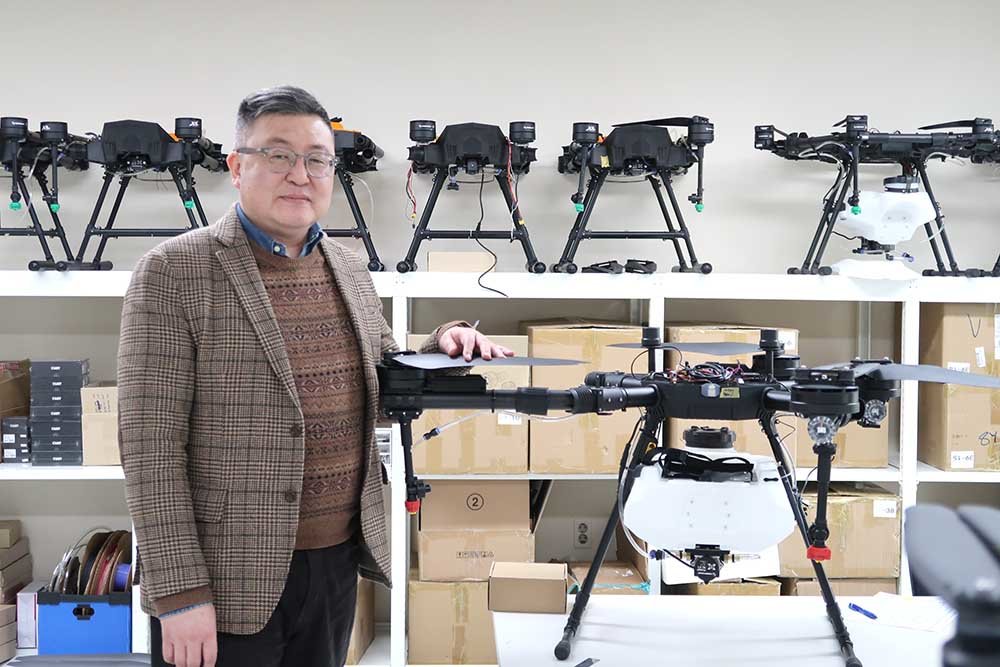
Chun Il-joon, CEO of MobilityLab / Source = IT Donga
Founding MobilityLab based on 10 years of experience in the UAV sectorIT Donga: Please introduce yourself, CEO Chun.
CEO Chun Il-joon: I am Chun Il-joon of MobilityLab. I am a tech entrepreneur with more than 10 years of research and business experience in swarm autonomous flight and unmanned aerial vehicles (UAV). I have broad experience in aviation and drone systems, autonomous flight algorithm development, and demonstration-based service businesses, and have personally overseen the full cycle from technology development and demonstration to commercialization. I am currently leading MobilityLab, a drone solutions company based on swarm autonomous flight technology.
IT Donga: What made you become interested in drones?
CEO Chun Il-joon: I originally developed embedded software and hardware for broadcasting equipment. I became interested in drones after being exposed to drone filming and then learned that drones are widely used not only for filming but also for pest control operations that prevent and eradicate crop diseases and pests. Wanting to learn more, I went to China in 2012, where drone technology was advancing, and met with related companies. The following year, I founded Korea Unmanned Aerial Service and started a business developing and selling agricultural drones.
IT Donga: Please explain what led you to found MobilityLab.
CEO Chun Il-joon: While running drone-related businesses, I felt a certain limitation. Although drone utilization increased, most operations relied on single-drone modes, which had limits in sufficiently improving productivity and economic efficiency. In particular, in agricultural pest control, disaster response and defense, I judged that technologies enabling multiple drones to be operated automatically and safely at the same time were urgently needed. I believed that combining collision avoidance and autonomous navigation technologies with swarm autonomous flight could address these shortcomings. So, after leaving Korea Unmanned Aerial Service and going through a preparation period, I founded MobilityLab in September 2024.
IT Donga: What is swarm autonomous flight?
CEO Chun Il-joon: Swarm autonomous flight is a technology that enables multiple drones to recognize each other’s positions and missions and conduct cooperative flight without centralized control. The entire system operates like a single organism rather than as individual drones. I believe swarm autonomous flight technology is the core of future drone technology, capable of simultaneously addressing productivity and scalability.
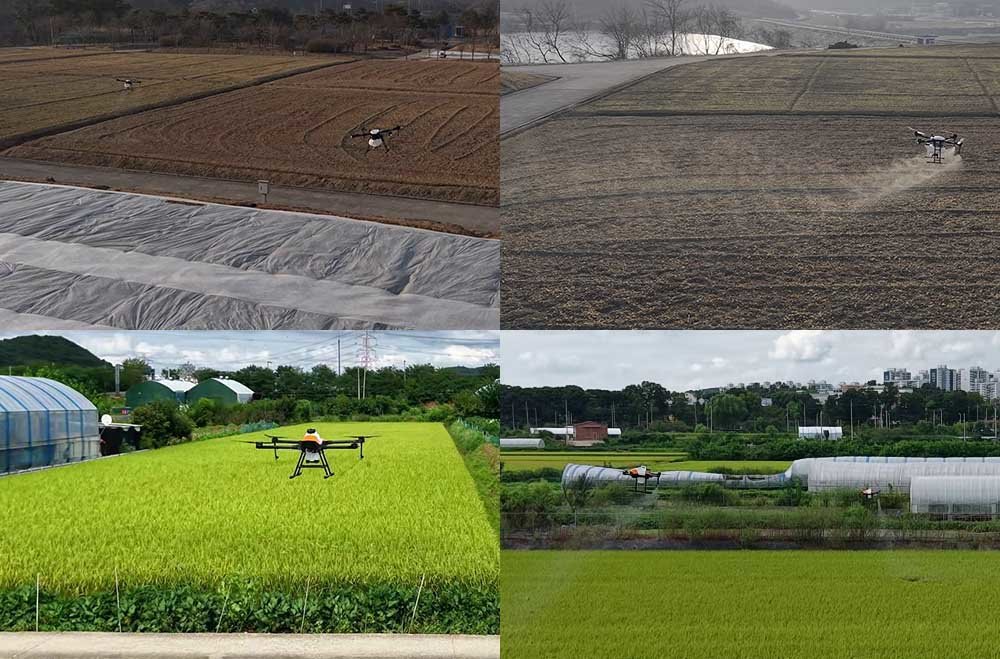
Pest control over farmland using MobilityLab’s swarm autonomous flight solution / Source = MobilityLab
Developing drone solutions based on swarm autonomous flightIT Donga: Please introduce MobilityLab.
CEO Chun Il-joon: MobilityLab is a deep-tech company that uses unmanned technologies to perform missions that are dangerous or physically impossible for humans. Tasks such as agricultural pest control, large-scale wildfire suppression, and defense operations can cause pesticide poisoning, casualties, and loss of assets when conducted directly by humans. We deploy swarm autonomous flight drones at such sites to remove risk factors and overcome operational limits. Our goal is not merely to manufacture drones, but to build unmanned systems capable of completing missions even in extreme environments, thereby simultaneously innovating human safety and productivity. For reference, the company name reflects our intent to apply our flight control technology not only to drones but also to helicopters, semi-submersibles, ships, automobiles and other mobility sectors.
IT Donga: You have developed a pest control solution based on swarm autonomous flight. What kind of solution is it?
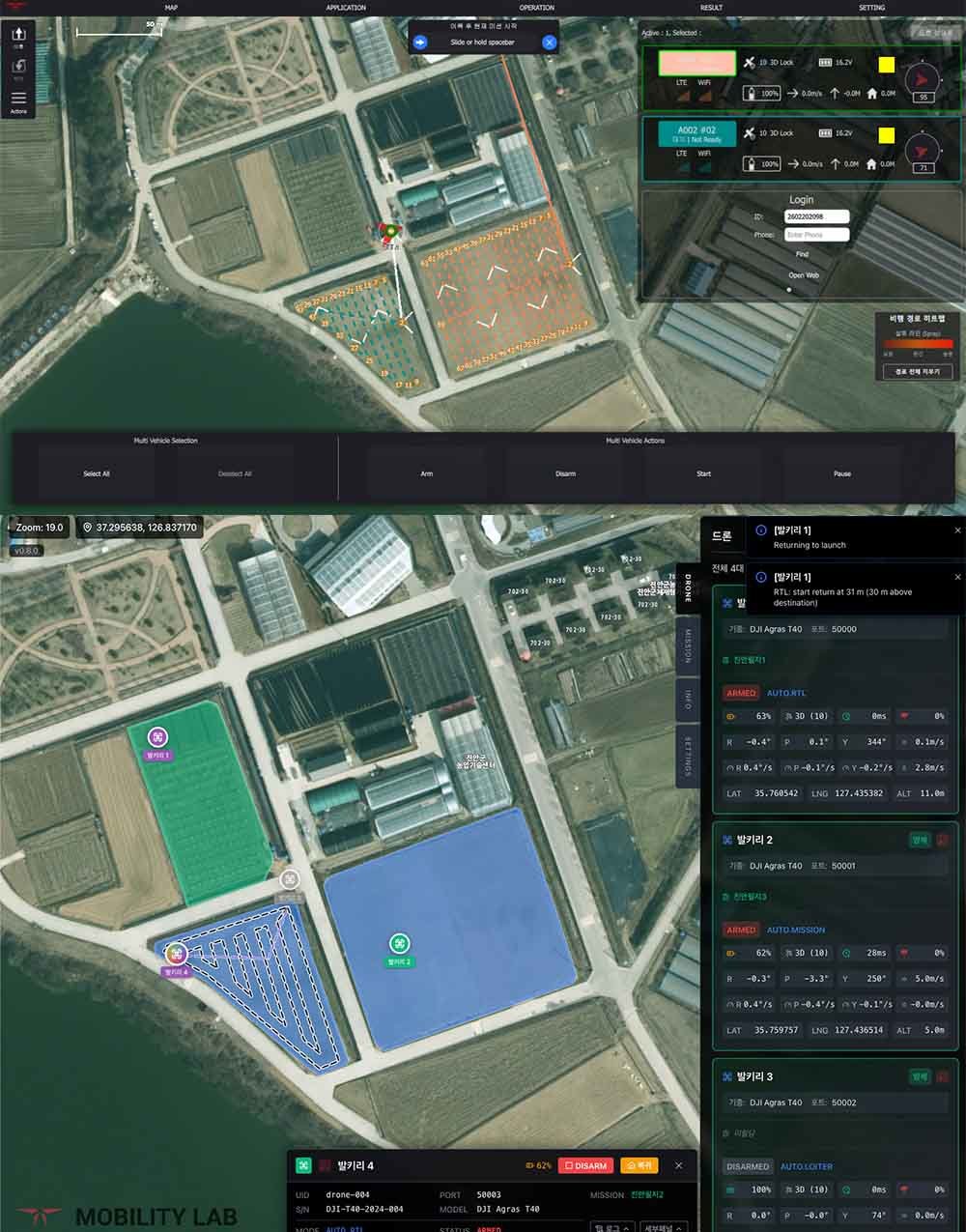
CEO Chun Il-joon: Pest control must be carried out within a specific period; if that window is missed, damage from diseases and pests becomes unavoidable. However, no matter how high-performing conventional agricultural drones are, there is a constraint that one pilot can only operate one drone. For example, to treat 100,000 pyeong of farmland, either 10 pilots are needed, or one pilot must work for several days and nights. Our solution enables one-to-many control, where a single pilot can control multiple drones. Once the pilot designates the treatment area and issues a command, the system automatically generates flight paths, and the drones divide the area and fly continuously to perform pest control.
The core technologies in our solution are AI mission planning and virtual gravity field-based swarm flight control. AI mission planning functions as the “brain” that perceives and assesses the overall situation. It analyzes environmental variables and mission objectives, allocates the most efficient mission to each drone in real time, and establishes optimal task execution plans. This is the technology that enables unmanned operation and autonomous navigation. Virtual gravity field-based swarm flight control is used for collision avoidance and path planning, setting up a virtual gravitational field so that drones can maintain formation and fly organically toward the target without collisions. This enables the system to calculate collision distances and avoid not only various on-site obstacles but also moving obstacles such as birds, through computations at a rate of 30 times per second.
IT Donga: How effective is it compared to a single drone?
CEO Chun Il-joon: Since the drones divide the area and fly continuously, pest control costs per unit area can be reduced by more than 60% compared to conventional single-drone operations. Treatment time is reduced to one-tenth, and it is possible to cover an area eight times larger within the same time frame. It is a solution well suited to rural areas where all farmland must be treated within a specific period.
Most importantly, it enables precision pest control. Conventional single-drone operations are often manually controlled, making it easy for errors to occur in routes or target points. For precision pest control, flight speed must be kept consistently below 2 m/s, but it is difficult to maintain a constant speed below 2 m/s through manual operation. As flight time increases due to operator fatigue, precision inevitably declines. Our solution flies at a constant speed and treats the entire area evenly without omissions, enabling precise and timely treatment over large tracts of farmland.
Integrated control platform for swarm autonomous flight drones / Source = MobilityLab
PoC completed in Gyeonggi-do and Jeonbuk, full-scale revenue generation this yearIT Donga: What is the current stage of development?
CEO Chun Il-joon: Development has been completed, and we conducted PoC in Gyeonggi-do. PoC is currently underway in Jeollabuk-do. The results were highly positive. Officials from the Jeollabuk-do Agricultural Research and Extension Services who participated in the PoC responded favorably to the fact that precision pest control was possible through low-speed and low-altitude flight, while overall work speed actually increased. They assessed that it is a technology capable of resolving conflicts of interest between farmers, who want meticulous work, and pest control service providers, who seek to speed up operations to pursue profits. It was recognized not only as a simple technology verification but also as a solution that addresses structural problems in the market.
Based on these results, we plan to begin full-scale provision of pest control services for approximately 10,000 hectares of farmland in Gyeonggi-do from April this year. From that point, we expect real revenue to start being generated this year.
IT Donga: It has been about 1 year and 5 months since the company was founded. Please share how the business is progressing.
CEO Chun Il-joon: From the early stages, our technology’s value was recognized, and we secured pre-seed and seed investments in February and October last year, respectively. In November last year, we were also selected for the TIPS (Tech Incubator Program for Startups) program, a private investment-led technology start-up support scheme. Through this, we have secured a cumulative total of more than KRW 2.5 billion. We have also been continuously selected for various support programs and leading technology development projects, including the 2024 Pre-Startup Package, the 2025 Re-Challenge Success Package, and a drone commercialization project.
I believe that maintaining a balance among three pillars—revenue, R&D, and investment—is critical in corporate management. Through long experience in running companies, I have learned that if even one of these is neglected, it becomes difficult to advance the business. MobilityLab has been able to grow rapidly in a short period because we developed the business while maintaining this balance.
Expansion into disaster and defense, and push for global market entryIT Donga: You are currently focused on agricultural pest control, but it is understood that you are also preparing to expand into other sectors.
CEO Chun Il-joon: For now, we are concentrating on agriculture. We will verify the stability of swarm flight to the extreme in pest control fields where thousands of flights are repeated daily, accumulate data, and secure system reliability. We are also working on advancing our technology. Through the TIPS program, we are developing AI-based technology that predicts high-risk areas for disease and pest outbreaks in advance and performs preemptive pest control, using data on soil, climate, past disease and pest outbreak histories, and pest control operations.
After that, we plan to expand into disaster response and defense. The precision control technology that was used to spray pesticides will be converted to fire-extinguishing bomb deployment, and the transport capability used for fertilizers will be adapted to supply military materiel. While the sectors differ, the core brain remains the same. Through a “One Core Multi Use” strategy that applies a single validated swarm control module to various airframes, we aim to reduce development costs and accelerate market entry.
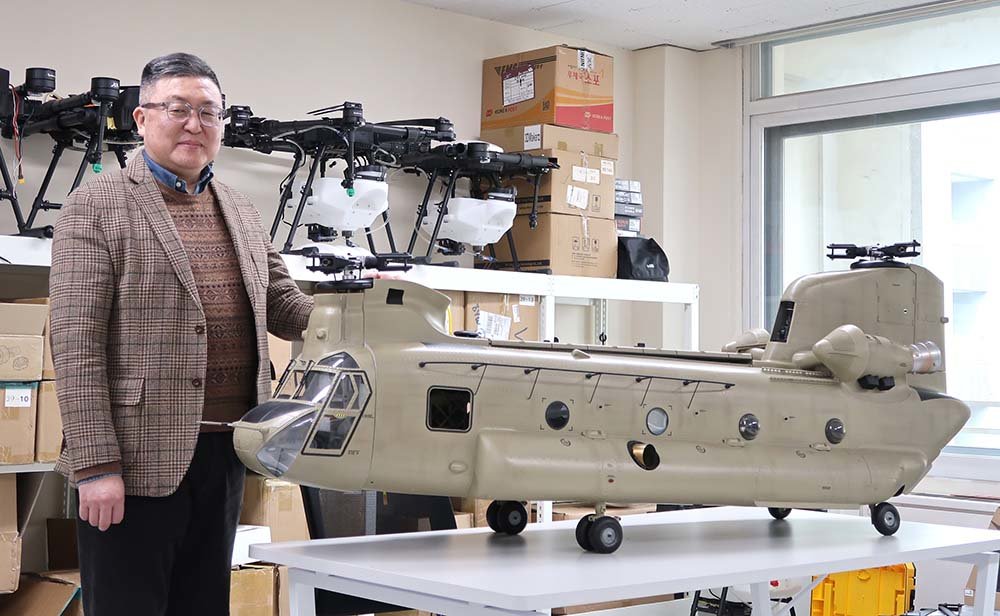
Large unmanned helicopter showcased at CES 2026 / Source = IT Donga
IT Donga: At CES 2026 in January, you showcased a fire-extinguishing bomb deployment system and an unmanned helicopter. What kind of solutions are these?
CEO Chun Il-joon: The two solutions unveiled at CES embody MobilityLab’s mission of “unmanned force-building for the most dangerous and demanding missions.” They also reflect our determination to replace humans in harsh disaster and defense environments and maximize mission success rates.
The fire-extinguishing bomb deployment system acts as a “special task force” that goes into flames where people cannot approach. Even at night or in dense smoke where helicopters struggle to operate, swarm drones are designed to precisely strike fire sources, thereby ensuring firefighter safety and contributing to initial fire suppression. This product was developed with the U.S. market in mind.
The large unmanned helicopter is designed to replace heavy equipment in extreme environments. It was developed to perform high-weight, long-distance missions that are impossible for small drones, such as dropping fire-extinguishing bombs weighing over 200 kg at wildfire sites or supplying ammunition and food to the front lines of battlefields. To this end, it uses an engine instead of motors. The large unmanned helicopter is being developed through a Ministry of Land, Infrastructure and Transport project and supports various communication standards, including high-precision GPS (RTK-GPS), Wi-Fi, LTE, and Starlink, enabling uninterrupted operations. After further advancement, the large unmanned helicopter is scheduled for official unveiling in June this year.
IT Donga: Are you also preparing to enter global markets?
CEO Chun Il-joon: We plan to enter the Japanese market first, where farmland area is more than four times that of Korea. We have agreed to conduct PoC in Fukui Prefecture and are currently coordinating detailed schedules. At the same time, we are preparing PoC in the Thai market. In the disaster sector, we are targeting the U.S. market, where we confirmed demand through our participation in this year’s CES. In the U.S., we plan to enter first through the disaster response sector and then expand into agriculture. We will actively promote our solutions by participating in local exhibitions and expand our market presence.
CEO Chun Il-joon explaining MobilityLab and its swarm autonomous flight solution / Source = IT Donga
IT Donga: Finally, please share MobilityLab’s future plans and goals.
CEO Chun Il-joon: Our roadmap is clear. In the short term, we will prove the productivity and economic efficiency of swarm autonomous flight drones in the agricultural market and then expand into disaster response and defense. We also plan to actively push for entry into the Japanese, Thai, and U.S. markets.
Our goal is to unmanned all dangerous environments faced by humanity. We will work to ensure that whenever a wildfire breaks out, our drones take off ahead of firefighters, and on battlefields, our drones carry out missions in place of soldiers, so that MobilityLab is always present in dangerous places.
Reporter Han Man-hyuk, IT Donga (mh@itdonga.com)
ⓒ dongA.com. All rights reserved. Reproduction, redistribution, or use for AI training prohibited.
Popular News