[10 Years After the AlphaGo Shock, Experimenting With AI–Human Coexistence] Part 3: A Realized Threat… Industry at a Crossroads
Webtoon and gaming sectors gripped by fears of a “job invasion”… Major impact expected on professionals in law, medicine, and beyond
“White-collar jobs will be replaced” vs. “AI will create new roles”… Global leaders and experts remain divided
“We must establish clear standards for AI use”
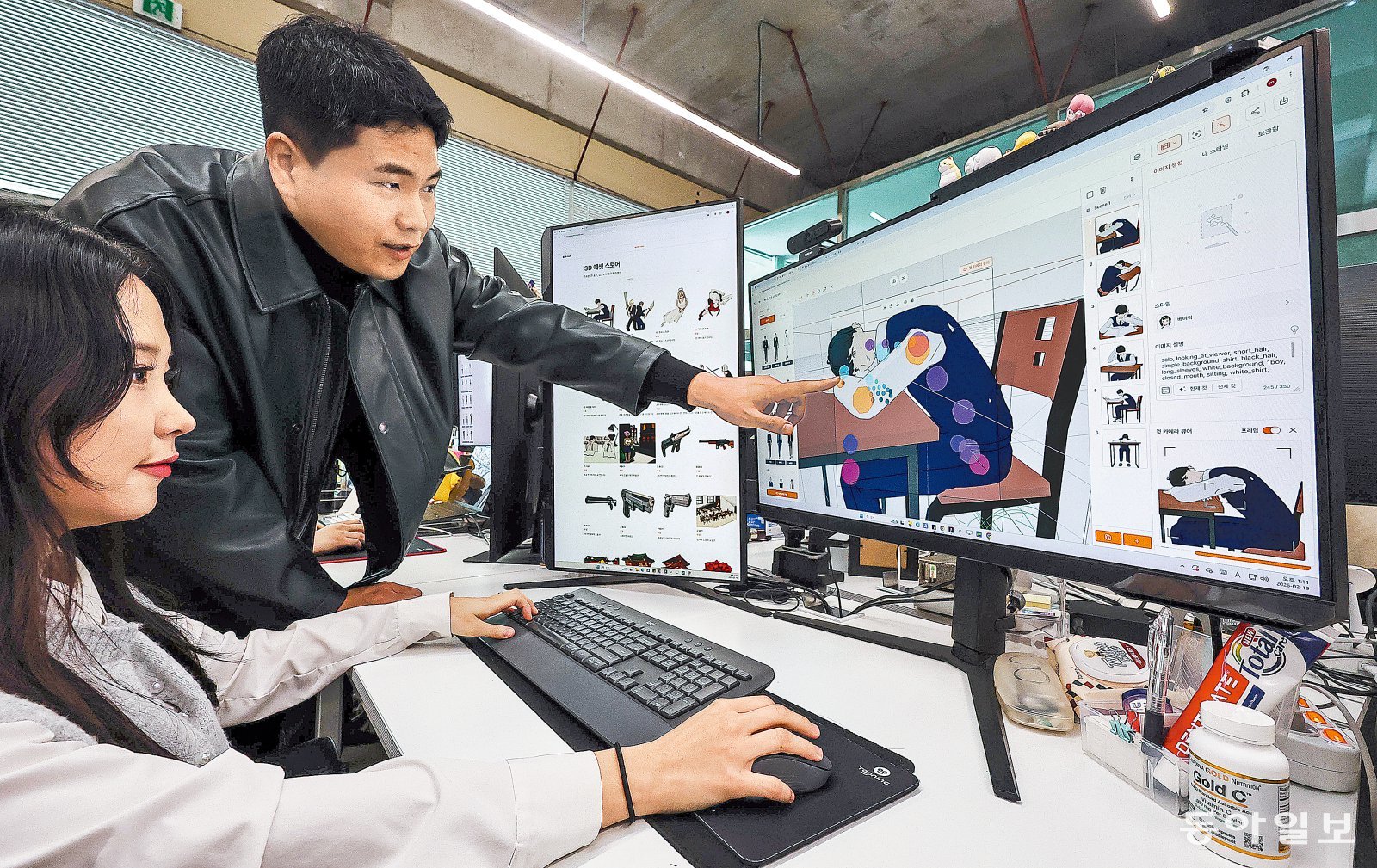
On the 19th of last month at “Toonsquare,” an artificial intelligence (AI)-based webtoon production startup in Seocho District, Seoul, Toonsquare CEO Lee Ho-young (right) communicates with an AX designer who is designing character images. Photo by reporter Yang Hoe-seong yohan@donga.com
When webtoon artist Shin Hyun-jung (41) was interviewed last month, it took her less than 10 minutes to complete two webtoon panels. Shin, who belongs to the AI-based webtoon production startup “Toonsquare,” explained, “Drawing 30 panels by hand takes about two weeks, but using AI it can be finished in a single day.”
Developer Lee Gi-u (29) at AI game development startup “AnchorNode” similarly used AI to instantly generate hundreds of weapons to be used in a game. After the developer selected a basic type of weapon such as a “two-handed sword” and entered a few detailed requirements, AI automatically produced a series of weapons. Using this technology, AnchorNode officially released a game called “Snaptown” in June last year. The company completed the entire process from game development to App Store launch in just two weeks.
“The fear is greater because it is impossible to foresee the colossal future that is coming.” Professional Go players made this confession after the match between Google DeepMind’s AlphaGo and grandmaster Lee Sedol 9-dan. Ten years on, as AI has begun in earnest to replace human hands and feet, industries across the board are struggling. The fear and anxiety that “my job” could also be taken by AI is rising as a huge wave regardless of sector.
● Professional and creative sectors alike in pain from AI’s onslaught
Even professional occupations are not exempt from AI’s onslaught. The judiciary recently built its own AI platform and began pilot application of a system to support trials. When questions are asked about key issues in a particular case, AI searches similar precedents or compiles relevant statutes and legal principles to provide answers. As the legal community remains sharply divided over the introduction of legal AI, AI has now begun to permeate even into the courts. In January this year, AI developed by a legal-tech startup contributed to the Supreme Court’s decision to overturn and remand a lower court ruling by detecting an error in the original judgment.
In the medical field, “K-Med AI,” a healthcare-specialized large language model (LLM) developed by Naver and Seoul National University Hospital, caused a stir last year by scoring an average of 96.4 on the Korean Medical Licensing Examination (KMLE). As AI has demonstrated outstanding analytical capabilities in areas such as image analysis and is now seeking to enter clinical practice, the Korean Medical Association filed a complaint with the police late last year, arguing that having AI diagnose patients and issue prescriptions via non-face-to-face channels such as chat constitutes a violation of the Medical Service Act.
As AI encroaches even on “creativity,” confusion in the creative industries is growing. The webtoon industry is a prime example. In an environment where there is still a prevailing sentiment that “creations produced using AI cannot be recognized,” the hit title “Expedition 33,” which swept Game of the Year (GOTY) and major awards at last year’s Indie Game Awards, was stripped of all its prizes after it was revealed that generative AI had been used in its production process. Yet AI is already depriving artists of income sources. Kwon Hyuk-joo, president of the Korea Cartoonists Association, said, “Commissioned work such as promotional comics and illustrations has been an important source of income for artists,” adding, “Promotional comics that previously had to be commissioned to artists are now created directly by PR managers sitting in front of their computers.”
● AI must be viewed as a tool, not a competitor
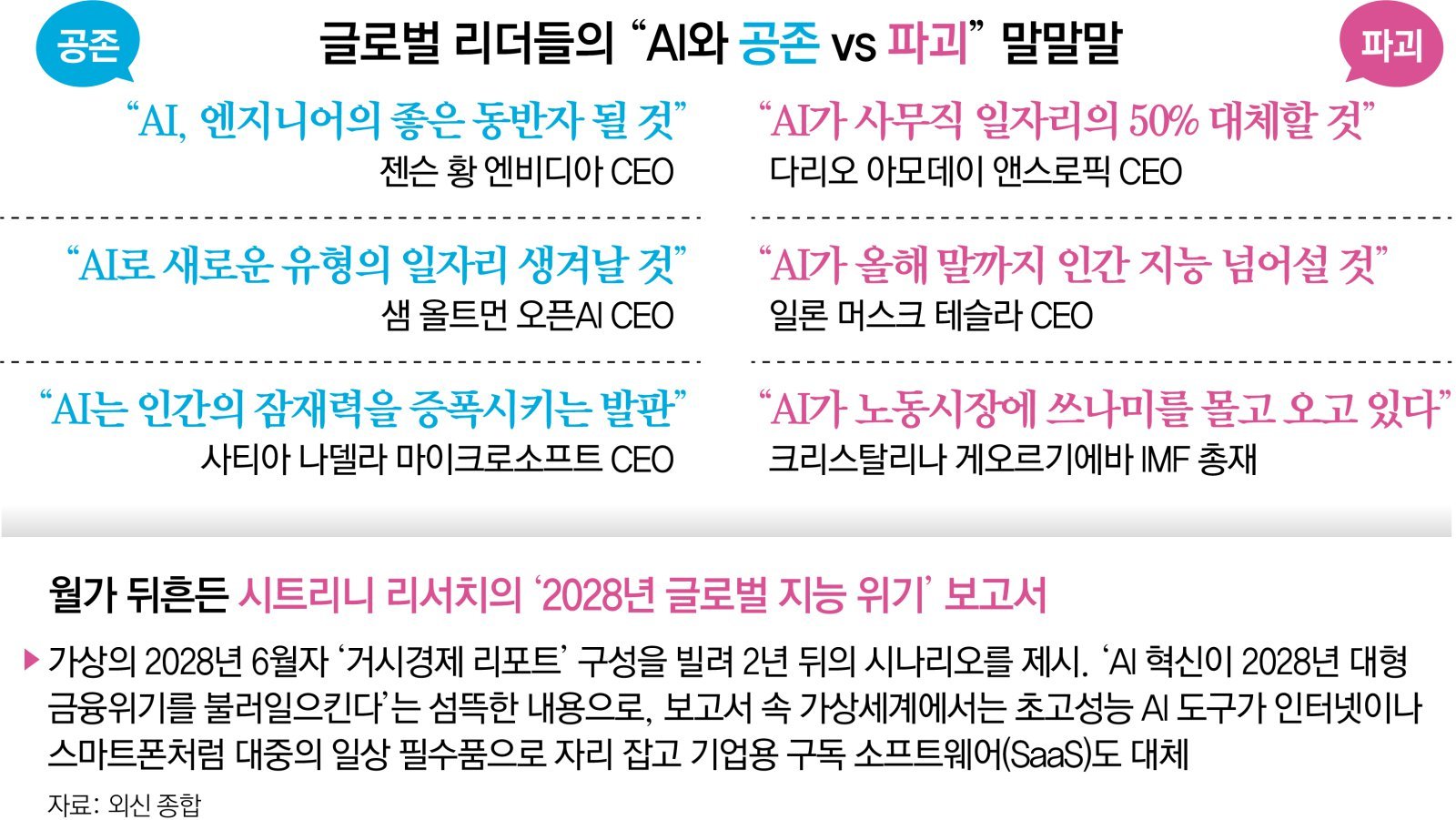
Global leaders are divided over AI’s seizure of jobs. Dario Amodei, CEO of Anthropic, warned of massive layoffs in white-collar occupations, saying, “AI can replace 50% of office jobs.” In contrast, Sam Altman, CEO of OpenAI, predicted that “as with every technological revolution, new types of jobs will be created.”
Experts say it is now necessary to establish “clear standards” on how far AI should be allowed and how this should be specified. Kwon said, “We now live in a world where AI with eyes and hands can draw from the most primordial stage,” adding, “This is the moment, before physical AI begins to learn through its own experiences, when systems must be created. If laws are not established now, creators will lose their place at the negotiating table altogether.” There are also calls to recognize AI not as a competitor but as a “tool” that enhances efficiency in creative work. Won Jae-ho, CEO of AnchorNode, said, “AI is merely a tool that raises the ‘floor’ of human capability.”
Seo Yong-seok, professor at the KAIST Moon Soul Graduate School of Future Strategy, said, “Across all sectors, including the creative industries, education, and labor, there must be deliberation and standard-setting on how AI will change the nature of work,” adding, “In any field, it is ultimately humans who make judgments on core values.”
ⓒ dongA.com. All rights reserved. Reproduction, redistribution, or use for AI training prohibited.
Popular News