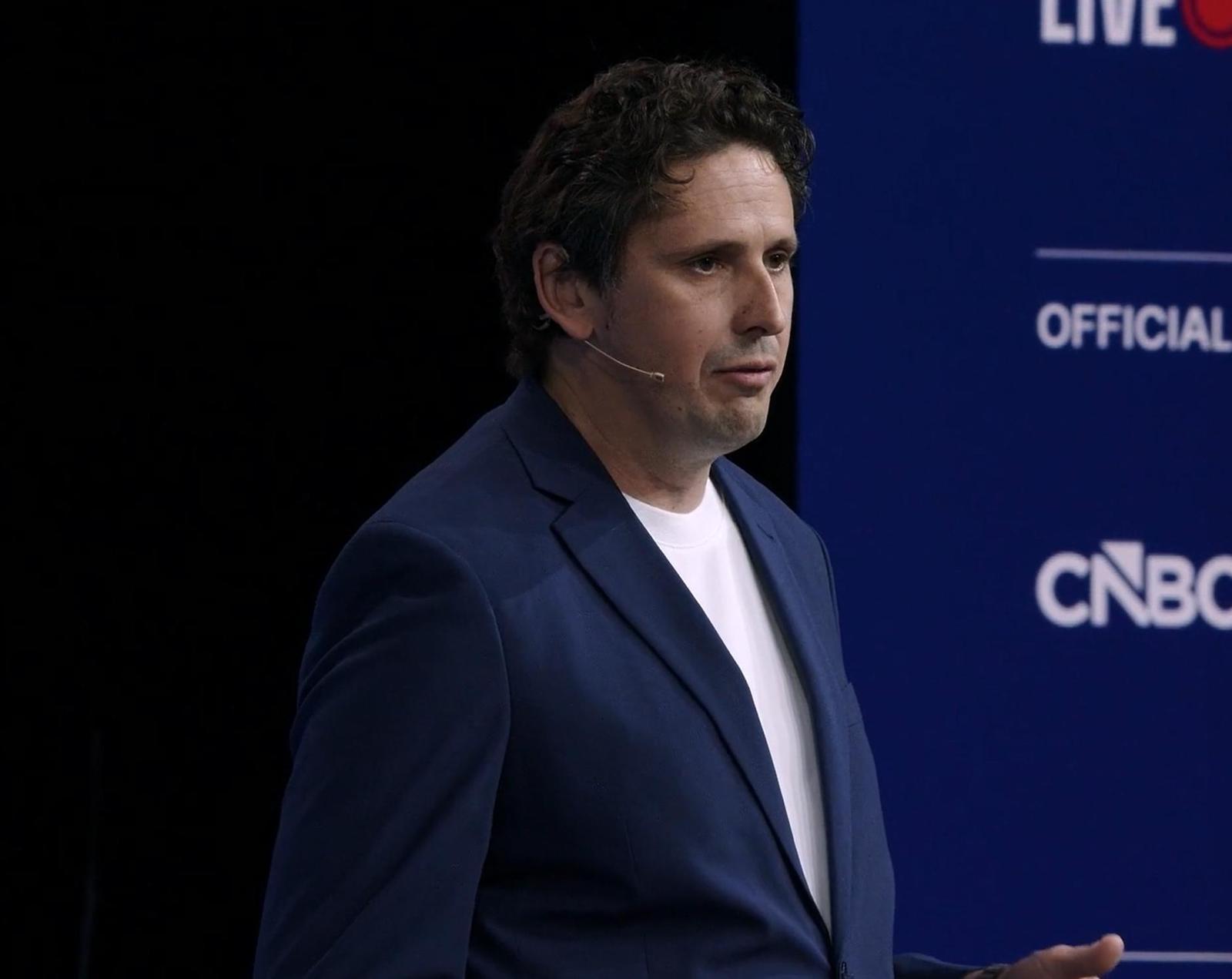
Michael Nichols, Senior Vice President of Starlink
“Next year, we will put second-generation satellites into orbit so that even ordinary smartphones can enjoy ultra-high-speed communication.”
This was stated by Michael Nichols, Senior Vice President of SpaceX’s Starlink, in a keynote speech at ‘Mobile World Congress 2026 (MWC26)’ held in Barcelona, Spain, on the 2nd (local time). Taking the stage together with SpaceX President Gwynne Shotwell, he unveiled a plan to begin launching second-generation satellites from next year using the next-generation launch vehicle ‘Starship’. There is a growing consensus that low Earth orbit satellite communications, which will eliminate coverage gaps, are emerging as a core “neural network” of the AI era alongside next-generation 6G.
● ‘Space communications’ to determine 6G dominance
On the day, Nichols presented a blueprint for second-generation satellites with data density 100 times and communication performance 20 times higher than the existing first generation. With these, even standard smartphones will be able to use 5G services at terrestrial-network-level speeds of up to 150 Mbps (megabits per second), enabling seamless ultra-high-speed internet access even in deserts or the middle of the Pacific Ocean.
The GSM Association (GSMA) set up a dedicated satellite communications exhibition zone for the first time at this year’s MWC26. The industry’s focus on satellite communications is driven by the goal of securing “absolute coverage.” In an environment where generative AI, autonomous driving, and urban air mobility (UAM) are commonplace, even a one-second interruption can directly lead to a critical accident. Covering dead zones where terrestrial base stations cannot reach with base stations in the sky—non-terrestrial networks (NTN)—has become a watershed for the 6G era. The International Telecommunication Union (ITU) has also put forward “connecting the unconnected” as a core value of 6G in the same context.
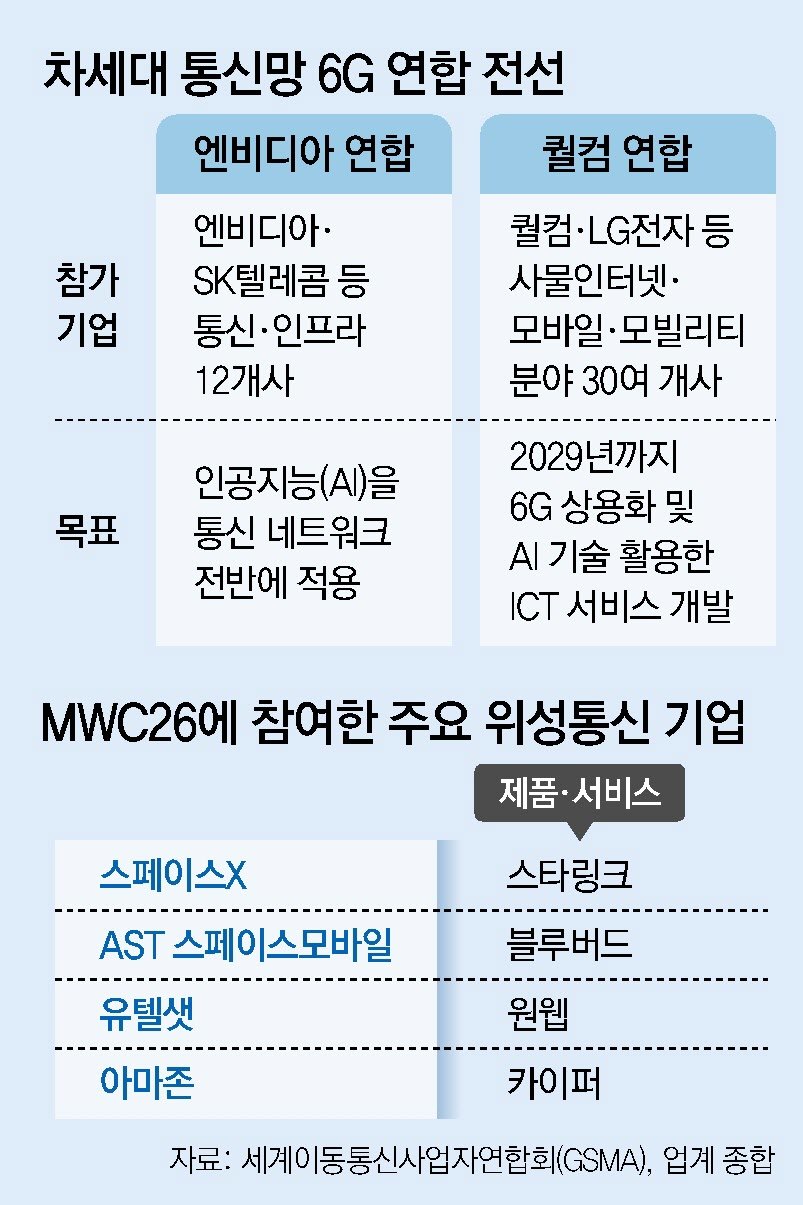
● ‘NVIDIA’ vs ‘Qualcomm’: 6G alliances In the AI era, there is active alliance-building to secure leadership in ultra-high-speed, ultra-low-latency 6G. Three-way groupings are forming between the “NVIDIA alliance,” targeting telecommunications infrastructure, and the “Qualcomm alliance,” spanning autonomous driving and devices.
Korean companies have emerged as key partners in both alliances. On the 1st (local time), SK Telecom joined the NVIDIA-led 6G network alliance, teaming up with BT of the United Kingdom, SoftBank of Japan, and others to combine AI with communication networks and to preempt “physical AI” infrastructure that connects robots and autonomous vehicles. For building a device ecosystem that encompasses mobility and the Internet of Things (IoT), a Qualcomm alliance has been formed that includes LG Electronics.
● Strong ‘K-ICT synergy’ at MWC26 On the same day, the heads of major Korean telecom operators also presented innovation strategies on the MWC stage. Hong Beom-sik, CEO of LG Uplus, took the opening keynote stage and stated, “The core of communication is ultimately voice,” proposing the establishment of a global calling standard led by the AI agent “ixi-O.” SK Telecom CEO Jung Jae-heon stressed at the “AI DC Conference” that “telecom operators must evolve into designers and key players of AI infrastructure.”
The two CEOs also visited the Samsung Electronics booth on the 2nd and met with Roh Tae-moon, President and Head of the Device eXperience (DX) Division at Samsung Electronics. Jung examined the “privacy display” applied to the newly released Galaxy S26 Ultra, which can selectively obscure parts of the screen, and praised it, saying, “This matches what customers need.” Hong experienced a virtual tour of Barcelona’s famous Sagrada Família through Samsung’s extended reality (XR) device, Galaxy XR, and commented, “It is far more impressive and lighter than expected.”
ⓒ dongA.com. All rights reserved. Reproduction, redistribution, or use for AI training prohibited.
Popular News