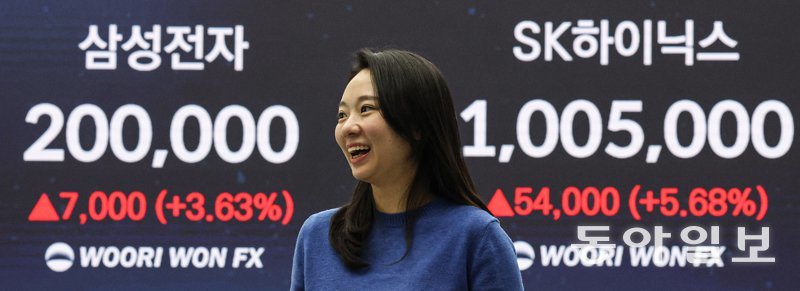
On the 24th, at the Woori Bank dealing room in Jung District, Seoul, the closing prices of Samsung Electronics and SK Hynix, which both hit record highs that day, are displayed. Photo by reporter Lee Han-gyeol always@donga.com
Although fears of a “dystopia” — a dark future in which artificial intelligence (AI) replaces humans and destroys key industries — have rattled the U.S. stock market, they have acted as a positive factor for Asia, which possesses competitiveness in semiconductor manufacturing.
The logic that growing AI investment inevitably expands demand for semiconductors and other AI infrastructure gained traction in equity markets. Backed by steep earnings growth projections for this year, Samsung Electronics and SK Hynix, the “two-top” semiconductor stocks in the Korean market, reached the symbolic milestones of KRW 200,000 and KRW 1,000,000, respectively, while the KOSPI is now on the verge of breaking through 6,000.
● ‘AI industry-destruction theory’: U.S. in decline, Asia on the rise On the 23rd (local time), the three major U.S. stock indices in New York all fell by more than 1%. The shock to Wall Street was triggered by a report from startup research firm Citrini Research. The report, titled “2028 Global Intelligence Crisis,” presented, in a science-fiction-like scenario, a forecast that AI will replace office workers, leading to higher unemployment, stagnant consumption, and an ensuing economic recession. As a result, share prices of highly valued companies, from software firms to delivery platforms and payment networks, declined. The Wall Street Journal (WSJ) analyzed that “Citrini Research’s report accurately captured Wall Street’s concerns.”
In contrast, in Asian stock markets, fears over AI’s destruction of industries acted as a positive catalyst. Expectations grew that supporting AI will necessarily require increased investment in semiconductors and AI infrastructure. Consequently, the “two-top” semiconductor stocks showed strong gains in tandem. In addition, as a bill to impose a blanket ban on imports of China-made energy storage systems (ESS) was introduced in the U.S. Congress, secondary battery stocks strengthened on expectations that U.S. companies would benefit.
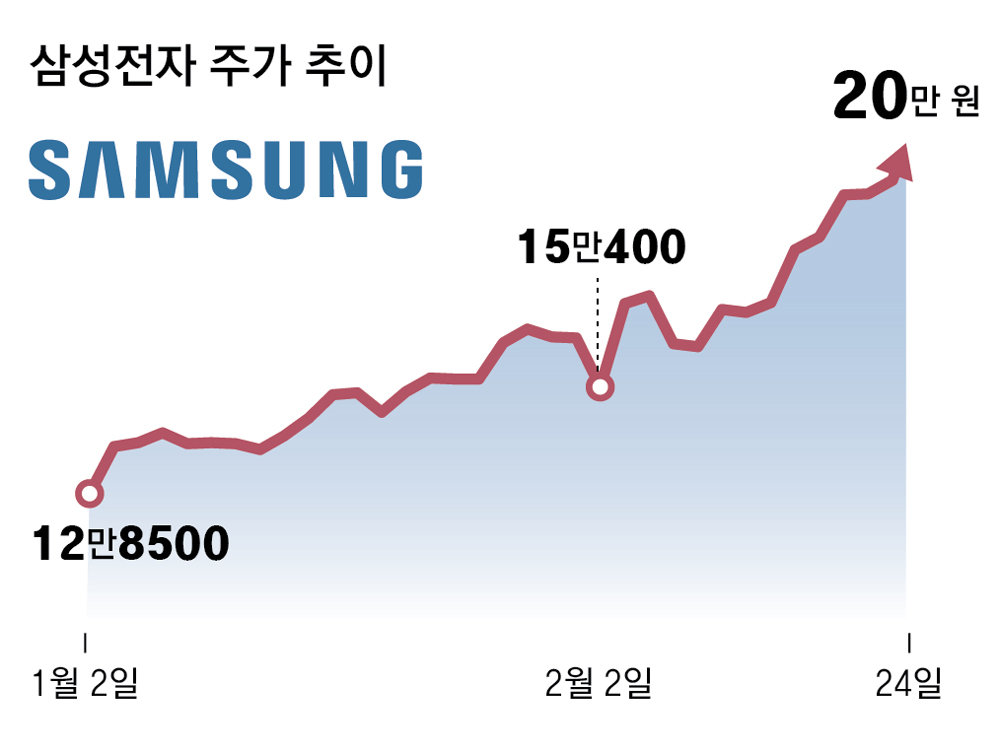
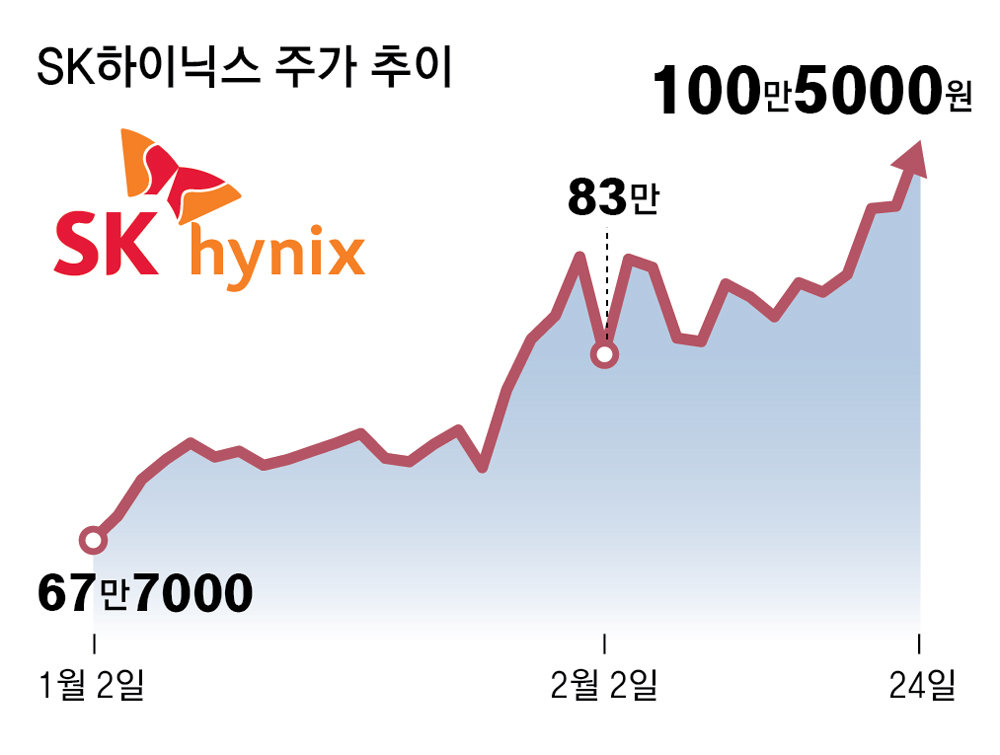
On the 24th, Samsung Electronics closed at KRW 200,000, up 3.63% from the previous trading day, while SK Hynix ended at KRW 1,005,000, up 5.68%. Both broke through the KRW 200,000 and KRW 1,000,000 thresholds, respectively. SK Hynix, which joined the ranks of so-called “emperor stocks,” rose to 21st place in the global market capitalization rankings that day, overtaking U.S. firm Micron. The KOSPI closed at 5,969.64, putting it on the brink of surpassing 6,000 less than a month after it first broke through 5,000 on a closing-price basis on the 27th of last month.
The strength of the two major semiconductor stocks is underpinned by earnings projections. The average operating profit forecast for this year by 24 securities firms stands at KRW 170 trillion for Samsung Electronics and KRW 145 trillion for SK Hynix. These figures correspond to sixth and eighth place, respectively, among global listed companies.
Kim Dong-won, head of research at KB Securities, said, “The unprecedented surge in server memory demand is expected to strengthen further,” adding, “The combined capital expenditure of the four major North American big tech companies is projected to reach KRW 960 trillion this year.”
AI infrastructure-related companies in Taiwan and Japan also showed strong performance. Shares of TSMC, the world’s No. 1 foundry (semiconductor contract manufacturing) company by market share, rose 3.42%, pushing Taiwan’s Taiex index up 2.75%. Delta Electronics, which supplies high-efficiency power systems and cooling components to AI data centers, jumped 6.13%. In the Japanese market, Furukawa Electric (+15.32%) and Sumitomo Electric Industries (+6.59%), which supply ultra-high-density optical cables and optical circuit switches to data centers, posted sharp gains.
● Positive forecasts grow, but fear index also climbs In the market, forecasts are emerging that the KOSPI will not only surpass 6,000 but move higher still. Kiwoom Securities on this day raised its projected upper band for the KOSPI this year from 6,000 to 7,300. The previous day, Nomura Financial Investment had suggested a first-half (January–June) KOSPI target range of 7,500–8,000.
However, the KOSPI fear index has risen for six consecutive trading days. The “KOSPI 200 Volatility Index (VKOSPI),” known as Korea’s fear index, has climbed for six straight sessions since the 12th. During intraday trading, it rose as high as 48.3. VKOSPI typically increases when the KOSPI plunges, but it appears to have climbed this time due to heightened uncertainty even amid a rising market.
Meanwhile, in the KOSPI market that day, individuals and foreigners were net sellers of KRW 228 billion and KRW 18 billion, respectively, while institutions were net buyers of KRW 237 billion, lifting the index. Among institutional investors, financial investment firms such as securities companies alone recorded net purchases of KRW 266 billion, which is interpreted as a result of individuals’ net purchases of exchange-traded funds (ETFs).
Jeong Yong-taek, a researcher at IBK Investment & Securities, explained, “In a market that has already risen to some extent, investors looking to enter tend to choose ETFs, which are perceived as less likely to incur investment losses and thus psychologically more comfortable, rather than selecting individual stocks,” adding, “Funds that these individual investors are putting into ETFs are flowing into the stock market.”
ⓒ dongA.com. All rights reserved. Reproduction, redistribution, or use for AI training prohibited.
Popular News