Completion of rollout within one year… Establishing itself as an essential technology for companies, medical staff, and patients alike
Improving quality of care by easing clinicians’ concerns and enabling proactive patient management
Pioneering the digital healthcare market with a goal of expanding to 100,000 beds and achieving annual sales of KRW 300 billion
Park Hyung-chul, Head of ETC Marketing Division, Daewoong Pharmaceutical
Daewoong Pharmaceutical has announced its plan to establish a “24-hour nationwide health monitoring system” that connects hospitals and homes. The company also presented a concrete roadmap to expand its next-generation smart bed monitoring system to more than 100,000 beds and to achieve annual sales of KRW 300 billion in the digital healthcare segment.
On the 23rd, Daewoong Pharmaceutical held a press conference under the theme “Digital Healthcare Vision: Opening an Era of Connected Daily Life and 24-Hour Nationwide Health Monitoring.” Park Hyung-chul, Head of the ETC Division, said, “The vision promised last year of ‘faster, closer, and smarter’ is now being realized in actual clinical settings,” adding, “Digital healthcare has moved beyond the introduction phase and has established itself as an essential technology that delivers a win-win-win outcome for companies, medical staff, and patients alike.”
Park stated, “A connected system is needed to overcome the reality in which care is cut off the moment a patient leaves the hospital,” and emphasized, “Although it usually takes a long time for new technologies to become widespread, digital healthcare has evolved into a critical solution for protecting patient safety in just one year, backed by active adoption by medical professionals.” He added that the company intends to entrench a new paradigm of nationwide home-based monitoring that enables continuous management of patients’ conditions even after discharge.
‘All-new Sync’ integrates fragmented medical data into one
The core competitiveness lies in the capability to organically connect vast volumes of biometric data on a single platform and analyze them through integrated AI. Daewoong Pharmaceutical unveiled “All-new Sync,” an upgraded version of its existing smart bed monitoring system “Sync.” All-new Sync represents an expanded version that goes beyond a smart bed monitoring system to become an integrated AI healthcare platform that manages various patient data at once.
Completed through broad-based partnerships with innovative startups in each field, the platform integrates Sears Technology’s wearable sensor-based smart ward platform, iCoop’s continuous glucose monitoring (CGM) solution “CGM Live,” Sky Labs’ ring-type cuffless blood pressure monitor “CART-I,” and Puzzle AI’s AI voice-recognition medical record solution “CL Note.” This has established a medical infrastructure that centrally manages previously scattered medical data on a single screen.
As devices that previously operated individually have been integrated, medical staff can now comprehensively analyze key vital signs such as electrocardiogram, blood pressure, blood glucose, body temperature, and oxygen saturation in real time and use them in clinical decision-making.
Lee Young-shin, CEO of Sears Technology, said, “All-new Sync is evolving into an AI-based platform that goes beyond vital sign detection to integrate and analyze diverse medical data to support clinical judgement by medical professionals,” adding, “Going forward, we will not remain confined to in-hospital monitoring but will expand into emergency and home-care environments to build a full-cycle monitoring infrastructure that connects the entire patient care journey.” The company plans to broaden the monitoring scope to include all vital signs required in inpatient wards, such as electromyogram, electroencephalogram, expiratory volume, auscultation, infusion, residual urine, and cardiac output.
iCoop’s “CGM Live” is reported to have dramatically alleviated the pain of hospitalized patients who previously had to undergo needle-based blood draws four times a day. It measures blood glucose in real time more than 288 times per day and automatically transmits the data to the hospital’s electronic medical record (EMR) system via Bluetooth and cloud technology.
Cho Jae-hyung, CEO of iCoop, explained, “When continuous glucose data is linked with Sync, it allows a more three-dimensional understanding of the patient’s condition, and eliminates repetitive blood draws, greatly improving both patient safety and the efficiency of medical staff,” adding, “When analyzed together with other vital data, it enables even more precise diagnosis.”
Sky Labs’ “CART-I” is a ring-type device worn on the finger, in which a photoplethysmography (PPG) sensor detects changes in blood flow in the vessels and uses AI to automatically estimate blood pressure. Executive Director Park Sun-hee stressed, “Through automatic measurement and recording, nurses can be freed from repetitive measurement tasks and focus more on patient observation and emergency response.” The technology, which has completed comparative verification against arterial line (A-line) and 24-hour blood pressure monitors, is highly reliable and significantly reduces the potential for errors associated with manual measurements as well as the workload of nurses.
Puzzle AI’s “CL Note” has dramatically improved the accuracy of medical records, the final destination of medical systems. By simply speaking into a microphone even while wearing surgical gowns and gloves, information is summarized in real time and entered into the EMR through a “pencil-free” and “end-to-end” automated system. Puzzle AI CEO Kim Yong-sik said, “When biometric data and clinical data from medical staff are integrated on a single platform, more precise analysis and prediction become possible and the speed of clinical decision-making by medical professionals will improve significantly.” By linking patients’ biometric signal data and treatment details from medical staff in real time on a single platform, an unprecedented level of data accuracy and scalability has been secured.
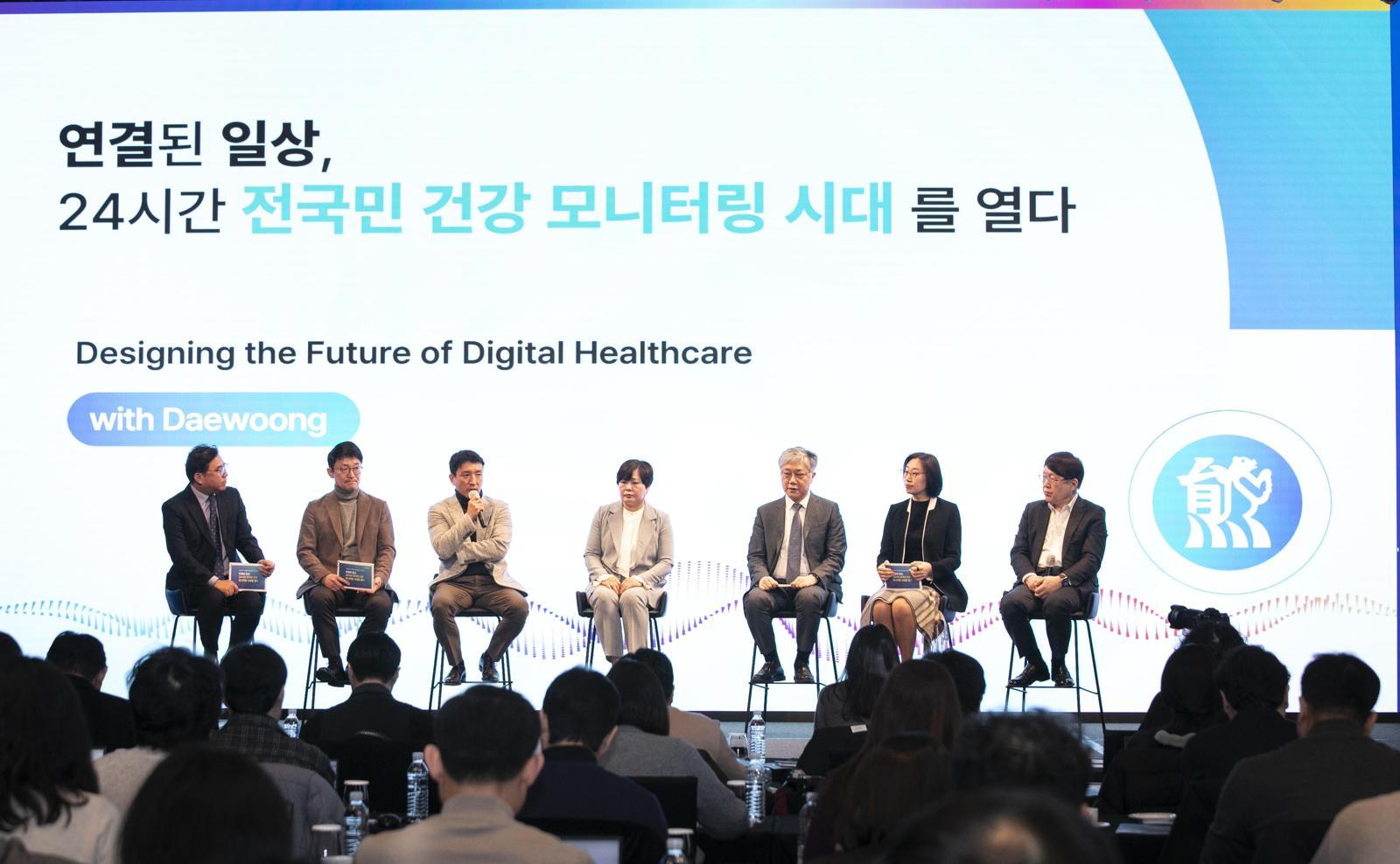
(From left) Park Hyung-chul, Head of ETC Division, Daewoong Pharmaceutical; Lee Young-shin, CEO of Sears Technology; Yang Moon-sool, Chair of the Future Healthcare Committee, Korean Hospital Association; Lee Kyu-min, President of the Korean Small and Medium Hospital Nurses Association; Cho Jae-hyung, CEO of iCoop; Park Sun-hee, Executive Director at Sky Labs; and Kim Yong-sik, CEO of Puzzle AI.
Addressing medical workforce shortages and starting proactive care
Amid an intensifying shortage of medical personnel, this kind of digital transformation is becoming a necessity rather than a choice. All-new Sync is said to be transforming traditional clinical environments, which had focused on reactive responses, into settings that enable proactive management.
There have reportedly been cases in which subtle early-warning alerts detected by Sync helped secure the four-minute “golden time” for cardiac arrest, saving lives, as well as cases where falls among elderly patients were detected immediately, enabling prompt intervention.
Yang Moon-sool, Chair of the Future Healthcare Committee at the Korean Hospital Association, said, “Until now, changes in patients’ conditions have been detected thanks to the sacrifice of medical staff,” adding, “Monitoring systems such as Sync are important tools that fill this gap and powerful weapons that provide new clinical insights.”
Yang continued, “With the introduction of real-time inpatient monitoring systems, the capability to identify high-risk patients earlier and respond proactively has been strengthened,” and added, “If such systems are gradually expanded to small and medium-sized hospitals, a patient monitoring environment equivalent to that of tertiary hospitals will become more widely available, contributing to overall improvement in healthcare quality and to narrowing regional disparities in medical services.” He also stated, “Based on patient data that is continuously accumulated, a variety of clinical studies will be possible, and this is expected to play an important role in advancing personalized precision medicine,” adding, “Digital healthcare will become a core infrastructure supporting clinical decision-making by medical staff going forward.”
Nurses, too, reported that being freed from repetitive tasks of measuring and recording vital signs allows them to focus on their primary roles, such as assisting in patient care and making professional judgements, significantly improving work efficiency and the quality of medical services.
Lee Kyu-min, President of the Korean Small and Medium Hospital Nurses Association, said, “Previously, nurses had to physically tour the wards to measure vital signs and check patients’ conditions, but since the introduction of real-time monitoring systems, we can grasp the status of patients at a glance from a central location,” explaining, “As work efficiency has improved, an environment has been created in which nursing resources can be concentrated on patients who require more intensive management.”
She added, “We are now able to detect abnormal signs and respond proactively before patients themselves request help, and especially during night shifts or when guardians are absent, continuous monitoring of patients’ conditions helps greatly in filling blind spots in care,” noting, “This has laid the foundation for more effectively managing patient safety even under constrained staffing conditions.”
There was also a case introduced in which a patient transitioning to bradycardia or tachycardia was first detected at the central station, allowing for proactive changes in prescription.
Targeting 100,000 beds and KRW 300 billion in sales… Pioneering the digital healthcare market
Daewoong Pharmaceutical announced three core goals: to accelerate digital transformation by expanding the adoption of Sync to more than 100,000 beds; to surpass annual sales of KRW 300 billion in the digital healthcare segment based on commercialized and validated products; and to establish a 24-hour health monitoring system that extends to home care after discharge.
In particular, the company expressed a strong commitment to pioneering the market in digital healthcare, following its traditional pharmaceutical industry goal of achieving “KRW 1 trillion in sales with a single blockbuster product,” by generating tangible results in this new field as well.
Park Hyung-chul stated, “Through an integrated platform that connects hospitalization, home care, and emergency stages, we will establish a new standard for managing public health.”
Going forward, Daewoong Pharmaceutical plans to build a “digital health safety net” that enables continuous patient management in cooperation with primary care institutions, by linking its chronic disease management platform “Well Check” with primary medical institutions. This reflects the company’s vision to build a robust digital infrastructure that enables immediate response even when a patient collapses alone at home, signaling a leap toward a “full-cycle monitoring platform” spanning hospitalization, home care, and emergency care. Medical professionals also expect that if such digital healthcare technologies become more widely disseminated, they will enable more precise and continuous understanding of patients’ conditions, making a substantial contribution to improving the quality of medical services and establishing a patient-centered care environment.
ⓒ dongA.com. All rights reserved. Reproduction, redistribution, or use for AI training prohibited.
Popular News