China’s ‘brain science startups’ receive bold backing
Latecomer overtakes U.S. in number of implant procedures
“Transitioning from research phase to mass production stage”
U.S. and China race to dominate the BCI ecosystem
Scholars voice concern over China’s “weaponization of brain technologies”
China is rapidly catching up with the United States not only in electric vehicles and artificial intelligence (AI) but also in the field of brain science. The Chinese government, aiming to become the global leader by 2030, is providing unprecedented financial and regulatory support to brain-computer interface (BCI) companies that analyze brain signals to read human thought. As both the US and Chinese governments view BCI technology as an emerging capability that will shape national security, intense competition to dominate the related ecosystem is expected to continue.
● Latecomer China in hot pursuit of US firm Neuralink
BCI technology connects the brain to computers by converting the brain’s electrical signals into digital signals. It enables external devices to be controlled purely by thought, evoking the “telepathy” technologies that appeared in past science fiction (SF) films.
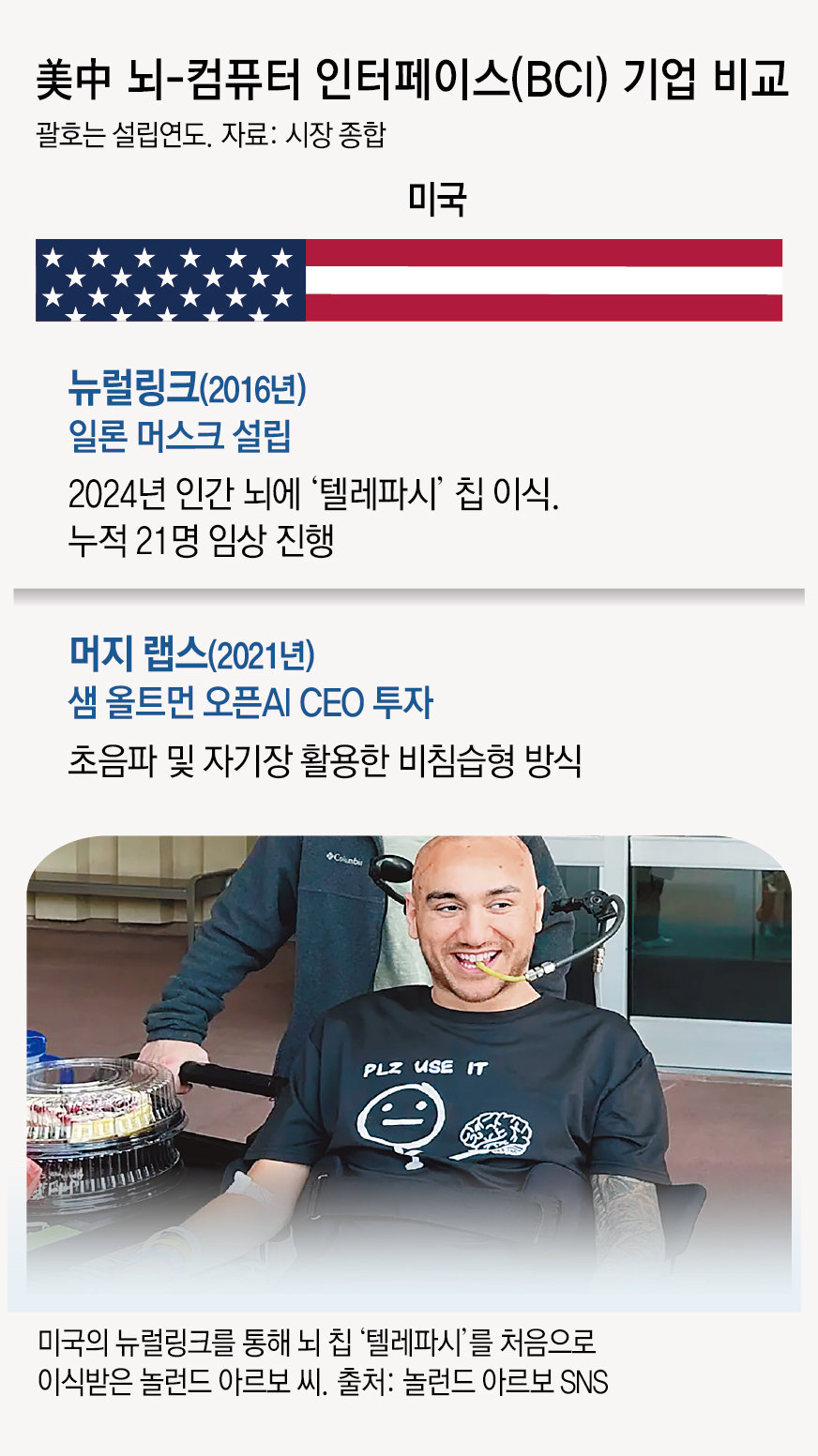
Until now, the leader in this field has been Neuralink, founded by Elon Musk, chief executive officer (CEO) of Tesla. Neuralink has showcased “brain implant” technologies by inserting “Telepathy” chips into the brains of 21 quadriplegic patients, allowing them to type or play games on a computer. Recently, the company also announced plans to launch “Blindsight,” a product that connects electrodes to the visual cortex of visually impaired patients so that the brain can perceive visual information.
However, Chinese BCI companies have recently been rapidly catching up with Neuralink, backed by strong government support. According to the brain engineering industry on the 23rd, Chinese BCI firm NeuroXess recently succeeded in enabling a quadriplegic patient to control a computer cursor purely by thought just five days after implanting a chip in the patient’s brain.
NeuroXess’s technology is similar to Neuralink’s in that it uses an invasive method that connects electrodes to the brain through surgery to obtain signals, but it differs in that it reads signals from a broader region of the brain. Although a latecomer, the company has already completed 54 implant surgeries. US IT-specialized media outlet TechCrunch analyzed that Chinese BCI firms are quickly moving beyond the research phase toward mass production, driven by “stronger policy support (from the Chinese government), expanded clinical trials, and growing interest from investors.”
● Concerns over weaponization of brain technologiesIn August last year, the Chinese government announced a national roadmap to accelerate the development of the BCI industry. The plan calls for developing core BCI technologies by 2027 and establishing common industry standards by 2030. In December, it also announced that it would create a brain science industry fund of CNY 11.6 billion (about KRW 2.4 trillion) to support BCI companies.
China’s decision to foster the BCI industry at the government level is seen as reflecting the high likelihood that BCI will become a core security technology in the future. While BCI technologies are currently used mainly for therapeutic purposes for quadriplegic patients, they are widely expected to be used in the future to enhance human intelligence.
Dr. Seo Dong-jin, co-founder of Neuralink, predicted during a lecture held in Korea in September last year that “within the next three to four years, there will be a turning point at which healthy, ordinary people choose to receive brain interface implants.” Musk has also indicated that, to prepare for an era in which AI becomes more intelligent than humans, it will be necessary to evolve into an “augmented humanity” with enhanced intelligence using BCI technologies.
Academic circles have voiced concerns that China could weaponize BCI technologies, for example by enabling drones or unmanned vehicles to be controlled solely by thought. Professor Margaret Kosal of the Georgia Institute of Technology in the US wrote in a paper that “China started later than the US, but (the) military deployment (of BCI technology) could proceed more quickly.”
ⓒ dongA.com. All rights reserved. Reproduction, redistribution, or use for AI training prohibited.
Popular News