[IT Dong-A x Korea University] Korea University operates the “Crimson Startup Support Group,” a startup incubation and support organization under the direct supervision of the Vice President for Research. In cooperation with the Crimson Startup Support Group, it introduces promising Korea University-affiliated startups that aim for growth, change, and innovation.
The “membrane filter,” which filters substances of specific sizes through ultra-fine pores, is an essential material for research and development in the bio/pharmaceutical sector, eco-friendly water treatment, and hydrogen-related technologies as a next-generation energy source. It is particularly active in the bio/pharmaceutical field. Most pharmaceutical companies worldwide, including those in Korea, use membrane filters in filtration processes that precisely separate and purify proteins, RNA, DNA, and other substances. As a result, the market size is steadily increasing. Market research firm Markets and Markets forecasts that the global bio/pharmaceutical membrane filter market will grow from USD 8.03 billion (approximately KRW 11.6121 trillion) in 2024 to about USD 15.04 billion (approximately KRW 21.7493 trillion) in 2029.
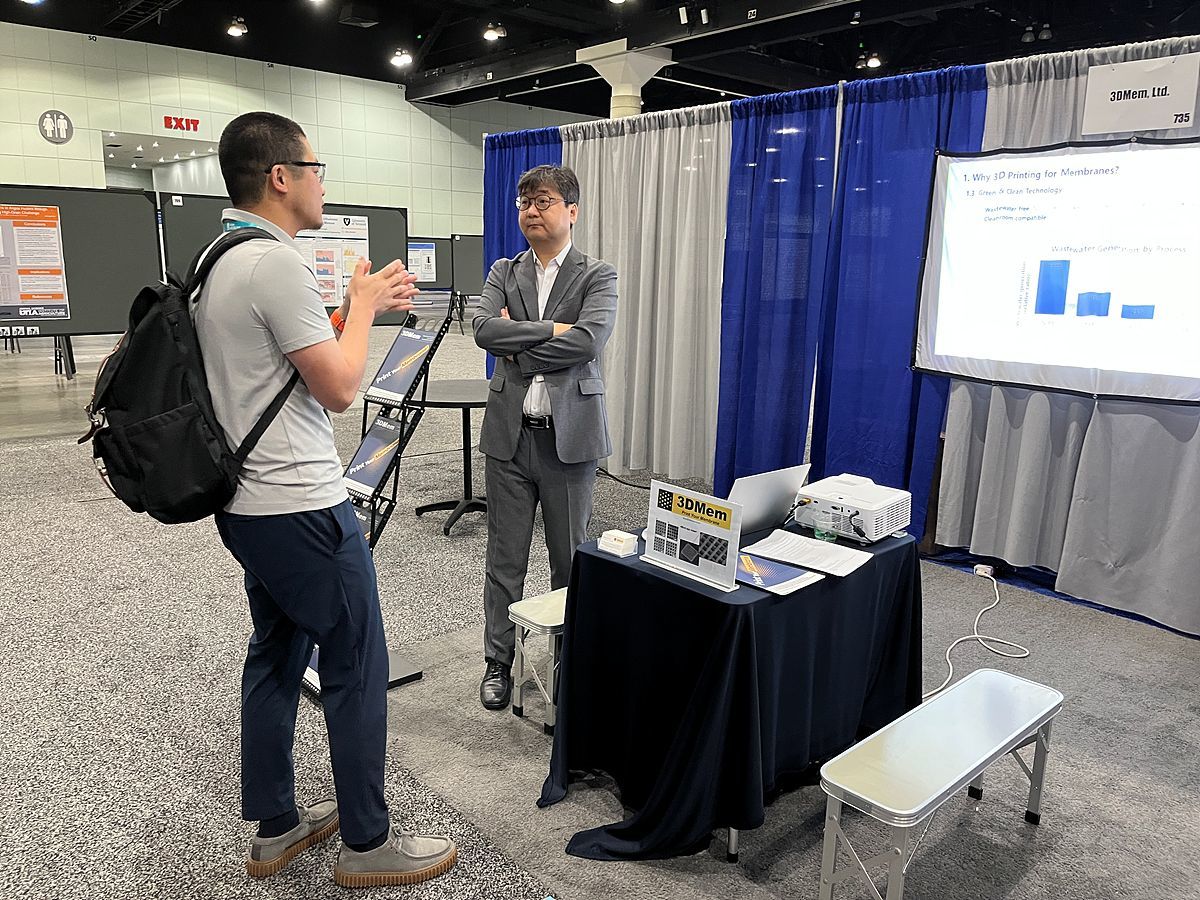
3DMem CEO Kwang Jin Lee (right) introducing the technology at ASM Microbe 2025 / Source = 3DMem
The problems are that most membrane filter manufacturers are overseas companies, resulting in a domestic localization rate close to 0%, and that, due to the limitations of membrane filter manufacturing technology, innovation across the entire process is becoming increasingly difficult. Korean startup 3DMem, Inc. aims to solve both of these issues by leveraging “nano 3D printing technology,” which handles materials with extremely high precision.
3DMem is led by CEO Kwang Jin Lee, an expert who worked for 21 years as a membrane filter researcher and for 5 years as a business leader at a major Korean chemical materials conglomerate. He has long sought to resolve the structural issues of the membrane filter industry. The key concept was the “smart factory.” The principle is to identify a core technology suitable for producing membrane filters with uniform quality and characteristics, and then use it to build a smart factory that carries out membrane filter manufacturing operations with no margin of error.
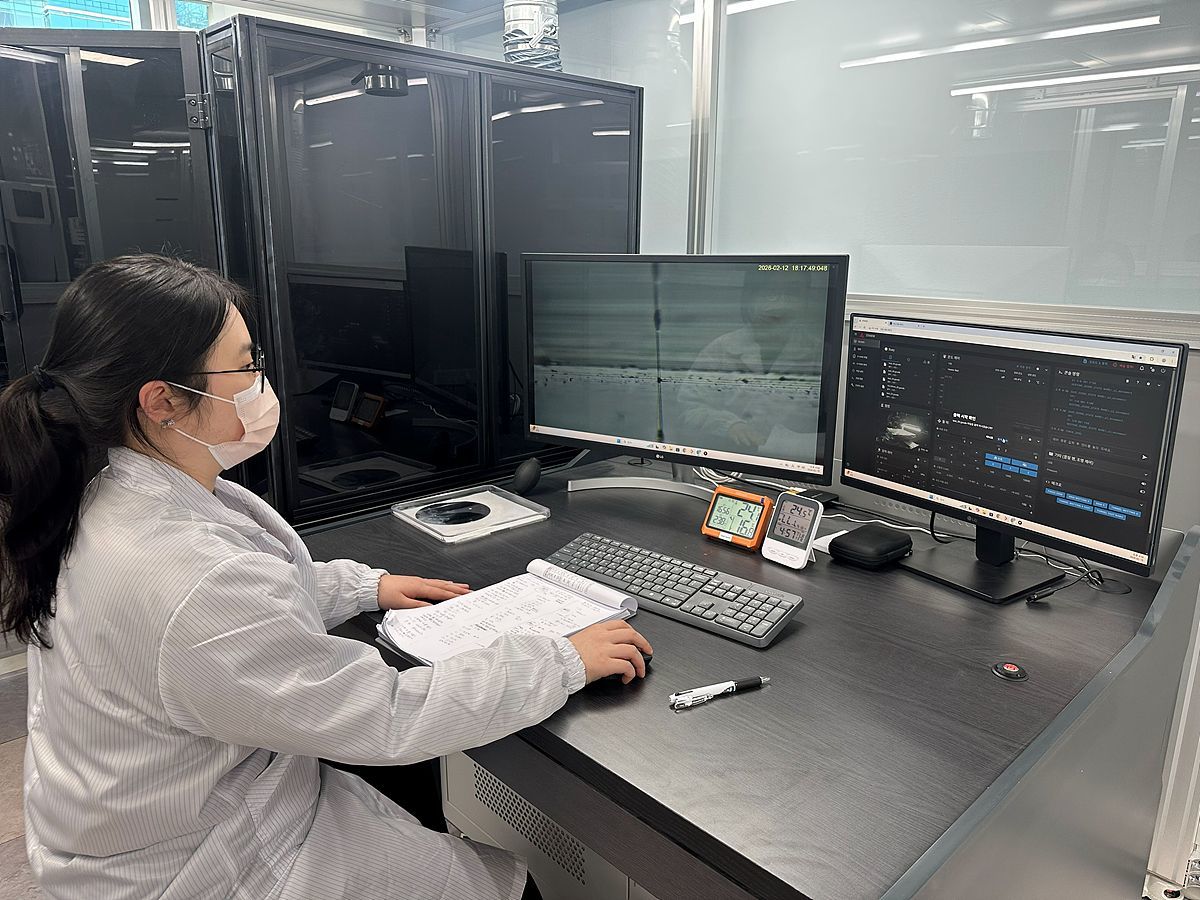
3DMem staff inspecting the nano 3D printing process / Source = 3DMem
He then focused on 3D printing as the core technology of the smart factory. However, when he first conceived this concept, 3D printing technology was not advanced enough to produce membrane filters with the required level of precision. Continuing his search, CEO Lee discovered in 2023 a core nano 3D printing technology capable of achieving a resolution of 70 nm (nanometers; 1 nanometer is one-tenth the thickness of a human hair). He acquired this core nano 3D printing technology from POSTECH (Pohang University of Science and Technology) and, after research and development, developed the first membrane filter production equipment in early 2025.
What advantages do membrane filters manufactured using 3DMem’s nano 3D printing technology offer? To understand these benefits, it is necessary to look at the structure and characteristics of membrane filters. A membrane filter is produced by densely forming ultra-fine pores in a porous film. The pore diameter determines which specific-sized substances are filtered out, while the spacing between pores affects the process time. In the case of membrane filters used in new drug development, large particulates are removed with a depth filter, smaller microorganisms and bacteria are removed with a sterile filter, and the smallest viruses are removed with a virus filter.
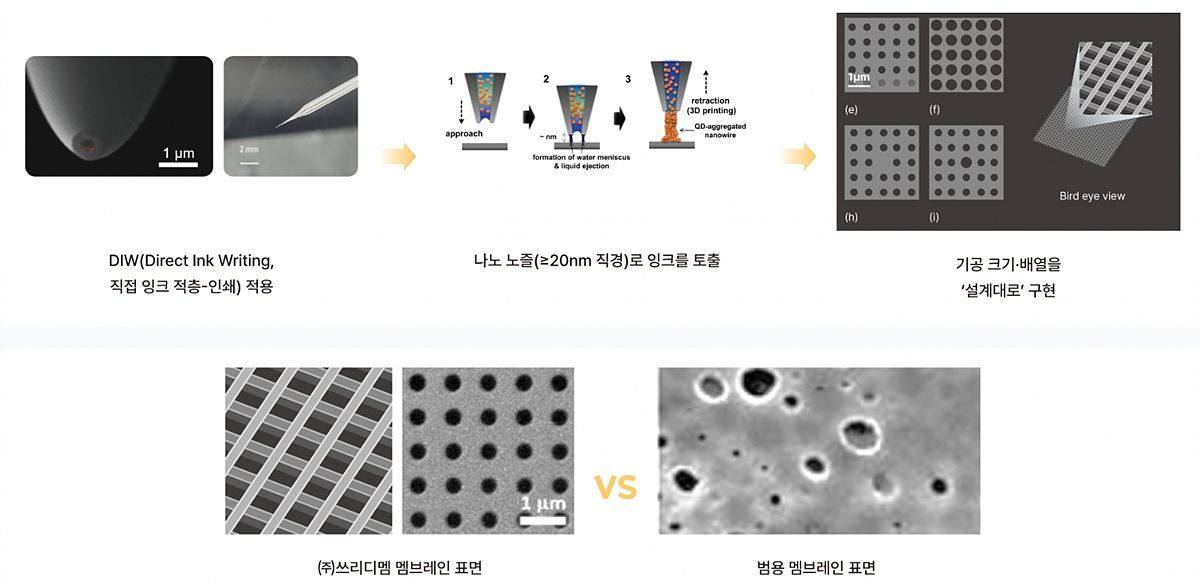
Advantages of 3DMem’s 3D-printed membrane filter / Source = 3DMem
However, conventional membrane filters have significant variation in pore diameter, depth, spacing, and the number of pores per unit area due to limitations in their manufacturing processes. If pore diameters vary, the filter may fail to precisely separate the target substances. For example, if all substances with a diameter of 3 must be filtered out, but the membrane filter pores that should handle this have diameters of 3.1 or 4 instead of 3, the filter will fail to perform its intended function. The same applies to pore depth. If depth is not uniform, the pores become curved or tortuous, which can unnecessarily extend filtration time.
Variations in pore spacing and the number of pores per unit area have similar consequences. If the spacing between pores is inconsistent, process speed will vary each time. Assuming the same area, a membrane filter with dense spacing and 100 pores in total will operate at a different speed from a membrane filter with wider spacing and 70 pores in total. In other words, a membrane filter with more pores will accelerate the process, while a filter with fewer pores will slow it down.
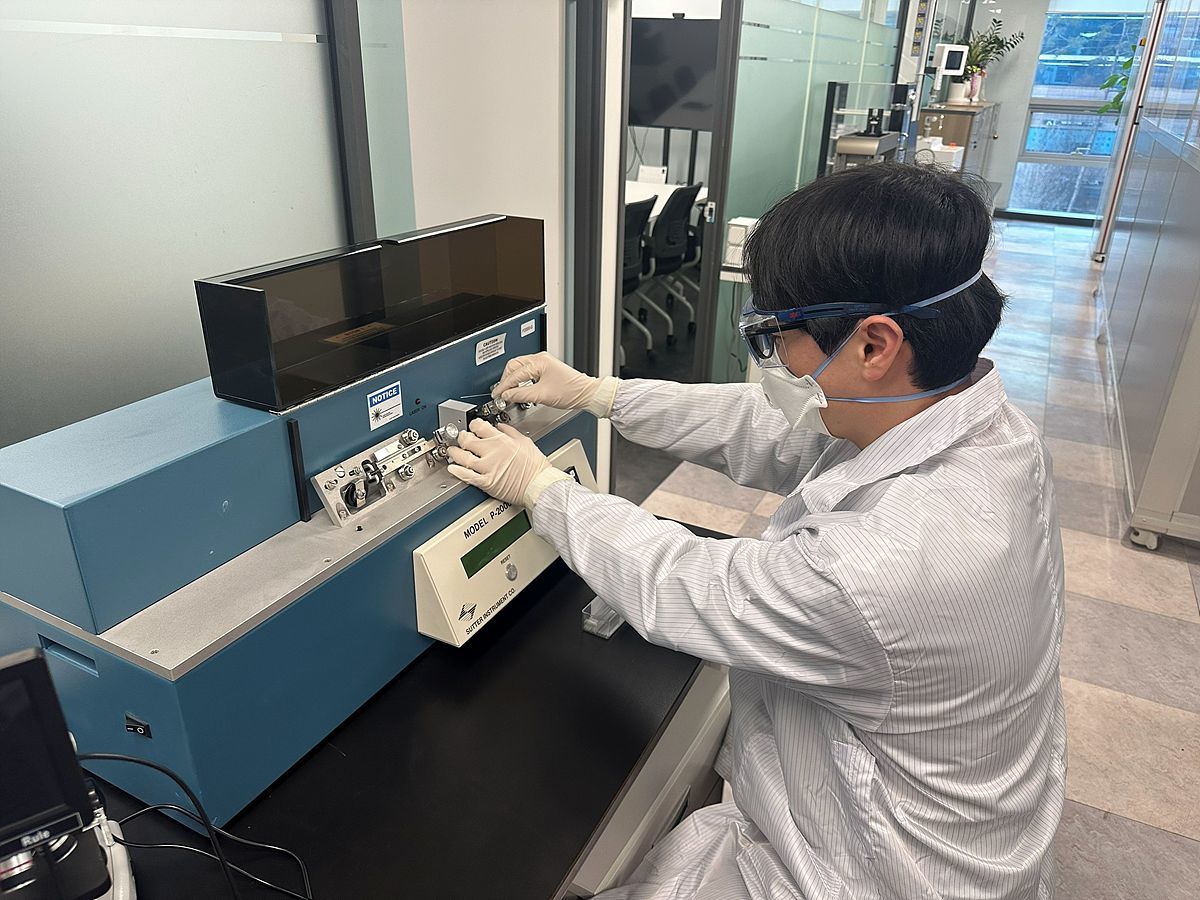
3DMem staff researching a nano 3D printing nozzle / Source = 3DMem
By using nano 3D printing technology, it is possible to control not only pore diameter but also depth, shape, and spacing in membrane filters. According to 3DMem’s internal research, membrane filters produced with its proprietary technology can reduce both the time required to filter specific substances and the overall filtration time, thereby improving process-wide speed efficiency by more than 800%, while reducing losses in the filtration process to nearly 0%. The company also presented the benefits for a bio-pharmaceutical company that runs 100 batches a year, spending KRW 10 billion per batch, when using 3DMem’s membrane filters. By shortening filtration time, such a company could achieve annual cost savings of approximately KRW 90 billion, and by maintaining consistent pore sizes and minimizing loss of active substances, it could generate an additional KRW 30 billion in annual cost savings.
The value of 3DMem’s technology extends further. Conventional membrane filters require chemical agents and cleaning water during manufacturing. The wastewater and cleaning solutions containing chemicals and solvents generated after production are all environmental pollutants. Since nano 3D printing produces membrane filters by “printing” them, it does not generate these pollutants. With its nano 3D printing technology and its first membrane filter production unit as a foundation, CEO Lee has attracted strong interest from the market. Having completed pilot production and preparing to scale up to mass production, 3DMem has been building its fundamentals by leveraging its technology to participate in government-funded support programs and R&D projects. It has also secured patents to protect its nano 3D printing technology and enhance productivity.
3DMem employees / Source = 3DMem
Korea University’s Crimson Startup Support Group has also contributed to 3DMem’s growth. It has provided a broad range of essential early-stage support, including participation in demo days, joint participation in the ILS 2025 exhibition in Japan, investor matching and patent filing assistance, BI/CI design support, as well as the Deep Tech Bridge Program and overseas expansion training and networking. Through these efforts, 3DMem has engaged with global investors and partners.
3DMem has recently achieved significant results. Through participation in domestic and overseas exhibitions, it has received strong interest from several of the world’s top-tier membrane filter manufacturers. CEO Lee plans to deliver membrane filter samples to these companies and define the scope and nature of collaboration within 2026. He is also developing strategies to secure the productivity necessary to meet their requirements.
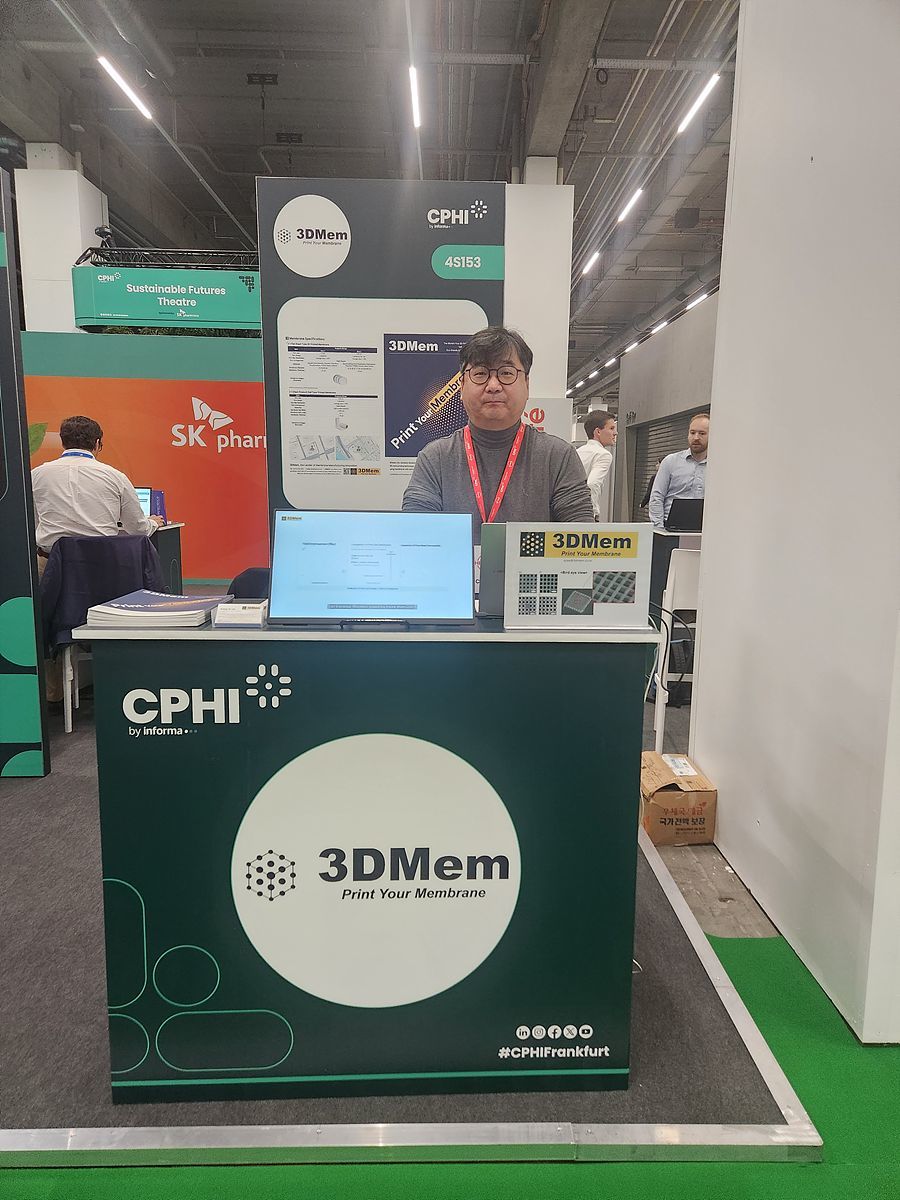
3DMem and CEO Kwang Jin Lee at CPHI Frankfurt 2025 / Source = 3DMem
On this basis, 3DMem aims to address the challenges of securing cost competitiveness and expanding mass production capacity. The company plans to simultaneously increase both the production volume and quality of membrane filters to meet client demand. CEO Lee stated that he already understands a substantial portion of customer requirements and that he intends to secure both cost competitiveness and mass production scale by leveraging technologies such as multi-nozzle blocks and ultra-high-speed nozzles. To this end, the company has been raising pre-Series A funding and is expected to close the round soon after attracting strong interest from global FI and SI investors.
CEO Lee commented, “3DMem’s goal is to become the first in the world to commercialize nano 3D printing technology, transform the landscape of the membrane filter market, and establish itself as the industry’s leading company. The company will continue to grow so that Korea’s technology becomes the global benchmark and exerts a positive impact on all sectors utilizing membrane technologies, including water treatment and hydrogen.”
Reporter Cha Joo-kyung, IT Dong-A (racingcar@itdonga.com)
ⓒ dongA.com. All rights reserved. Reproduction, redistribution, or use for AI training prohibited.
Popular News