※ The Entrepreneurship Support Group of Seoul National University of Science and Technology operates a variety of support programs to help startups grow, including the Preliminary and Early Startup Packages and collaboration programs with global companies. IT Donga introduces promising startups that are developing together with the Entrepreneurship Support Group of Seoul National University of Science and Technology.
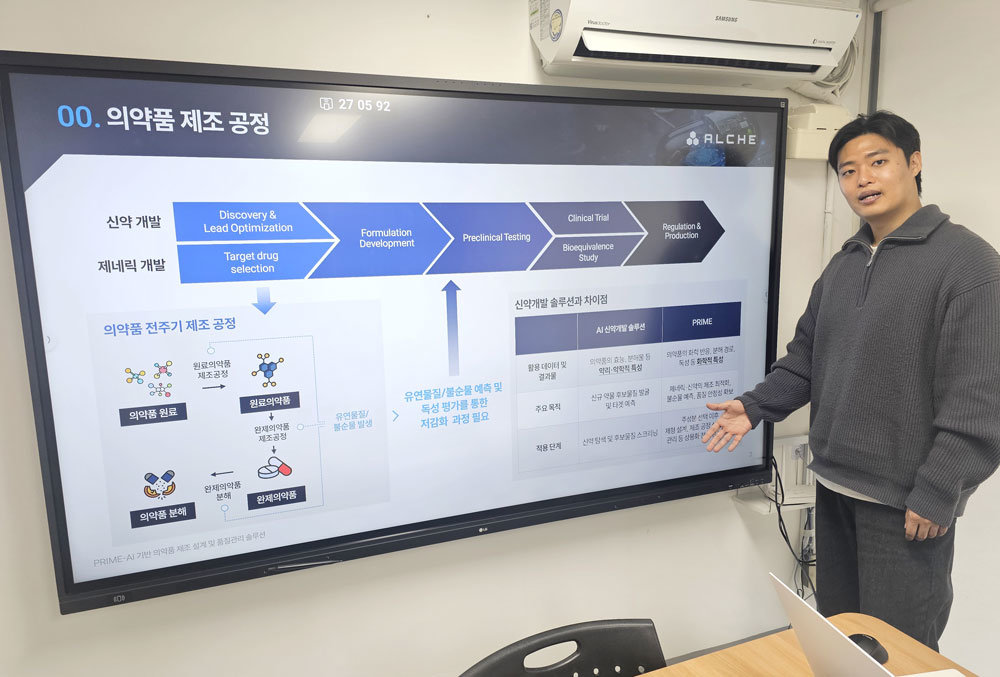
Alche CEO Kang Dong-joo / Source=IT Donga
Developing a single new drug requires astronomical time and cost. For this reason, the pharmaceutical industry’s adoption of artificial intelligence (AI) has mainly focused on how to discover new drug candidate substances. However, even if a candidate substance is successfully discovered, the question of how to mass-produce it in a stable and efficient manner is an entirely different issue.
Traditional pharmaceutical manufacturing process design often relied on the experience and know-how of experts—what is commonly referred to as “gut feeling.” During this process, repeated trial and error frequently led to enormous costs. For example, unforeseen impurities could arise, threatening patient safety or causing substantial losses for pharmaceutical companies. Ultimately, complying with regulations while manufacturing drugs safely and efficiently is as important as discovering effective drugs, and constitutes a core competitive factor in the pharmaceutical industry.
Startup Alche (CEO Kang Dong-joo) is a deep-tech company that aims to solve these chronic manufacturing and quality control issues in the pharmaceutical industry using AI. Its full life cycle pharmaceutical quality management SaaS (Software as a Service) solution, PRIME, is more than a simple statistical tool. From raw material selection to chemical reactions and excipient mixing ratios, the AI autonomously designs and proposes the optimal process.
Founded in March 2024 and led by process AI expert CEO Kang Dong-joo, who holds a PhD in engineering from Seoul National University, Alche is transforming the traditionally experience-based pharmaceutical manufacturing process into a data-driven, predictable science. IT Donga spoke with CEO Kang, who has ventured into the new frontier of manufacturing process optimization, regarding Alche’s vision.
- You have a PhD in Chemical and Biological Engineering. What led you to establish a company that applies AI to manufacturing processes rather than to drug discovery?: I majored in Chemical and Biological Engineering at Seoul National University and went on to a doctoral program. Initially, I was researching traditional chemical engineering, but around 2016, when the AlphaGo boom occurred, I became very interested in AI technology. I believed that combining this innovative AI technology with chemical engineering and pharmaceuticals would create enormous synergy. During my doctoral studies, as I researched materials with new properties and novel drugs, I realized that manufacturing processes are just as important as drug discovery.
In the pharmaceutical industry, even when AI is used, the focus is usually only on what kind of drug to develop with it. If drug discovery is akin to drawing an excellent blueprint, I wanted to devise how to build the structure based on that blueprint in the most efficient and robust way. Rather than simply following trends that everyone else is pursuing, I founded Alche to pioneer a new trend that no one had properly addressed: optimization of pharmaceutical manufacturing processes.
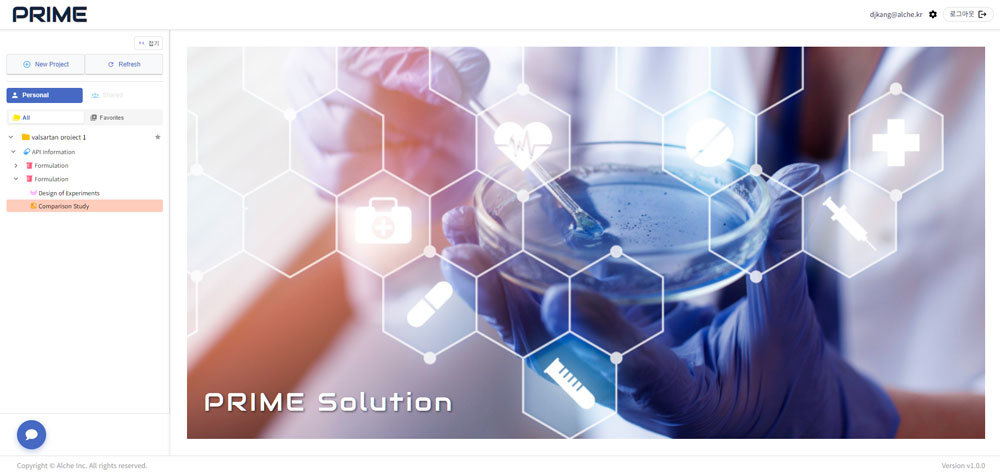
Alche’s pharmaceutical manufacturing process optimization solution, “PRIME” / Source=Alche
- Specifically, what kind of solution is PRIME, Alche’s core product?: In a word, PRIME is an AI platform that optimizes and rationalizes the entire pharmaceutical manufacturing process. The process of making pharmaceuticals is chemically very complex. For example, a chemical reaction is induced from a specific raw material to extract an active pharmaceutical ingredient (API) such as acetylsalicylic acid or sildenafil. Then, various excipients are added and multiple complex processes are carried out before the finished pharmaceuticals known as aspirin and Viagra are produced.
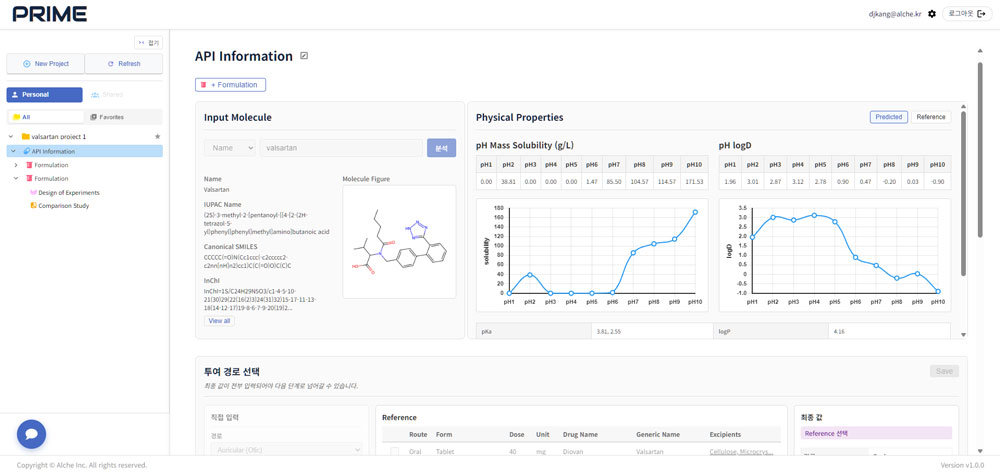
Throughout this series of steps, there are countless variables, ranging from the choice of raw materials to pressure and temperature during processing, and the mixing ratios of numerous excipients. In addition, there are very stringent regulations to control the various impurities that inevitably arise in this process. PRIME is a system in which an AI trained on massive datasets proposes to researchers the most ideal pressure, temperature, excipient ratios, and so forth, while fully complying with these stringent regulations. Based on the optimal recipe suggested by the AI, researchers can conduct experiments that maximize the completeness of the pharmaceutical product.
- There must have been process-related software in the existing pharmaceutical market. What is the decisive differentiator of PRIME?: In the past, companies had to go through numerous trials and errors because they relied on the personal intuition and gut feeling of experts or on simple statistical data. We are confident that a solution like PRIME, in which AI proactively analyzes chemical processes and preemptively proposes optimal manufacturing conditions, is essentially the first of its kind.
Above all, PRIME’s greatest strength is that it applies explainable AI technology. Whereas traditional AI would simply present results by saying, for example, “these conditions are good,” PRIME clearly shows the causal relationships explaining why such results were derived and why a particular temperature and mixing ratio constitute the optimal process conditions. Researchers in the pharmaceutical industry, who handle human life, cannot easily accept results from even the most advanced AI if they do not understand the rationale. Because PRIME clearly presents the scientific basis, it enables researchers to fully trust the results and make subsequent decisions with confidence.
Through “PRIME,” pharmaceutical manufacturing processes such as temperature and mixing ratios can be optimized / Source=Alche
- From a corporate standpoint, what business value can be gained by adopting PRIME?: PRIME is provided as a cloud-based B2B SaaS. Fundamentally, the pharmaceutical business is an intellectual property (IP) business, and each company’s unique process know-how and data are its lifeblood.
Newly established pharmaceutical companies or biotech ventures may discover excellent substances but often lack the on-site experience and data to produce them. These companies can leverage PRIME’s AI engine to bridge that gap and establish a fast and stable production system. Conversely, long-established traditional pharmaceutical firms can train PRIME using the extensive data they have accumulated over many years. Through this, they can further advance PRIME into a more powerful proprietary production solution that is perfectly tailored to their needs. Regardless of company size, PRIME becomes an essential partner that dramatically reduces development timelines and failure costs.
- How is the actual market response, and what is the current status of business development?: We released the beta version of PRIME in January this year. We are currently actively conducting proof-of-concept (PoC) projects with mid-sized pharmaceutical companies by applying the solution on actual production sites. As this is a solution that did not exist in the existing market, the pharmaceutical industry is responding with highly positive feedback, calling it a very fresh and practical approach.
Recognizing this potential, we were recently selected for national R&D projects by the Ministry of Trade, Industry and Energy, securing funds for research, development, and commercialization. On this basis, we are further refining the solution and accelerating its full-scale commercialization.
- As a technology-based startup, how did the Early Startup Package program of the Entrepreneurship Support Group at Seoul National University of Science and Technology help?: Having spent a long time as a researcher, I had solid technology and ideas, but was lacking in terms of how to actually run a company from a business perspective. The program at Seoul National University of Science and Technology went beyond simple financial support and provided a wide range of one-on-one mentoring and educational seminars covering all aspects of corporate operations, such as business models (BM), IR (investment attraction), and global business expansion.
At a time when we were rushing forward without pause, it allowed us to reflect on our overall business from a fundamental standpoint and verify whether we were heading in the right direction. It played a decisive role in rebuilding the corporate framework solidly from the ground up, so I would strongly recommend this program to other startups that have excellent technology but feel uncertain about business operations.
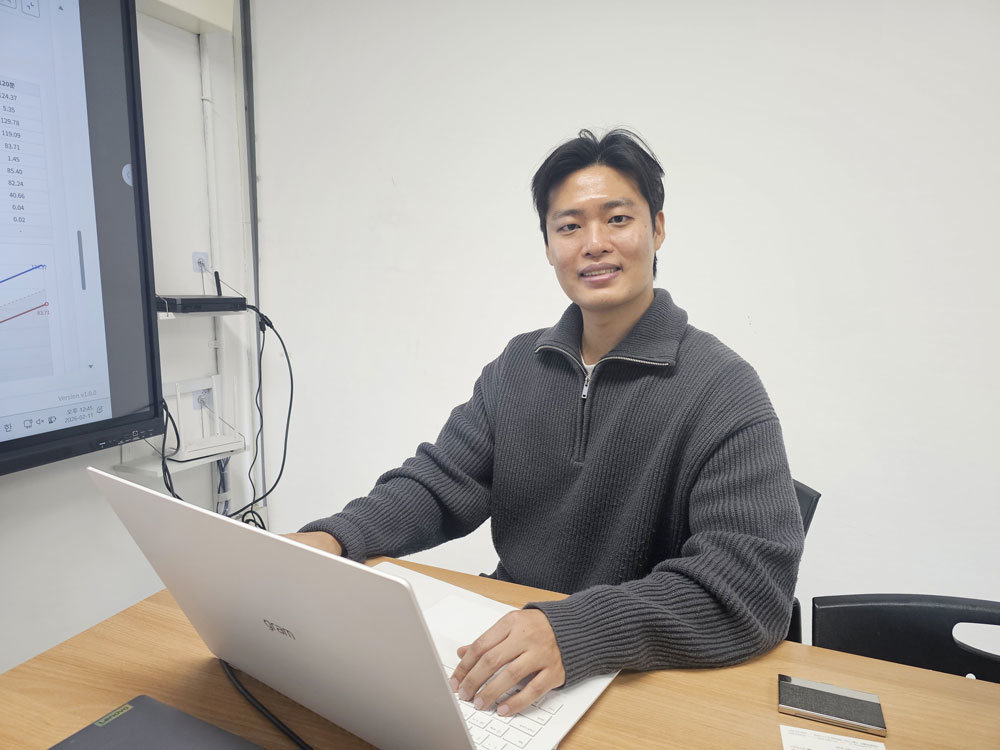
Alche CEO Kang Dong-joo / Source=IT Donga
- What are Alche’s ultimate vision and goals?: It is to innovate the paradigm of pharmaceutical quality control and process design. Currently, we are focusing on the field of chemically synthesized pharmaceuticals, but in the future we plan to extend our solutions to biopharmaceuticals as well, establishing ourselves as a global solution that becomes the standard for all pharmaceutical development.
Through Alche’s PRIME, pharmaceutical companies will be able to reduce massive losses and anxiety caused by impurity issues, while patients will receive safer and more reliable medicines. Alche aims to set a new standard for pharmaceutical quality control in the global market, and we hope many will follow our progress with interest.
IT Donga reporter Kim Young-woo (pengo@itdonga.com)
ⓒ dongA.com. All rights reserved. Reproduction, redistribution, or use for AI training prohibited.
Popular News