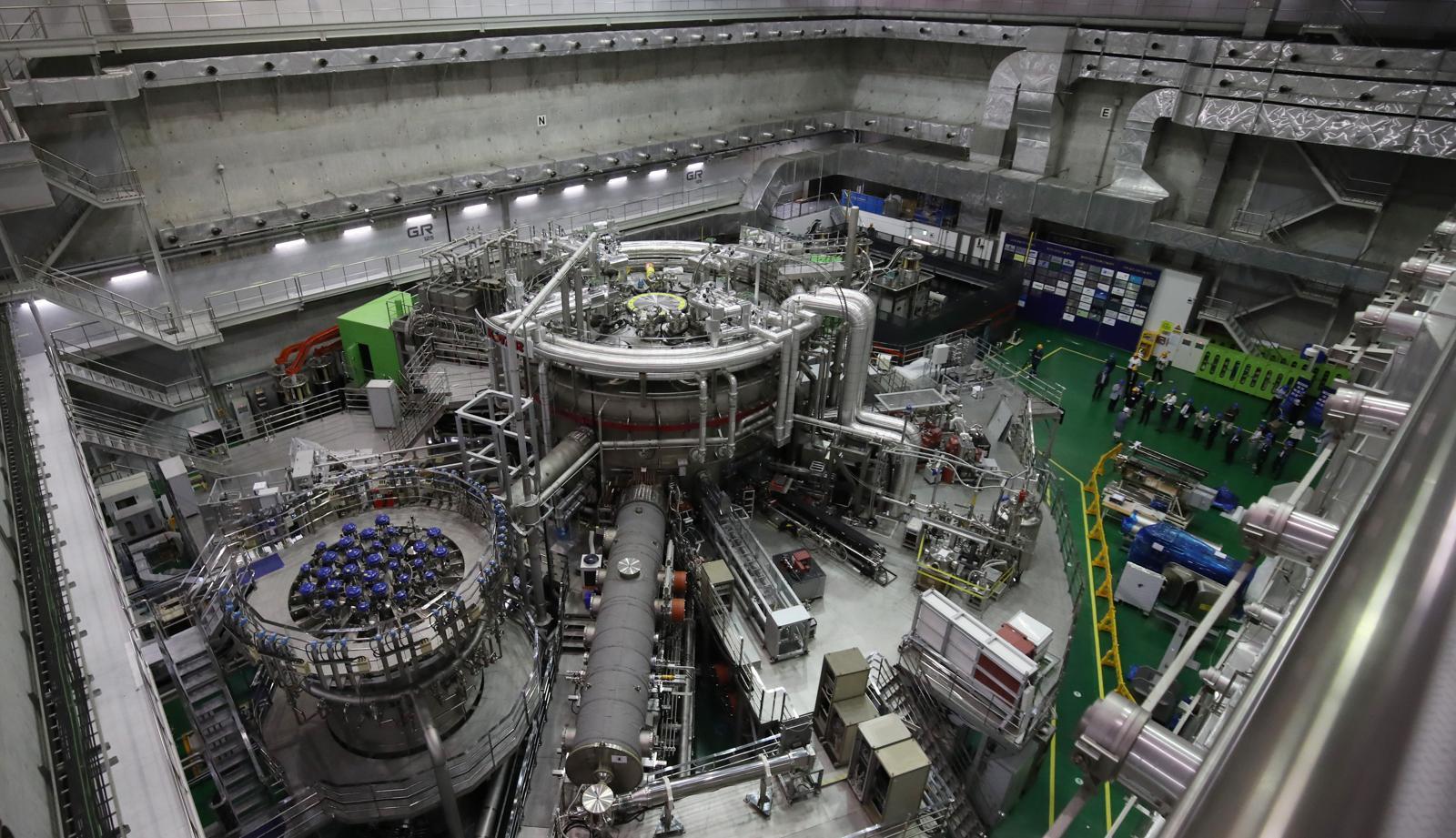
Korea Superconducting Tokamak Advanced Research (KSTAR). 2024.7.22 ⓒ News1
The Ministry of Science and ICT announced on the 19th that it will secure “superconductor technology,” a core technology for the commercialization of fusion energy, by 2035.
Fusion energy is a next-generation clean energy that reproduces on Earth the energy-generation principle of the Sun. It generates no carbon emissions and uses virtually inexhaustible fuel, drawing attention as a potential solution to humanity’s energy challenges. Superconductor technology is essential for creating ultra-strong magnetic fields in fusion reactors, but it is a highly complex field that requires long-term research and development (R&D).
As the race to develop superconducting fusion technologies accelerates among leading global private companies and research institutes, the need is growing for a preemptive, self-reliant technological base in anticipation of the commercialization of fusion. In response, the Ministry of Science and ICT plans to comprehensively promote measures including strengthening R&D, establishing an industry–academia–research cooperation framework, expanding research infrastructure linked to regional bases, and pursuing strategic collaboration with leading global research institutions in this field.
First, it will build world-class infrastructure for testing and verification of superconducting conductors. The ministry stated that it is constructing a superconducting conductor testing and verification facility within the Korea Institute of Energy Technology and that construction of the experimental building is scheduled for completion by June. The facility will be able to conduct tests in a magnetic field environment about 30% stronger than that of SULTAN, the world’s leading superconducting test facility in Switzerland, and is therefore expected to become the world’s top-level facility once completed.
The development of high-temperature superconductor technology, a key to downsizing fusion reactors, will also be fully launched. High-temperature superconductors can generate stronger magnetic fields than existing technologies and are regarded as a core component of next-generation fusion reactors. The Ministry of Science and ICT will invest KRW 2.15 billion this year to develop technologies for manufacturing high-temperature superconducting magnets.
Global cooperation will also be strengthened. The Korea Institute of Fusion Energy plans to sign a memorandum of understanding (MOU) next month with the European Organization for Nuclear Research (CERN), the world’s largest particle physics laboratory, for joint research on the production of superconducting wires and to commence collaborative research. The Ministry of Science and ICT is also jointly developing with the European Union (EU) “fusion blanket” technology, which is a key component for electricity and tritium production.
Jeon Hye-jin
AI-translated with ChatGPT. Provided as is; original Korean text prevails.
ⓒ dongA.com. All rights reserved. Reproduction, redistribution, or use for AI training prohibited.