Will first deploy in own factories, then sell Hyundai Motor and Tesla declare themselves physical AI companies Benz, BMW and others also conducting commercialization tests
Global finished vehicle manufacturers are rapidly shifting their business focus toward the humanoid sector. Based on their manufacturing experience specialized in physical AI, they are making a decisive move to preempt the humanoid market, which is expected to reach USD 5 trillion (approximately KRW 7,230 trillion) around 2050.
On the 18th (local time), according to leading U.S. automotive media outlet Automotive News and Reuters, Mercedes-Benz is conducting test operations of the humanoid robot “Apollo” at its plant in Hungary in cooperation with U.S. robotics startup Apptronik. Earlier, BMW completed an 11‑month commercialization test at the end of last year by deploying “Figure 02,” a robot from another U.S. startup, Figure AI, in the body assembly process at its Spartanburg plant in the United States.
Chinese electric vehicle manufacturers have also joined the race. XPeng will begin mass production of its humanoid robot “AIRON” this year. It plans to start with 1,000 units this year and ramp up to 1 million units by 2030. Li Auto, which halted its humanoid robot project two years ago, announced the resumption of the project last month and has completed organizational restructuring.
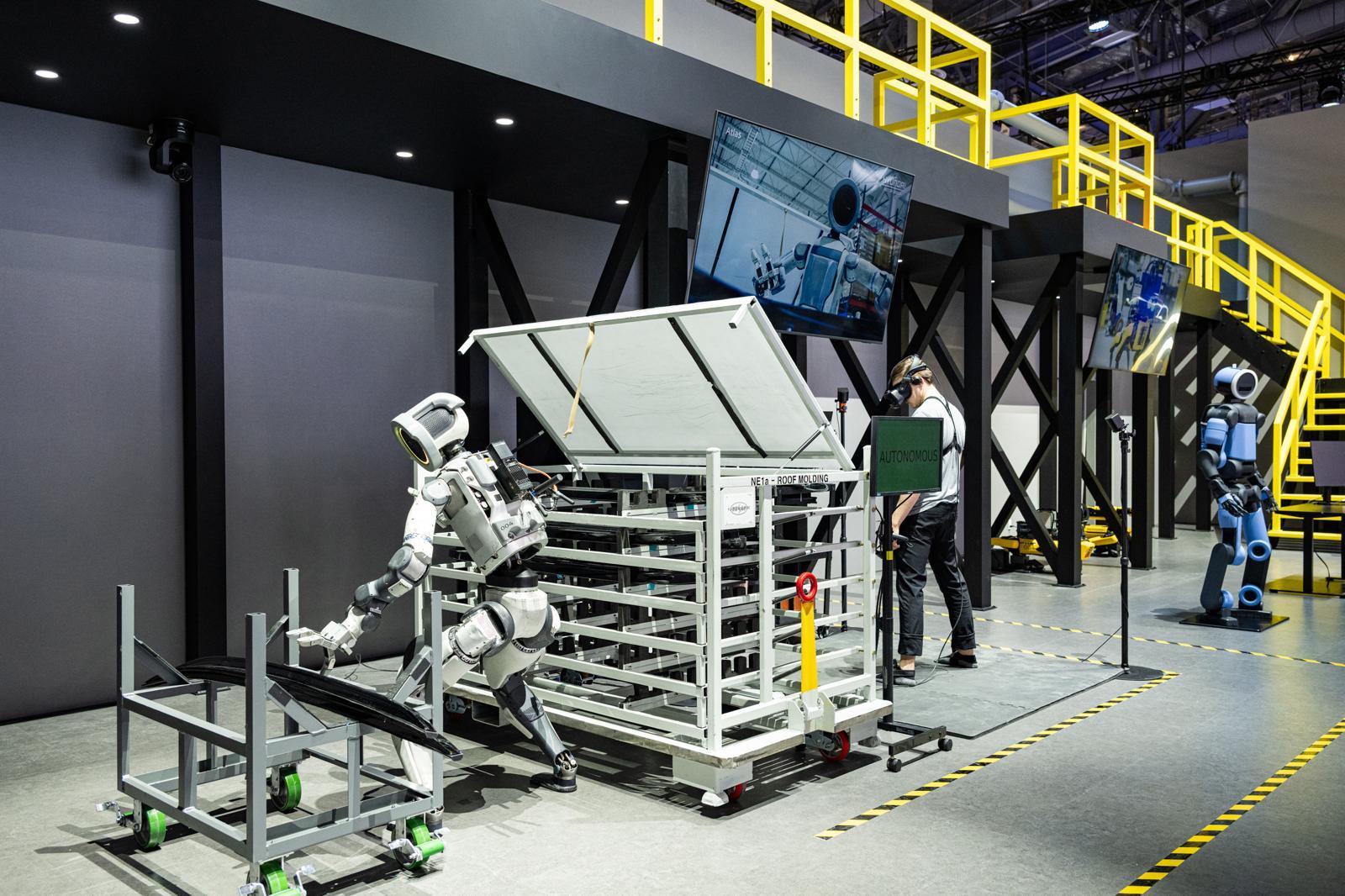
Hyundai Motor Group’s “Atlas”. Newsis
The leading players, Tesla and Hyundai Motor Group, have already declared their leap into physical AI companies, fronting their in‑house robots whose technological capabilities have been recognized. Tesla will discontinue sales of its flagship sedan “Model S” and its sport utility vehicle (SUV) “Model X” in the second quarter of this year (April–June) and will convert the production lines at its Fremont electric vehicle plant in the United States, which produced these models, into a mass‑production base for “Optimus.” Hyundai Motor Group’s “Atlas” is scheduled to be deployed at Hyundai Motor Group Metaplant America starting in 2028. The target for Atlas mass production is 30,000 units per year.
This rapid entry of finished vehicle manufacturers into robot competition is seen as stemming from the characteristics of the automotive industry. The production facilities and data associated with large‑scale manufacturing of automobiles, which are complex machines equipped with a large amount of software and sensors, provide the foundation for robot development and mass production. The fact that “self‑consumption” is possible before securing external customers also lowers the barriers to entry. They can first utilize their own robots in their plants that produce several million vehicles annually. Robots that have completed in‑house use can then be resold to client companies. Automotive News also analyzed that “because the automotive industry faces low profit margins and other challenges, the robotics industry is well suited as a target for portfolio diversification.”
In a report published in May last year, Morgan Stanley forecast that a total of 1 billion humanoid robots would be in operation by 2050 and projected that the market size would reach USD 5 trillion. This would exceed the current size of the global automotive industry, which stands in the USD 4 trillion range. Auto parts suppliers are also joining this expanding market. Last month, Israeli automotive parts company Mobileye announced that it would acquire humanoid robot startup Mente Robotics for USD 900 million (approximately KRW 1.3 trillion).
Choi Won-young
AI-translated with ChatGPT. Provided as is; original Korean text prevails.
ⓒ dongA.com. All rights reserved. Reproduction, redistribution, or use for AI training prohibited.